Ask most people to picture a Greek island and they picture the Cyclades: the white cube houses of Santorini stacked above the caldera, the windmills of Mykonos, blue domes against a hard blue sky. What they are not picturing, usually, is the beach. And that is the quiet problem with the most famous islands in Greece. They are magnificent to look at and, for the most part, ordinary to swim at.
The Ionian islands, strung down the other side of the country, are the reverse. Fewer postcards, far better beaches. If you are planning a trip to Greece and the beach is the point rather than the backdrop, the Ionian is the smarter choice, and there is now a neat piece of evidence to back that up.
The 2026 scoreboard: three Ionian winners, no Cyclades
When the World's 50 Best Beaches for 2026 were announced, Greece landed three beaches on the global list. Every one of them was Ionian: Fteri on Kefalonia at number two in the world, Porto Katsiki on Lefkada, and Porto Timoni on Corfu. The Cyclades, for all their fame, placed none.
That is not a fluke of one list. It reflects something real about how the two island groups are built, and once you understand the geography the result stops being surprising.
Why the Ionian wins on beaches
The difference comes down to sand, shelter and wind.
The Ionian islands sit on the calmer, western side of Greece, and their beaches are far more likely to be soft sand or fine white pebble running into water that holds that deep turquoise colour. Because the islands are green and mountainous, many beaches are tucked into sheltered bays where the sea stays flat and warm, which makes them genuinely easy to swim at rather than just photograph.
The Cyclades have the opposite conditions. Many of their beaches are coarse pebble, rock or dark volcanic shingle, and crucially they are exposed to the meltemi, the strong dry north wind that blows across the Aegean through much of the summer. On a windy day around Santorini or Mykonos, an exposed beach becomes a sandblasting session with a churned-up sea. The scenery is still there. The relaxed beach day is not.
The Ionian beaches that make the case
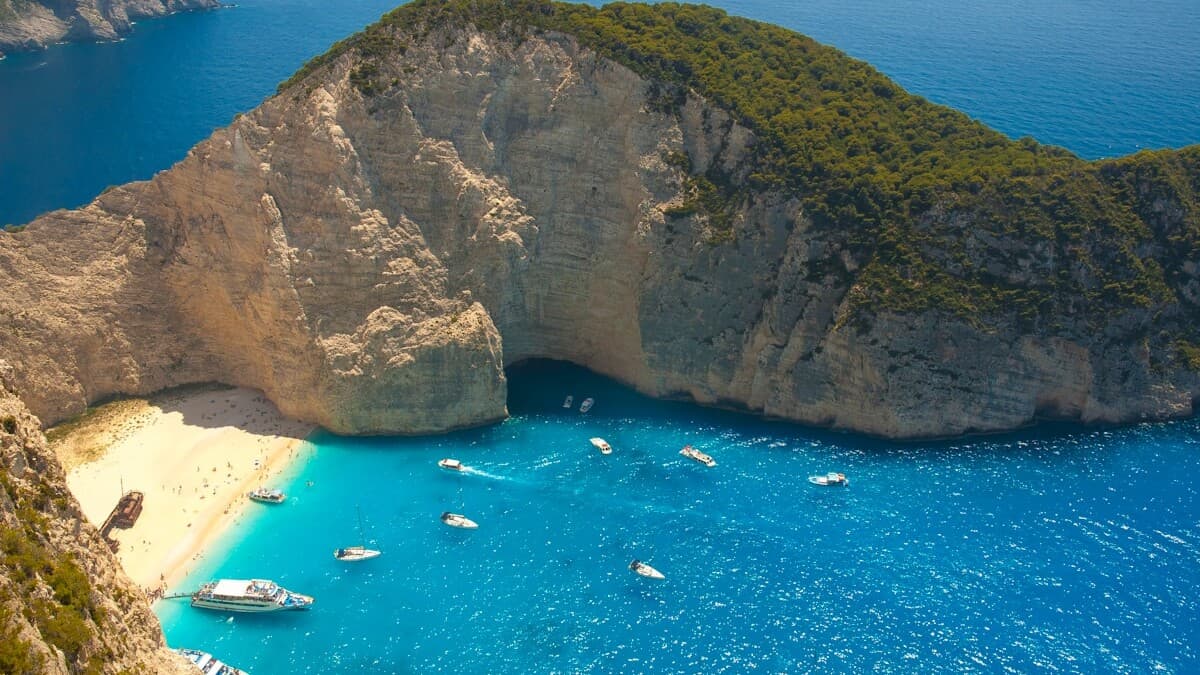
The headline names do a lot of the arguing on their own. Navagio, the Shipwreck Beach on Zakynthos, is a cove of white sand and impossibly turquoise water walled in by limestone cliffs, with a rusting freighter marooned on the sand. Myrtos on Kefalonia is a long arc of pale pebble against water that shifts through blues all day. Porto Katsiki on Lefkada drops soft white sand beneath tall white cliffs, and Fteri on Kefalonia, the number-two beach in the world for 2026, is the kind of clear-water cove you reach by boat or a steep path down.
The Ionian is not just its famous beaches, though, which is really the point. On Zakynthos, Gerakas is a protected stretch of soft golden sand where loggerhead turtles nest, calm and shallow and a world away from a party beach.
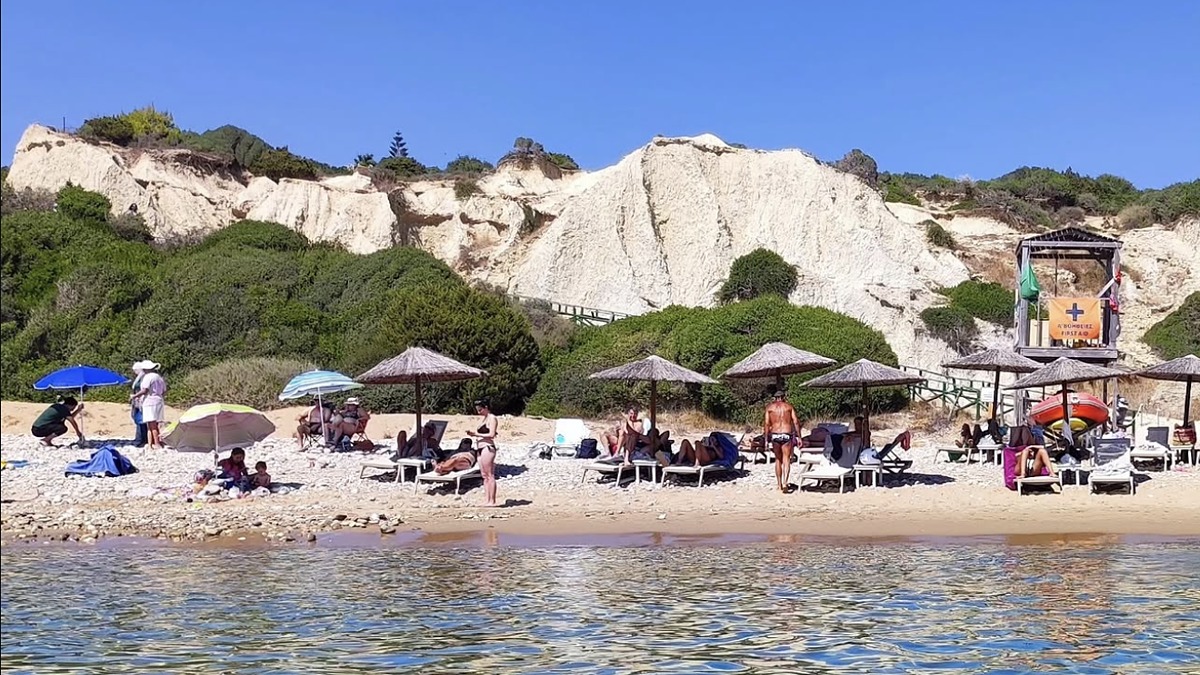
On Corfu, Rovinia is a hidden cove below the cliffs near Liapades that you reach on a short forest walk, which keeps the crowds thin even in August.
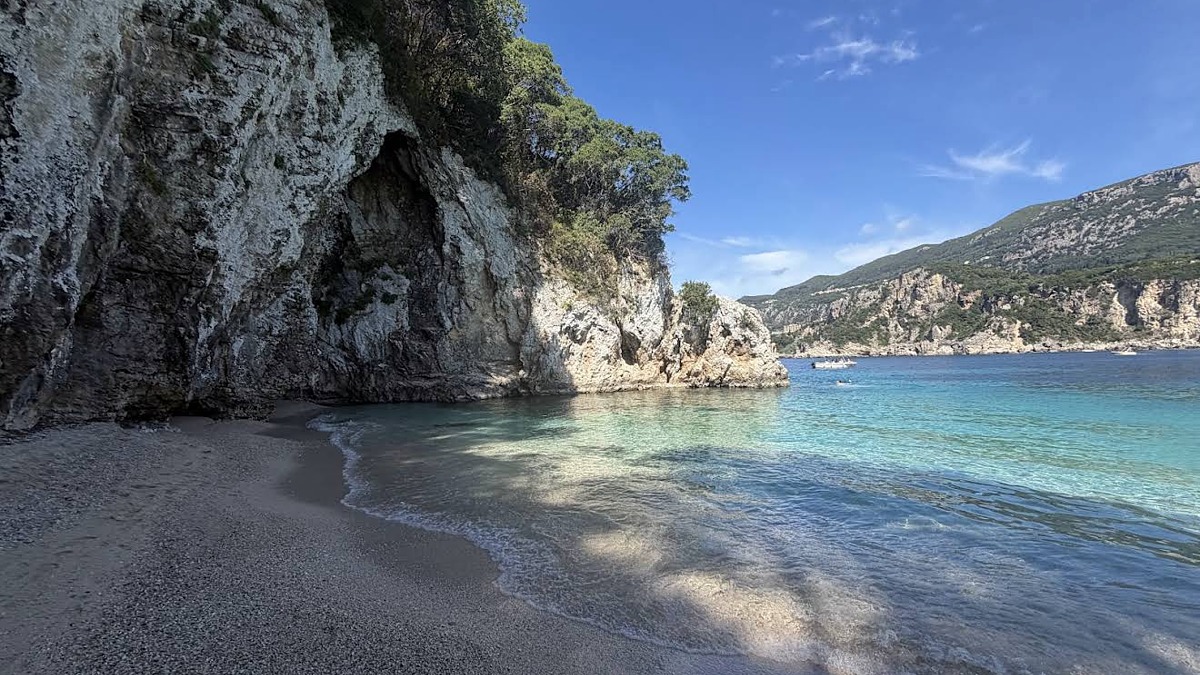
For the full run of each island's beaches, our guides to the best beaches in Kefalonia, Zakynthos and Corfu go island by island.
Where the Cyclades fight back
This is where being fair matters, because "the Cyclades have bad beaches" is simply not true. It is the two most famous islands that let the group down.
Santorini's beaches are mostly dark volcanic pebble and never the reason to go. Mykonos does have real golden-sand beaches, but they come loaded with crowds, high prices and a nightlife scene that is the actual draw. Look past those two, though, and the Cyclades have genuine beach islands. Naxos is the standout, with long, soft, swimmable sand at beaches like Plaka that stay uncrowded because they are so big. Paros has good sand and granite coves at Kolymbithres, and Milos has some of the most extraordinary coastline in Greece, though its moon-like Sarakiniko is a place to marvel at more than to spend a lazy beach day.
And the Cyclades win outright on the things that are not beaches. No Ionian island has the drama of the Santorini caldera at sunset, the nightlife of Mykonos, or quite the same density of whitewashed, blue-domed villages. The ferry connections from Athens are quicker and more frequent, too, which makes island hopping easier. If the beach is one item on a longer list, the Cyclades still make a strong case.
So which should you choose?
Be honest with yourself about what you actually want from the trip.
If you want calm, swimmable, sandy beaches as the main event, go to the Ionian. You get the better water, the better sand and the shelter from the wind, and you can still find drama at places like Navagio and Porto Katsiki. Kefalonia and Zakynthos edge it for headline beaches, with Corfu and Lefkada close behind as all-rounders.
If your picture of Greece is the villages, the sunsets and the scene, go to the Cyclades, pick Naxos or Paros if you still want good beaches in the mix, and treat Santorini as a place to look rather than swim. There is no wrong answer, only a wrong match between the island and what you came for.
The verdict
For beaches, the Ionian has quietly out-beached the Cyclades, and the 2026 World's 50 Best simply put numbers on what regular visitors already knew. The famous Cyclades sell the idea of Greece better than anywhere on earth, but they cash that fame in on views and villages, not on the sea. The Ionian, greener and calmer and less photographed, is where the actual swimming is.
Come for the beaches, choose the Ionian. Come for the postcard, choose the Cyclades. Just do not turn up in Santorini expecting the beach day the brochures quietly leave out.