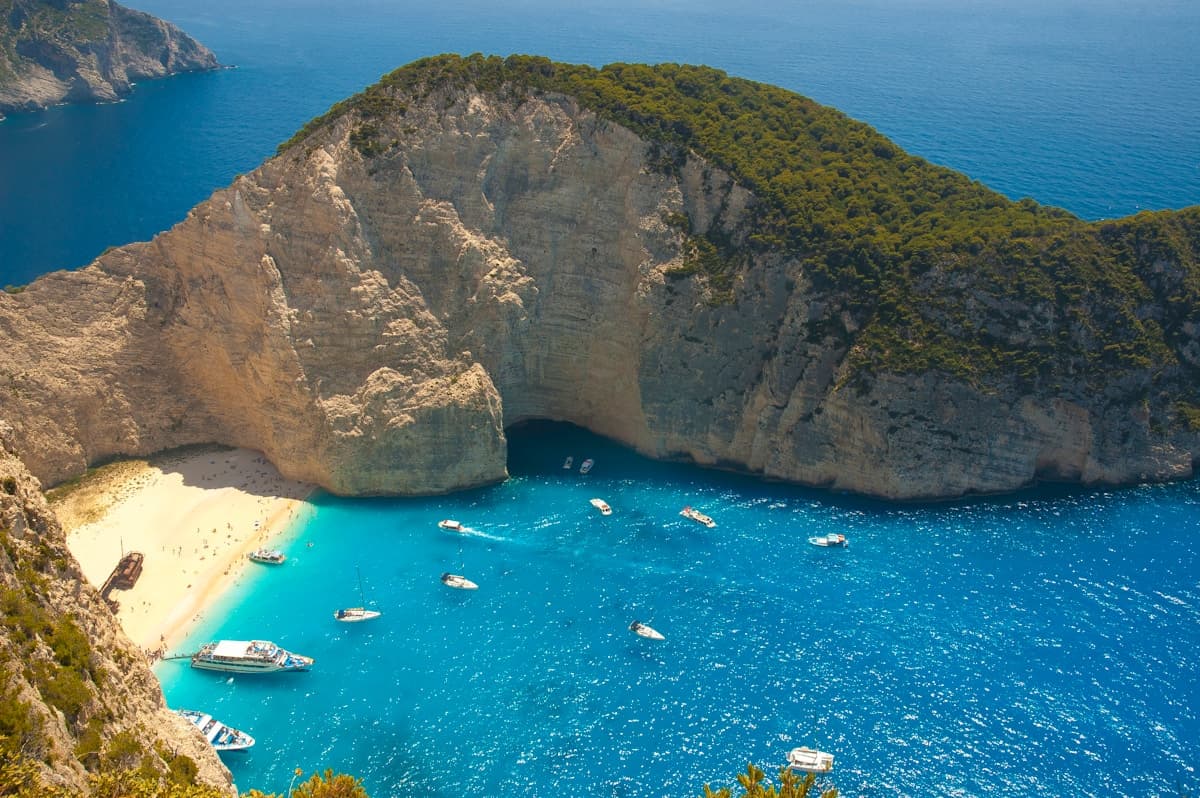
Navagio, the Shipwreck Beach on the northwest coast of Zakynthos, is the most photographed cove in Greece, and you cannot set foot on it. Visitors have been barred from the sand every season since 2023 because the cliffs above it keep falling. The 2026 joint ministerial decision, published in the Government Gazette as FEK B' 3033/28.05.2026, closed the beach, banned swimming in the cove and kept every boat at least 50 metres from the shore until 31 October 2026. That date has passed, but no reopening has been announced, and in 2024, 2025 and 2026 the ban was renewed by a fresh decision each spring. Checked November 2026.
What you can still do is look at it: from a boat in summer, or from the platform on the clifftop. Plan for that and Navagio is still worth a morning of your trip.
What the 2026 rules allowed, and what they banned
The decision was signed by four ministries (Citizen Protection, Shipping and Island Policy, Tourism, and Climate Crisis and Civil Protection) and reported in detail by CNN Greece on 1 June 2026. Under it:
- The beach: no access to either the "Prohibited Zone" or the "Controlled Access Zone", which together cover the sand and the wreck. The only exception is emergency and rescue access to a marked area near the wreck.
- The water: no swimming anywhere inside a line joining the cove's northern and southern ends, and no boat of any kind may anchor or approach closer than 50 metres to the shoreline.
- The clifftop: viewing only from the existing platform at the top of the slope, and only once the Municipality of Zakynthos had finished fencing and protecting the cliff edge.
- Penalties: administrative fines under the Hellenic Police, on top of any criminal or civil liability. The decision does not publish fixed amounts.
The decision also left room for the Port Authority to mark out safe zones for limited boat access later, after a fresh assessment by OASP, Greece's earthquake planning and protection agency. To Vima reported the same terms on 2 June 2026. If you are reading this before a summer trip in 2027, look for the new decision, which in recent years has appeared in May.
Why the cliffs keep it shut
The limestone walls around the cove are the reason it looks the way it does, and the reason it is closed. On 13 September 2018 a slab of rock broke off and fell about 60 metres, injuring several people, and the Port Authority banned landing, anchoring and swimming until further notice. The beach reopened, then in September 2022 a landslide followed a magnitude 5.4 earthquake between Kefalonia and Zakynthos. In spring 2023 four ministers closed the bay by land and sea for the summer, on the advice of OASP's scientific team, and the closure has been renewed every year since.
The wreck has its own problem. It sits about 25 metres from the sea and is corroding. In July 2026 the authorities announced a plan to widen the beach by about 30 metres using 45,000 cubic metres of gravel, moving the waterline away from the hull before any restoration of the ship can start, Euronews reported on 13 July 2026. No start date for the works had been published by November 2026.
The Panagiotis
Before 1980 the cove was known as Agios Georgios. On 2 October 1980 the cargo ship MV Panagiotis ran aground here in bad weather, and local accounts have long said it was carrying contraband cigarettes. Nobody moved it. Four decades of salt and sun have turned it into the rust-brown hull that every photograph of the island is built around.
How to get to Navagio: by boat or the clifftop
You cannot land on the beach, so there are two ways to see it: from a boat in summer, or from the viewing platform on the cliff above.
Seeing Navagio from the water
In summer, the closest departures are from Porto Vromi on the west coast and Agios Nikolaos (Skinari) at the northern tip, where boats also run to the Blue Caves. Under the 2026 rules a boat could enter the cove but not come within 50 metres of the shore, so you see the wreck and the cliffs from the water and nobody gets off. Prices vary by operator and by how many other stops are included, so compare what a trip includes before you book.
Go early. Tour boats from every harbour on the island converge on the same few hundred metres of water through the middle of the day, and a boat on the first departure of the day from Porto Vromi gives you the cove with far fewer engines in it.
The clifftop platform
The overhead shot of the wreck on white sand, ringed by bright blue water, is taken from the top of the cliff above the cove. Drive to Anafonitria in the northwest of the island and follow the signs to the viewpoint. The 2026 decision permits viewing only from the existing platform, and only behind the fencing that the municipality was required to finish along the cliff edge. We could not find an official notice confirming those works were complete, so expect parts of the edge to be taped or fenced off, and do not step past the barriers for a better angle. The edge is the part of this landscape that moves. Checked November 2026.
When to visit Navagio
June to September is the best window for the boat view, ideally on a trip that reaches the cove before 10am. The boat season runs from late spring to the end of October, so by November most operators have stopped and the next season starts in late spring 2027. Before you book, look for that year's closure decision, which in recent years has appeared in May.
Who should go, and who should skip it
Go if you want the photograph and the scale of the place: an hour on the clifftop and a morning boat trip in June or September is the realistic Navagio day now. Skip it if you are picturing a swim beside the wreck. That has not been possible since 2023, and nothing published by November 2026 suggests it will be in 2027.
For a beach on Zakynthos you can actually walk onto, Gerakas in the southeast is open from 7am to sunset under the marine park's turtle-nesting rules, and our guide to the best beaches in Zakynthos covers the rest of the island. If it is the white cliffs and clear water you are after, Corfu's Porto Timoni has no closure and a path down to the sand, and the pink sand of Elafonissi in Crete is a different Greek beach altogether.