The brown tide is going out. On 31 October 2026 the University of South Florida's Optical Oceanography Lab reported that sargassum in the Caribbean and the Gulf had more than halved in most regions during October, and said it expects the amount to keep falling until possibly the end of November or December. CARICOOS, the Caribbean ocean observing network, republished the outlook on 4 November.
On the Mexican Caribbean, that means the clearest months of the year are starting now, after what Semarnat, the federal environment ministry, called the worst season on record. Anyone weighing up sargassum in Cancún in 2027 should know two things the outlook does not say: the lab has published nothing for next year, and last winter the seaweed came back in January, months early.
Seaweed is not the only thing to check in the Caribbean this winter: our El Niño beach holidays guide covers the dry-season forecast and coral heat stress.
What the 31 October outlook says, and what it leaves out
The USF outlook is built from satellite imagery and compares each region with every October since 2011. Its headline is the fall, but the detail is less comforting: in every region except the eastern Atlantic, the October total still exceeded the historical maximum or 75th percentile. A narrow belt of seaweed still stretched from West Africa to the Gulf.
For beaches, the lab expects "negligible" beaching around Florida. Around the Caribbean, it says some beaching events will likely continue, "but the severity is much lower than in previous months."
The outlook does not mention Mexico, Cancún or 2027, and it is not a seasonal forecast. The lab publishes a bulletin at the start of each month, so the next one, covering November, is due in early December. The bulletin to watch is the one in early January. On 5 January 2026 the same lab warned of beaching along the Mexican Caribbean coast and called such early arrivals unusual.
Talk of 2027 has come from Mexico instead. Quintana Roo's environment secretary, Óscar Rébora Aguilera, briefed the state Congress's ecology commission on a possible record season, Riviera Maya News reported on 8 October. Treat it as a warning, not a forecast.
For scale, Rébora said the state had collected 138,000 tonnes in 2026 by the end of September, Por Esto reported. The Mexican Navy plans to add 17 vessels in 2027 (four oceanic, six semi-oceanic and seven coastal).
Seaweed in Cancún now: what the November reports show
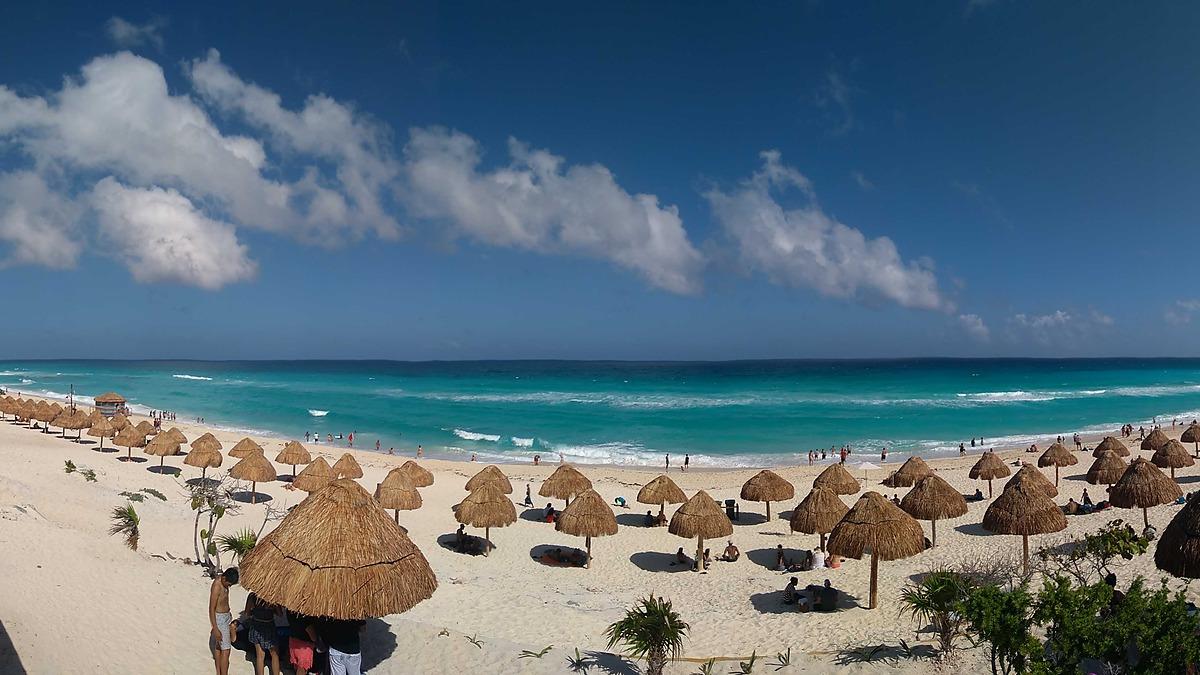
Very little. The state's traffic light at the start of November put 85 of the 140 beach zones it monitors at low or no sargassum, Riviera Maya News reported on 4 November. Holbox and Isla Contoy had none at all, while Cancún's Las Perlas, Tortugas and Delfines were rated low, along with Isla Blanca, Costa Mujeres, Puerto Morelos, Cozumel and parts of Tulum.
The nine zones still flagged red were mainly in the south, including Xcalak, Río Huache and Canal de Zaragoza. Few visitors staying in Cancún or the Riviera Maya go that far.
Tulum shows how quickly the coast cleared. In a report published on 20 October, David Buchanan García, who heads Tulum's federal beach zone office (Zofemat), said landings along the hotel zone had dropped for several days and that he expected that coastline to be practically clean by the end of the week, The Tulum Times reported. Six days earlier a fresh landing had put stretches of Tulum's shore at red and orange. Checked November 2026.
How to read the sargassum traffic light (semáforo) before you go
Quintana Roo has two traffic lights, and they answer different questions. Read the wrong one and the colour tells you little about your beach.
- The Navy's colour for the sea. Mexico's Navy (Semar), through its Gulf and Caribbean oceanographic institute, gives one colour for the waters off the whole state. It is based on its estimate of the seaweed floating in the Mexican Caribbean and the tonnes that could reach the coast in the next 24 hours. In 2026 it went from red in summer to yellow by 28 August, Riviera Maya News reported, and to green with a "very low" rating by 8 October, according to Por Esto. It tells you what is coming, not what is on your beach.
- SEMA's rating for each beach. The state environment ministry (SEMA) rates 140 beach zones, 100 in the north and 40 in the south, in five levels: no sargassum, low, moderate, abundant and excessive. Low is shown green and excessive red. This is the one to use for a beach day, and the authorities urge swimmers to check it daily.
The two can disagree sharply. On the day the Navy called the sea "very low", SEMA still had 21 beaches at the excessive level. Look up the beach you plan to use, a day or two out, and treat a fresh red there as real. Checked November 2026.
Which months to book in 2027
The yearly cycle is well established, and the USF lab's monthly bulletins track it: the seaweed grows through winter and spring to a summer peak, declines from about August, and reaches its annual low around October and November.
The table below is our reading of that cycle and of how the 2026 season played out. It is not a forecast.
| Months | What the record shows | Our call for 2027 |
|---|---|---|
| January and February 2027 | Arrivals reached the Mexican coast in January 2026, unusually early | Good odds; check the early-January bulletin before you pay |
| March and April | Rising; a cold front pushed 51 tonnes onto Playa Norte in March 2026 | A gamble, Easter (28 March 2027) included |
| May to August | 2026 peak in June and July (state network); Navy red until late August | Avoid if the beach is the point of the trip |
| September and October | Navy had dropped to yellow by 28 August 2026, green by early October | Improving but patchy, in hurricane season |
| November and December 2027 | USF's 2025 bulletins put the annual low around October or November | The best odds of the year |
January needs a closer look, because last winter broke the pattern. On 1 December 2025 the USF bulletin declared the season over for every Caribbean and Gulf region. Five weeks later, after sharp growth to record levels in December, the lab was warning of beaching in Mexico.
By its 31 January 2026 bulletin, the amount in the Caribbean had grown from 0.45 million to 1.7 million tonnes in a month. Cancún's crews cleared about four tonnes between Playa del Niño and Playa Perla in January 2026 after strong winds, Riviera Maya News reported, and a week later none had returned.
For Tulum in particular, our Tulum Beach review covers the beach itself, and the Tulum airport flights guide explains why Cancún is the safer airport from January 2027. If you are still choosing a region, the winter sun guide compares Tulum with warm beaches elsewhere.
For January or February, where you stay matters as much as when.
Where to stay if the seaweed arrives
Sargassum rides the current and the wind, which is why the open, east-facing coast catches most of it. Whether a given beach gets a lot depends on local winds and currents that are hard to predict, the USF lab notes in its bulletins, but a base that faces away from the open Caribbean improves your chances.
- Holbox. The island on the Yucatán's north coast, reached by ferry from Chiquilá, had no sargassum at all in the 4 November report. It is a long way from Cancún airport, so it suits a stay rather than a day trip.
- Isla Blanca and Costa Mujeres. The coast north of Cancún was rated low in November, part of a long low-sargassum stretch that ran west to Chiquilá.
- Cancún's bay side. Las Perlas and Tortugas are on the short northern arm of the Hotel Zone, which faces the sheltered Bahía de Mujeres rather than the open sea. Both were rated low in November, and Tortugas and neighbouring Langosta were low on the state's 9 October map too, when 18 northern beaches were at excessive. They are not immune, only better placed.
- Playa Norte, Isla Mujeres. Its north-facing shore usually escapes the worst, which is why our Cancún beaches guide ranks it the best swimming beach in the area. Winter cold fronts are its weak spot. In March 2026 cold front 41 pushed 51 tonnes onto the beach in two days, Isla Mujeres City Hall said, before crews and the Navy cleared it.
The Riviera Maya, from Playa del Carmen to Tulum, faces the open Caribbean and has no such shelter. Xcacel, the turtle-nesting beach past Akumal, was still on the Navy's watch list in late August 2026, and it is on the same open shore as the beach in our Xpu-Ha review. If you want no risk at all, cross to the Pacific or Baja, which Atlantic seaweed does not reach; our Mexico beaches guide covers both coasts.
How the Caribbean islands compare
The belt that feeds Mexico passes the islands first. When the USF lab lists where landings will continue, the same names keep appearing: the Dominican Republic, Haiti, Puerto Rico, the US Virgin Islands and the Lesser Antilles, alongside the Mexican Caribbean. In October 2025 it said most of the seaweed left in the eastern Caribbean and western Atlantic lay around the Dominican Republic and Haiti.
| Destination | Exposure | What the sources say |
|---|---|---|
| Cancún and the Riviera Maya | East-facing, open Caribbean | Most beaches low in November 2026 after a record season |
| Holbox and Isla Contoy | North coast of the Yucatán | No sargassum in the 4 November 2026 state report |
| Dominican Republic and Haiti | Atlantic and eastern Caribbean | Held most of the eastern Caribbean's seaweed in October 2025 (USF) |
| Puerto Rico and US Virgin Islands | Eastern Caribbean | Named for continued landings in USF's September 2025 bulletin |
| Florida | Gulf and Atlantic coasts | Negligible beaching expected (USF, 31 October 2026) |
| Curaçao | Southern Caribbean, off Venezuela | Below the belt's main path, the tourist board says; heavy on north-coast bays in April 2026 |
In Puerto Rico, our Flamenco Beach review notes that the lab recorded sargassum growing from November 2025 right through February 2026, so Culebra is not a guaranteed winter escape. On the Bahamas' Atlantic side, our Pink Sand Beach review covers Harbour Island's summer exposure.
The surest dodge is the far south. Curaçao's tourist board says the small amounts that occasionally arrive land on the island's uninhabited north coast and that its swimming beaches are all on the south and west, though it concedes no destination is entirely immune. That north side can still take a lot: in April 2026 thick layers built up in Sint Joris and Ascension bays, the Curaçao Chronicle reported. Our Kokomo Beach review covers one of its calm leeward bays.
The safest way to book Mexico's Caribbean coast for 2027
Go between November and February: now to the end of February 2027, or November and December 2027 for next year's low. Fly into Cancún, and pick a base on the bay side, around Isla Mujeres or on Holbox if a clean beach matters more than nightlife.
Before you pay for January or February, read the lab's early-January bulletin; in 2026 that was the bulletin that flagged the early return. In the week before you fly, check SEMA's rating for your beach rather than the Navy's colour for the sea. Our Mexico tourist tax guide covers Visitax and the entry fee for the same trip.