Malta is mostly rock. Its coast is limestone shelf, harbour wall and swimming ladder, and real sand turns up in a handful of bays, most of them at the north-west end of the main island and on Gozo. The best beaches in Malta are Mellieħa Bay for small children, Għajn Tuffieħa for the setting, and the Blue Lagoon on Comino for clear, shallow water over sand, if you get there early.
The other five fill the gaps. Golden Bay is the step-free alternative to Għajn Tuffieħa next door, Ramla on Gozo has red sand and space in August, and a small cove near the Gozo ferry terminal suits a lido day. St Peter's Pool and Xlendi are where you swim off rock into deep water. Five of the eight are sand; the other three are rock, or mostly rock.
Lifeguard cover at Golden Bay ended on 15 September 2026, and the bus network's summer beach extensions stopped on 7 November. Below: the eight beaches, the bus or boat to each, which ones still make sense for an October or November swim, and what changes for summer 2027.
Does Malta have sandy beaches?
Yes, but you can count the good ones on two hands. Visit Malta, the tourism authority's site, calls Mellieħa Bay the largest of the thirteen pocket beaches around Mellieħa and Golden Bay the second-largest sandy beach in Malta. Ramla is Gozo's largest sandy bay. Around Sliema, St Julian's and Valletta, where most visitors stay, the "beach" is flat rock, concrete platforms and ladders.
Rock is not second best. You step off a ledge or a ladder straight into water deep enough to swim, and the slabs make a dry, sand-free place to lie. It is no place for toddlers or nervous swimmers, though, so the sand-or-rock column below matters more than any ranking.
| Beach | Sand or rock | Best for | Bus or boat | Last stretch on foot |
|---|---|---|---|---|
| 1. Mellieħa Bay (Għadira) | Sand | Small children, wheelchair users | Bus 41, 42 or 222 | Flat, from the coast road |
| 2. Golden Bay | Sand | Families who can't manage steps, sunsets | Bus 44 from Valletta | Step-free |
| 3. Għajn Tuffieħa | Sand | The setting, fewer people | Bus 44, 223 or 225 | A long flight of steps (186, says Lonely Planet) or a gravel track |
| 4. Ir-Ramla taċ-Ċirkewwa | Sand, small cove | A lido day facing Comino | Bus 101 to the car park | A long, steep flight of steps |
| 5. Blue Lagoon, Comino | Mostly rock, sandy seabed | Shallow, clear water | 20-minute boat from Ċirkewwa or Marfa | Rock ledges by the jetty |
| 6. Ramla Bay, Gozo | Red sand | A long beach day, space | Ferry, bus 301 or 303 to Victoria, then 302 | Car park; cafés on the beach |
| 7. Xlendi, Gozo | Rock, with ladders | Deep-water swimming, sunsets | Bus 306 or 330 from Victoria | Ladders off the rocks |
| 8. St Peter's Pool | Rock | Confident swimmers | Bus 81 or 85, then 119 | A 20 to 30-minute walk from Delimara |
Bus routes are from Malta Public Transport's route maps; the steps and walks are covered under each beach.
Mellieħa Bay, Golden Bay, Għajn Tuffieħa and Ramla were among the 13 Maltese beaches the government named as Blue Flag winners on 28 June 2025. Checked November 2026.
The 8 best beaches in Malta, Gozo and Comino, from the north-west round to the south
Four of the eight sit within a few kilometres of each other at Malta's north-west end, on the roads to the Gozo ferry. Comino and Gozo come next, then St Peter's Pool in the south-east.
1. Mellieħa Bay (Għadira): the easiest sand for small children
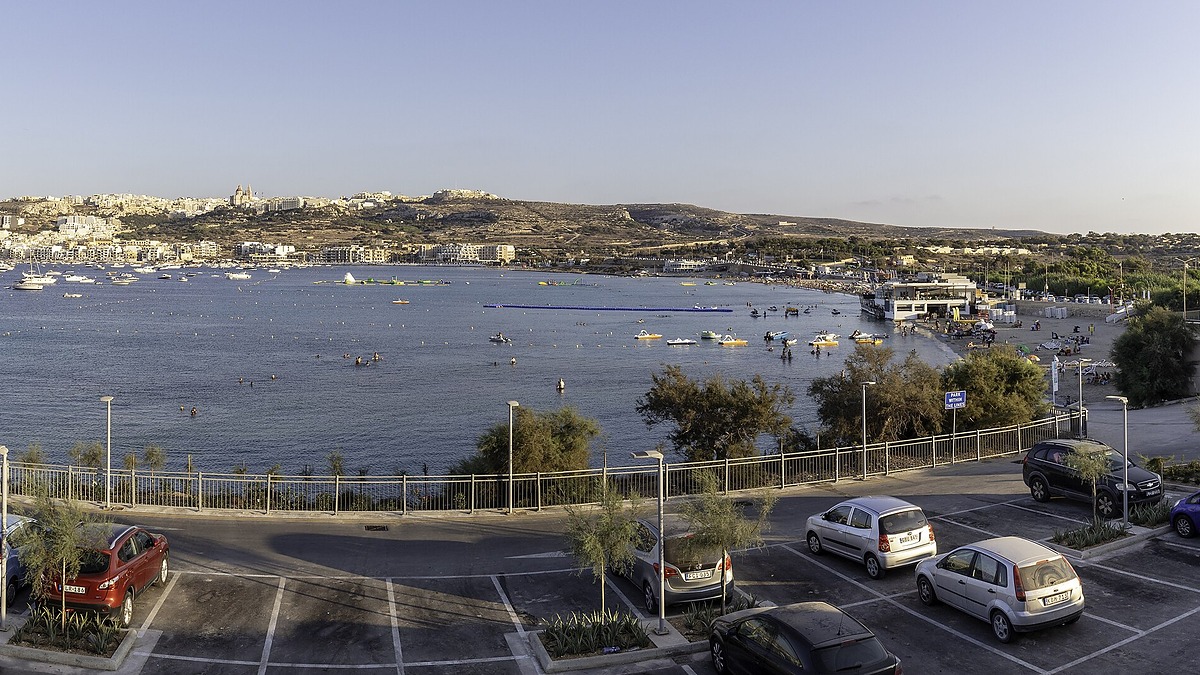
Choose Mellieħa Bay if you are bringing a pushchair or a four-year-old. Visit Malta calls it the most popular family beach on the island, and the reasons are physical: the sand shelves on a low gradient into clear, shallow water, and the bay is sheltered between two headlands. It is also the largest of Mellieħa's pocket beaches, with restaurants and two hotels behind it.
For anyone with limited mobility, no beach in Malta is better equipped. Between June and September the Malta Tourism Authority runs the beach with the local council: lifeguards, a small first-aid clinic, wheelchair access, a mobile toilet and sand wheelchairs for disabled bathers.
The main road to the Ċirkewwa ferry runs right behind the sand, which makes the bay easy to reach and puts traffic at your back. Buses 41 and 42 from Valletta and 222 from Sliema all stop at Għadira, according to Malta Public Transport. Across the road is BirdLife Malta's Għadira Nature Reserve, a free-entry wetland that paused visits over summer 2026 for the breeding season; check its site for winter opening days.
2. Golden Bay: sand without the steps
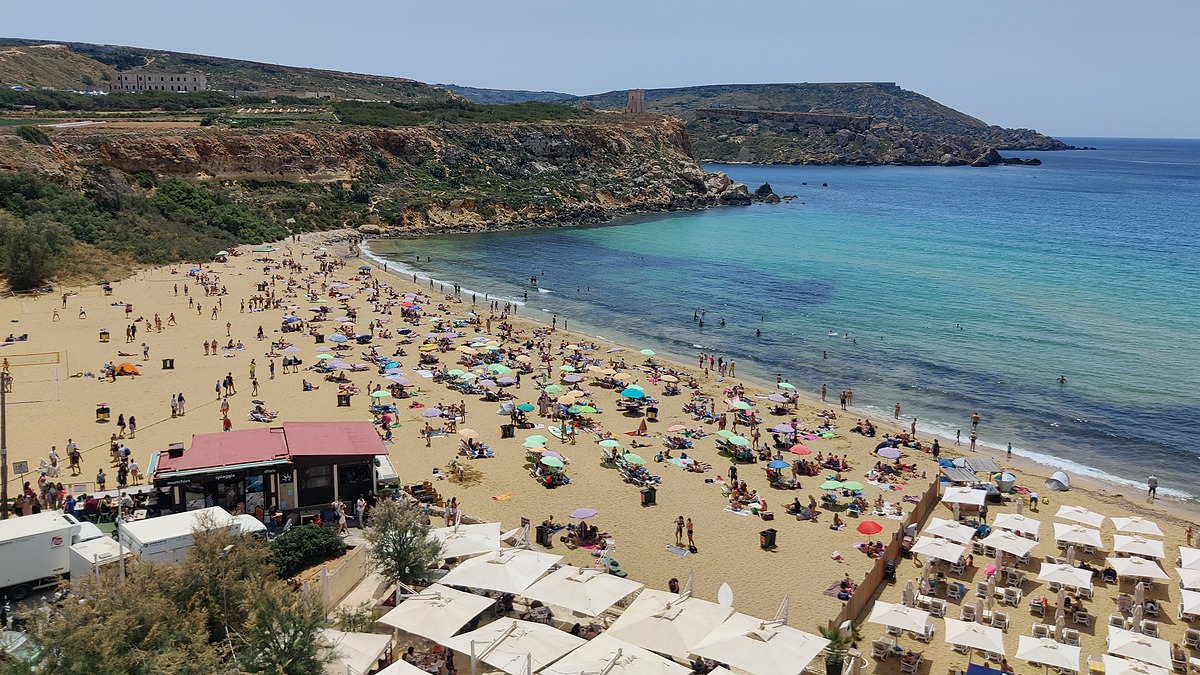
Golden Bay is the step-free alternative to its neighbour. Visit Malta's listing says its easy access makes it suitable for less mobile visitors and families with small children, which settles a common mix-up: the long staircase people describe belongs to Għajn Tuffieħa, the next bay south.
Easy access brings the crowds. There is a café-restaurant, sunbed and umbrella hire, jet skis, banana boats and other water sports, and the sunsets draw a barbecue crowd in the evening. The hills behind are part of Il-Majjistral Nature and History Park, so they stay green, though a large hotel stands above the beach.
The Malta Tourism Authority manages the beach from 15 June to 15 September, with lifeguards on duty daily. The bay is prone to strong currents when the wind blows from the north-west, and a red flag means bathing in the shallows only. Bus 44 runs here from Valletta, and route 101 links it to Mellieħa and Ċirkewwa.
3. Għajn Tuffieħa: a long flight of steps to the best sand in Malta
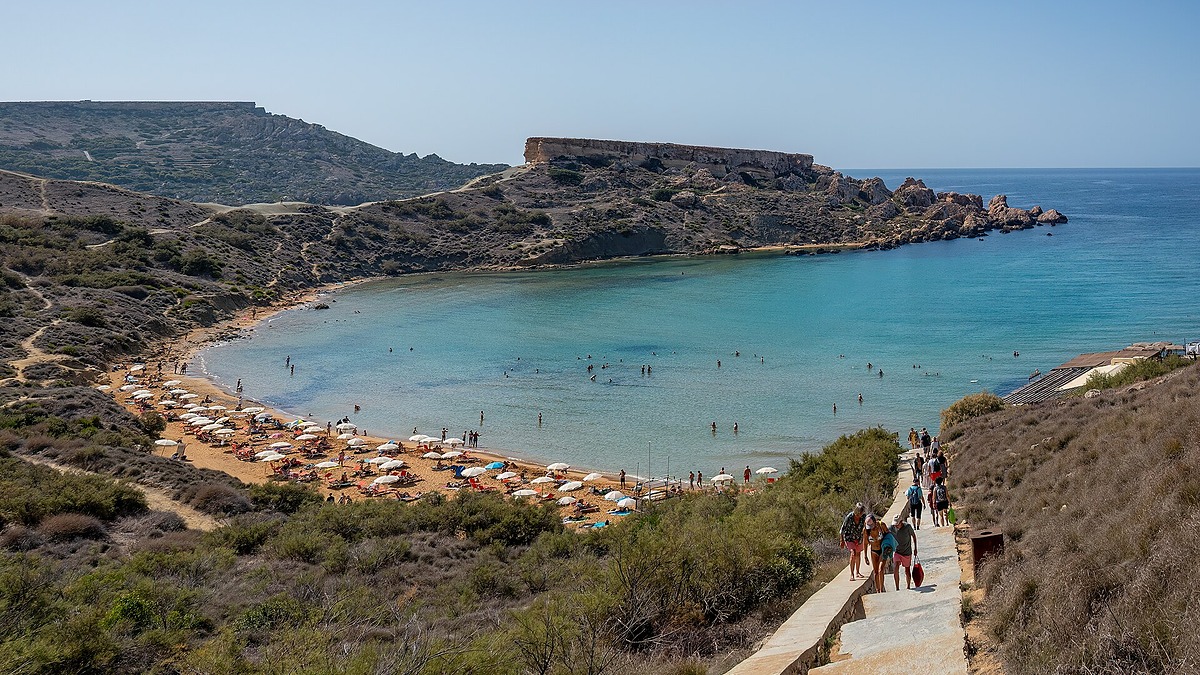
Over the headland from Golden Bay, Għajn Tuffieħa (often written Ghajn Tuffieha, and also called Riviera Bay) is the prettier of the pair. A 250m strip of red-brown sand lies below slopes of acacia and tamarisk, guarded by a 17th-century watchtower, and Lonely Planet counts 186 steps down from the car park. Visit Malta's listing calls the bay undeveloped and gives a gravel track as the other way down.
Those steps keep the numbers down. The GAIA Foundation manages the beach with a lifeguard and safety ropes along the bay, and there is sunbed and pedalo hire and a small snack bar. It shares Golden Bay's warning: strong currents in a north-westerly wind.
Bus 44 from Valletta stops at Riviera and Tuffieħa, and routes 225 from Sliema and 223 from Buġibba serve the same stops. Carrying a cool box and a toddler back up those steps in July is the real cost of the view.
4. Ir-Ramla taċ-Ċirkewwa: a small cove near the Gozo ferry
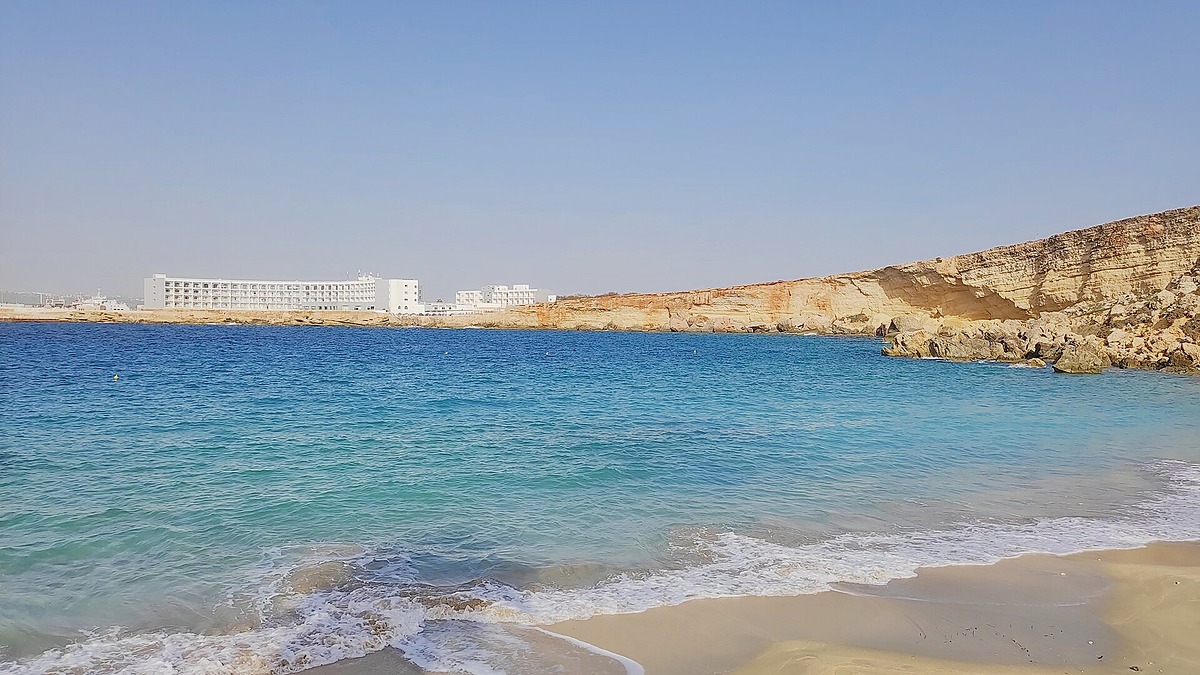
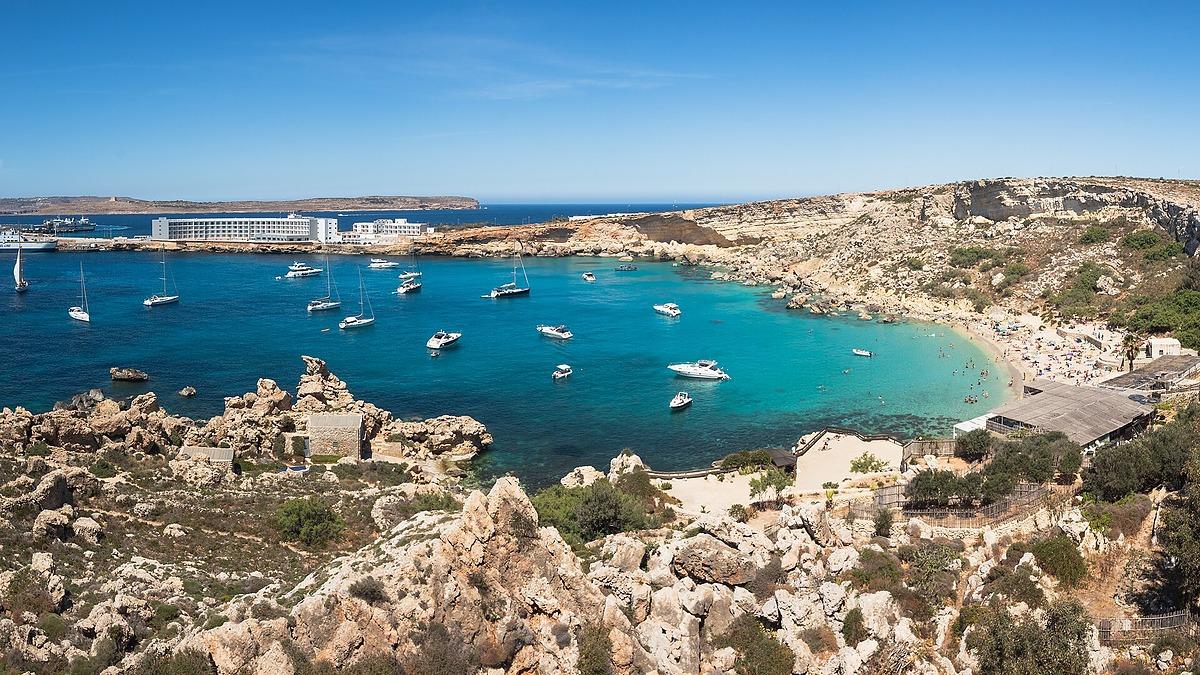
At Malta's northern tip, about 1km from the Ċirkewwa ferry terminal, a small sandy cove looks straight across to Comino and its tower. Maltese maps call it Ir-Ramla taċ-Ċirkewwa; most guides in English name it after the large white resort hotel on the point above it, and Malta Public Transport's bus stop above the cove carries the same name. Visit Malta notes a second, quieter beach belonging to the hotel, open to the public as well.
The cove is mostly sand and slopes gently into the water, with caves and rocky inlets either side for snorkelling, according to the independent guide Malta Uncovered. A large lido beside the beach sells food and drinks and has sunbeds and showers.
Getting down is the problem: a long, steep flight of steps is the only way, which the same guide says rules it out for anyone with limited mobility. The sand also fills quickly in summer. Bus 101 stops at the car park above the bay; the 41 and 42 from Valletta end at Ċirkewwa, about 1km away.
5. Blue Lagoon, Comino: the clearest water, on a booking system
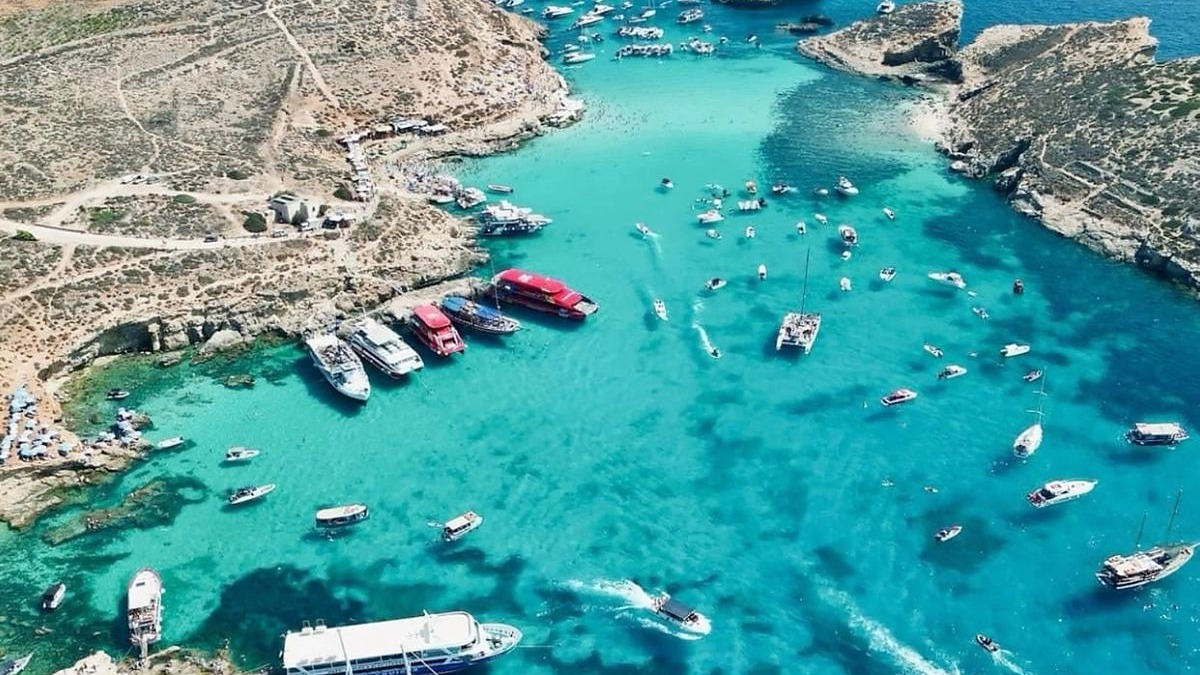
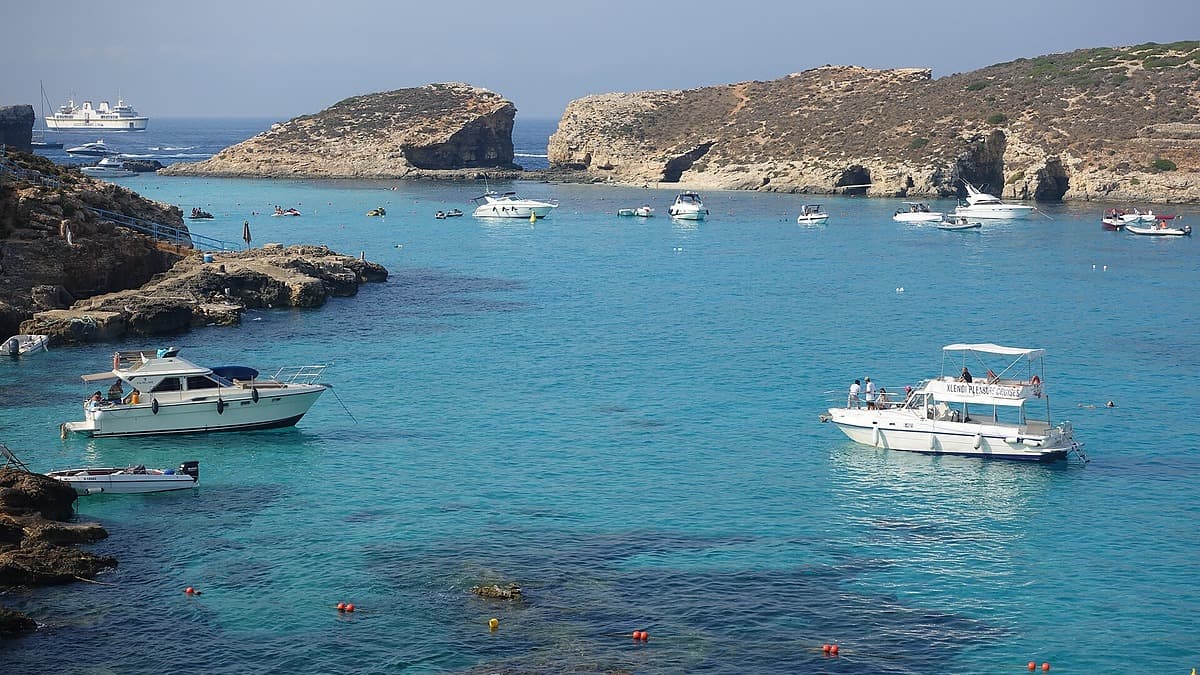
The Blue Lagoon is a channel of shallow water over pale sand between Comino and the islet of Cominotto, and the colour is the reason everyone comes. The shore is another matter: mostly bare rock ledges, with toilet blocks and, in peak season, food kiosks.
The crowds made it a test case. At peak in summer 2024 the Malta Tourism Authority counted up to 12,000 people at once.
Since 1 May 2025, anyone landing has needed a free booking for one of three daily slots (8am to 1pm, 1.30pm to 5.30pm or 6pm to 10pm), with a cap of 4,000 at a time, according to the MTA's notice. On average the slots ran at about half that: TTG reported in October 2025, using the authority's figures, that they averaged 1,979 visitors each over that summer.
Comino Ferries, which has run from Marfa and Ċirkewwa since 1990, says its tickets include landing access, so its passengers need no separate pass. The schedule page gives a 20-minute crossing and a return fare of €15 for adults and €7 for children under 10, and its booking page says tickets are valid for three months from purchase. Buses 41, 42, 101 and 222 all reach Ċirkewwa.
Budget 2027 adds a €5 charge for non-resident visitors to Comino, collected through the booking system. No start date had been published in mid-November 2026; our guide to Malta's 2027 tourist tax and Comino charge tracks it. Checked November 2026. Even capped, 4,000 people is a lot for one small inlet, so take the first boat and leave before the afternoon slot lands.
6. Ramla Bay, Gozo: red sand and room to spread out
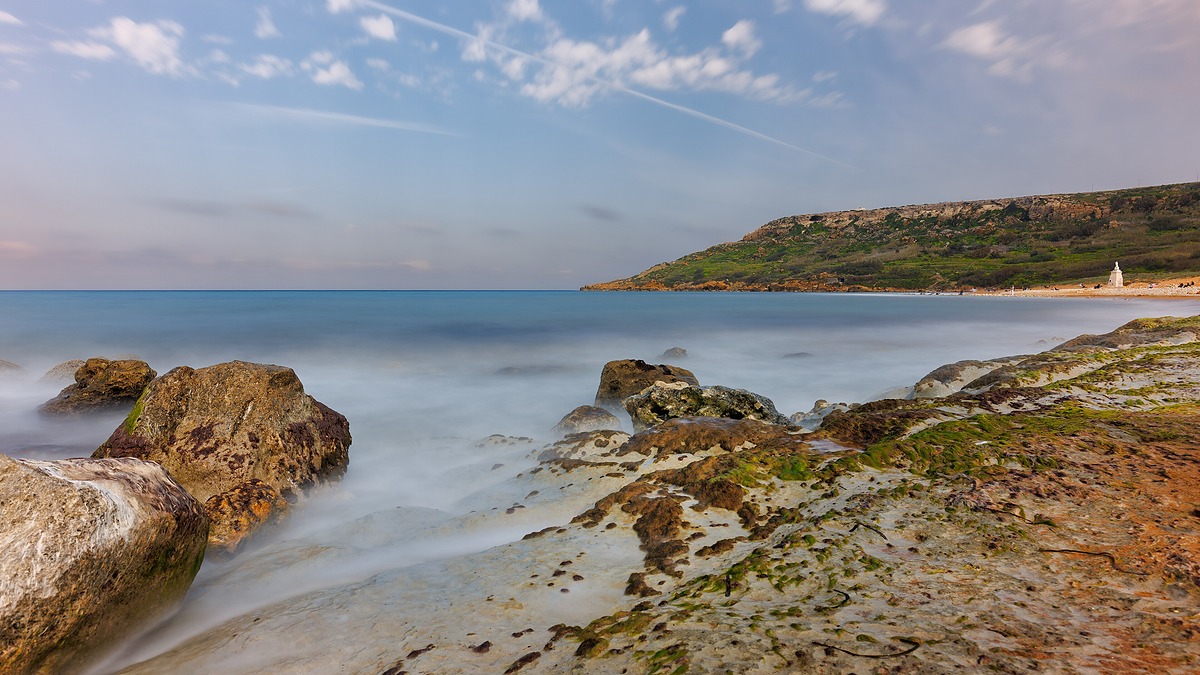
Ramla l-Ħamra, on Gozo's north coast, is the sandy beach that rarely feels full. Visit Malta describes deep reddish-gold sand below terraced hills and Calypso's Cave, a white statue of the Virgin Mary on the beach and no hotels, just a few snack bars and cafés. Even in peak summer, by its account, there always seems to be space, and in winter you can have it to yourself.
Visit Malta calls the bay safe for swimming, and the GAIA Foundation provides lifeguards. Smooth boulders lie a few metres out in the central strip, easy to clear but worth pointing out to children, and on windy days surf rolls onto the sand.
Without a car, Ramla is a ferry and two buses from Malta. The Gozo Channel ferry from Ċirkewwa to Mġarr costs €4.65 for an adult return, according to its fares page. You buy the ticket online or at the booths, and it is validated in Gozo before the trip back. From the ferry at Mġarr, buses 301 and 303 run to Victoria, where the 302 leaves for Ramla. Budget 2027 raises the visitor foot fare to €11, with no start date yet. Checked November 2026.
7. Xlendi, Gozo: deep water at the end of a ravine
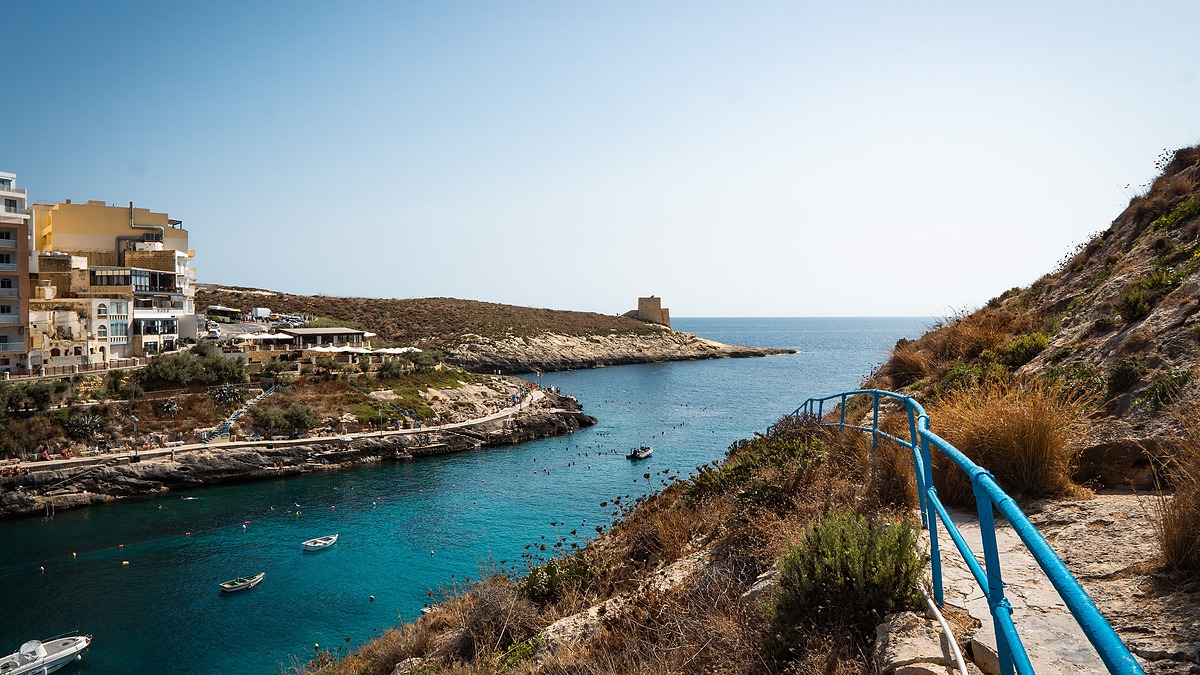
Xlendi is an inlet at the end of a deep, green ravine on Gozo's south-west coast, flanked by steep cliffs and watched over by Xlendi Tower, built in 1650. It was a fishing port until the mid-20th century and is now a small resort with cafés along the water.
Swimming here means rock. Visit Malta says bathing is usually off the rocks, down ladders into deep water, while two tiers of paths on the left side of the bay leave flat space for towels. Children who need to paddle are better off at Ramla.
Buses 306 and 330 run from Victoria to Xlendi. Stay into the evening. The sunsets are the reason to spend a night in Xlendi, and the stairs up the cliffs on the right side of the bay give the best views.
8. St Peter's Pool: flat rock and deep water near Marsaxlokk
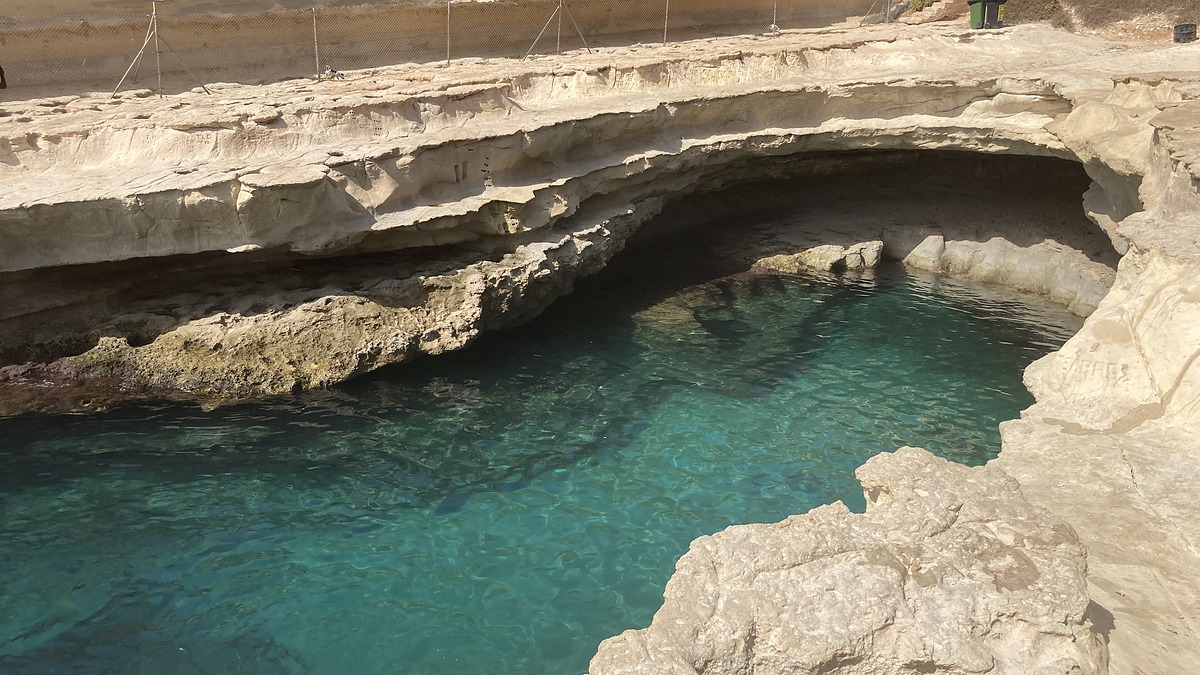
St Peter's Pool, on the Delimara peninsula past the fishing village of Marsaxlokk, is a natural lido in the rocks with large slabs of flat stone for sunbathing between swims, as Lonely Planet puts it. There is no sand and no gradual way in: you swim from the rock into deep water.
That makes it a beach for confident swimmers only. Malta Info Guide, last reviewed in September 2026, lists no lifeguard, toilets or sunbeds, says not to rely on buying food or drink, and warns that getting out is harder when waves break against the rocks. People jump from the ledges; the guide does not encourage copying them.
Buses 81 and 85 run from Valletta to Marsaxlokk, and route 119 serves a stop at Delimara, about a 20 to 30-minute walk from the pool. Bring water and shade. Il-Kalanka, a smaller swimming hole nearby, is usually quieter.
Can you swim in Malta in October and November?
Yes in October, and with care after that. The Malta Met Office's long-term norm for the October sea is 23.5°C, down from about 26°C in September (our Mediterranean in September guide has the detail), and the average October air temperature is 21.5°C. October is also when the rain returns, with a monthly norm of about 77mm in the Met Office's reports.
By November the sea norm falls to 21°C. That is still swimmable for many northern Europeans, but the support has gone. Golden Bay's lifeguards finish on 15 September, Mellieħa Bay's at the end of September, and a north-westerly wind brings the strong currents that Visit Malta warns about at Golden Bay and Għajn Tuffieħa. In winter, Mellieħa Bay, sheltered between its two headlands, is the calmer choice.
Buses are thinner too. From 7 November 2026 route 101 no longer runs to Ġnejna and ends in Mġarr, according to Malta Public Transport's winter update. The Golden Bay, Mellieħa Bay and Ċirkewwa stops are still served. Checked November 2026.
Planning for summer 2027: lifeguards, the Comino charge and the Gozo ferry
The main lifeguard season is the one to plan around. On the Malta Tourism Authority's usual dates, Golden Bay is staffed daily from 15 June to 15 September and Mellieħa Bay from June to September. The GAIA Foundation provides lifeguards at Għajn Tuffieħa and Ramla, but Visit Malta's listings give no dates for them, so don't count on cover outside high summer.
Three Budget 2027 measures will change the cost of a beach week, and only one has a date:
- Eco tax: €8 per adult per night in hotels and €10 in short-lets from 1 January 2027, up from €1.50.
- Comino: a €5 charge for non-resident visitors, no start date published.
- Gozo Channel ferry: the visitor foot fare rises from €4.65 to €11, no start date published.
For a sand-and-swim week without a car, stay in Mellieħa. Mellieħa Bay is at the bottom of the hill, Golden Bay and Għajn Tuffieħa are one bus away, and Ċirkewwa puts both the Comino boats and the Gozo ferry on your doorstep. If you are still weighing Malta against other coasts for next summer, our pick of the best beach holidays in Europe compares it with the alternatives.