At Monterosso al Mare the train pulls in a few steps from the sand. Fegina beach runs west from the station under rows of lido umbrellas, a mix of sand and smooth pebbles that slopes gently into the sea, and it is the only beach in the Cinque Terre long enough to spread out on. The other four villages offer a harbour, a pebble cove or a rock ledge.
So the best beaches in Liguria are mostly just beyond the five villages: Levanto at the northern end of the Cinque Terre line, the Baia del Silenzio at Sestri Levante, and Camogli and San Fruttuoso on the Portofino headland. All eight below are on the Riviera di Levante, the coast east of Genoa, and none needs a car.
The lidos are packed away until spring. Prices and timetables below are from 2026, the best guide to the May to October 2027 season, with a note of what to check before you travel.
Liguria's best beaches at a glance: sand, cost and access
The Cinque Terre has one beach town, Monterosso, and four other places to swim. Vernazza and Riomaggiore have small pebble coves; Manarola and Corniglia have rocks and a harbour or marina. Outside the park the beaches get bigger: Levanto and Sestri Levante have sand mixed with pebbles, and Camogli has a long pebble beach below its painted houses. The table follows the railway from the Cinque Terre north-west to Genoa, in the same order as the entries.
| Beach | Sand or rock | Free or paid | Getting there | Best for |
|---|---|---|---|---|
| 1. Monterosso al Mare | Sand and pebbles | Lidos and free strips | Train or ferry | A full beach day in the Cinque Terre |
| 2. Vernazza harbour | Pebbles | Free | Train or ferry | A swim between sights |
| 3. Riomaggiore cove | Pebbles | Free, no lidos | Train or ferry, then a short walk | Clear water |
| 4. Levanto | Sand and pebbles | Lidos and free stretches | Train or ferry | A beach base next to the park |
| 5. Baia del Silenzio, Sestri Levante | Fine sand | Free, capped in July and August | Train, then a walk | The prettiest small bay |
| 6. Camogli | Pebbles | Lidos and free stretches | Train | Painted houses and boats |
| 7. San Fruttuoso | Pebbles | Lido and free section | Boat (€17 return) or footpath | An abbey on the beach |
| 8. Boccadasse, Genoa | Pebbles | Free | City bus | An evening swim in Genoa |
| Manarola and Corniglia | Rock, harbour or marina | Free | Train, then steps | Confident swimmers on calm days |
The 8 best beaches in Liguria, from the Cinque Terre west to Genoa
1. Monterosso al Mare: Fegina and the old-town beach
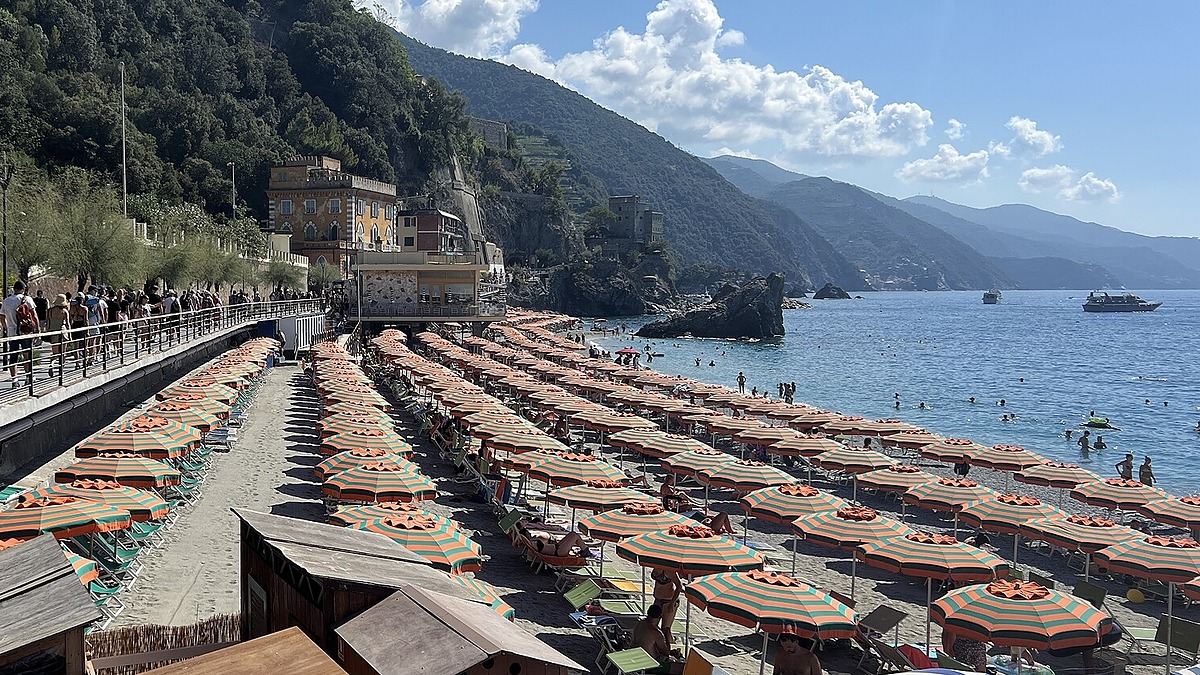
Monterosso has two beaches, joined by a pedestrian tunnel under the headland. Fegina is the big one: a long curve of sand and pebbles in front of the station and the seafront Via Fegina, lined with lidos such as Bagni Fegina, Eden and Stella Marina. The seabed shelves gently, which makes it the Cinque Terre's family beach.
Not all of it is paid. There are free strips by the station and at the western end, below the Gigante, a giant statue of Neptune built into the cliff. They fill first on July and August mornings, so be there by 9am.
The old-town beach on the other side of the tunnel, by the ferry landing, is smaller, with a few equipped sections and free stretches; choose it for lunch in the lanes behind. Both sides are on the train line and the ferry route. The coastal path to Vernazza, covered by the Cinque Terre Card, starts at the old-town end.
2. Vernazza: the harbour beach
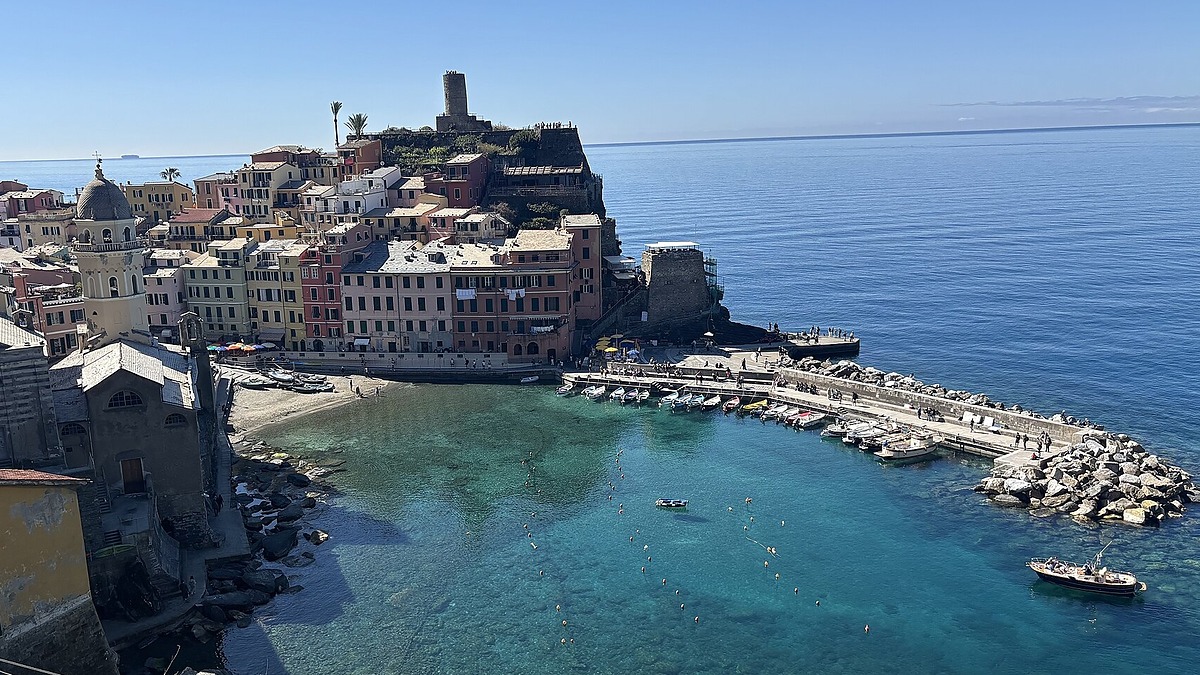
Vernazza swaps Monterosso's space for a small patch of pebbles beside the harbour, with the church on one side and the village's main square a few metres away. It is free and has no services, and the water inside the breakwater is sheltered.
On a busy afternoon there is more swimmer than stone. A second, quieter pebble cove is reached through a passage under the rock off Via Roma, the main street down to the harbour, according to the beach guide Spiagge.it. Swim here between the walk from Monterosso and a late lunch, then take the train or ferry on.
3. Riomaggiore: the pebble cove east of the village
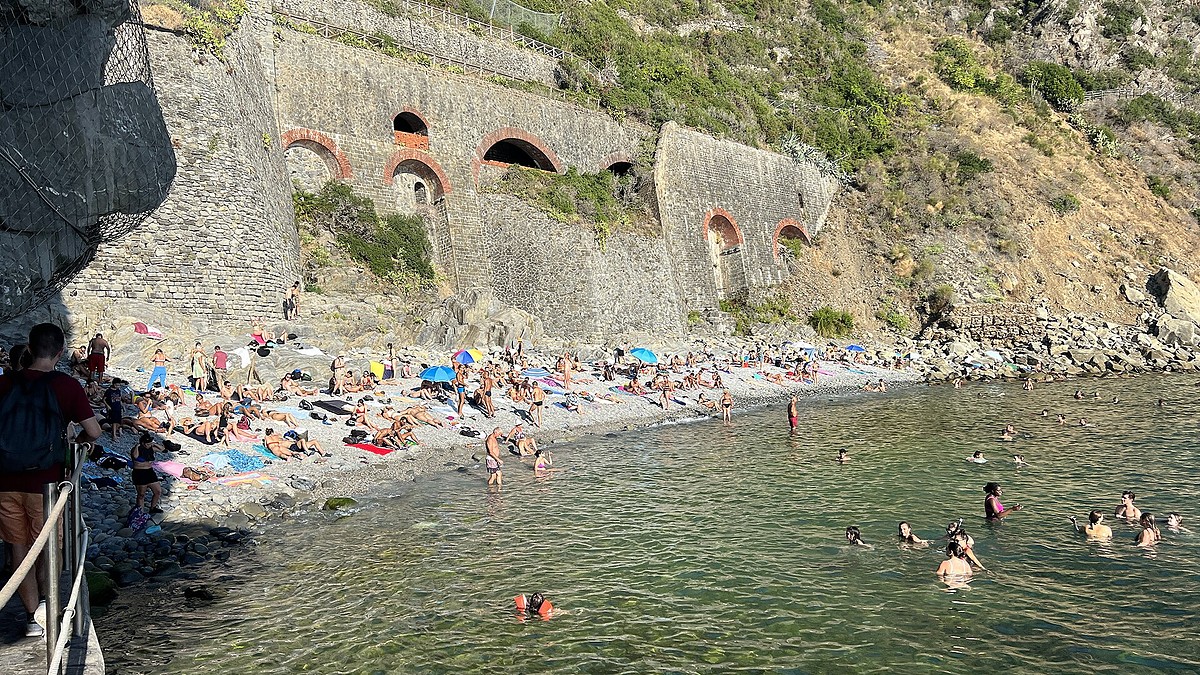
Riomaggiore's beach is a pebble cove a short walk east of the village and its little marina, below the cliffs, with clear water. There are no lidos: in August 2025 the mayor, Fabrizia Pecunia, told SiViaggia the council had never considered granting beach concessions. The council has added a public shower, but at the time a lifeguard post had only been discussed.
Bring water shoes and something soft to lie on. Riomaggiore is also where the Via dell'Amore starts. The cliff path to Manarola runs one way only and takes about 30 minutes, and it needs a timed booking and a Cinque Terre Card (the Trekking and Treno cards include it), according to the park's Via dell'Amore page. Checked November 2026. North of the park, the coast flattens out and the beaches get easier.
4. Levanto: the beach town at the edge of the park
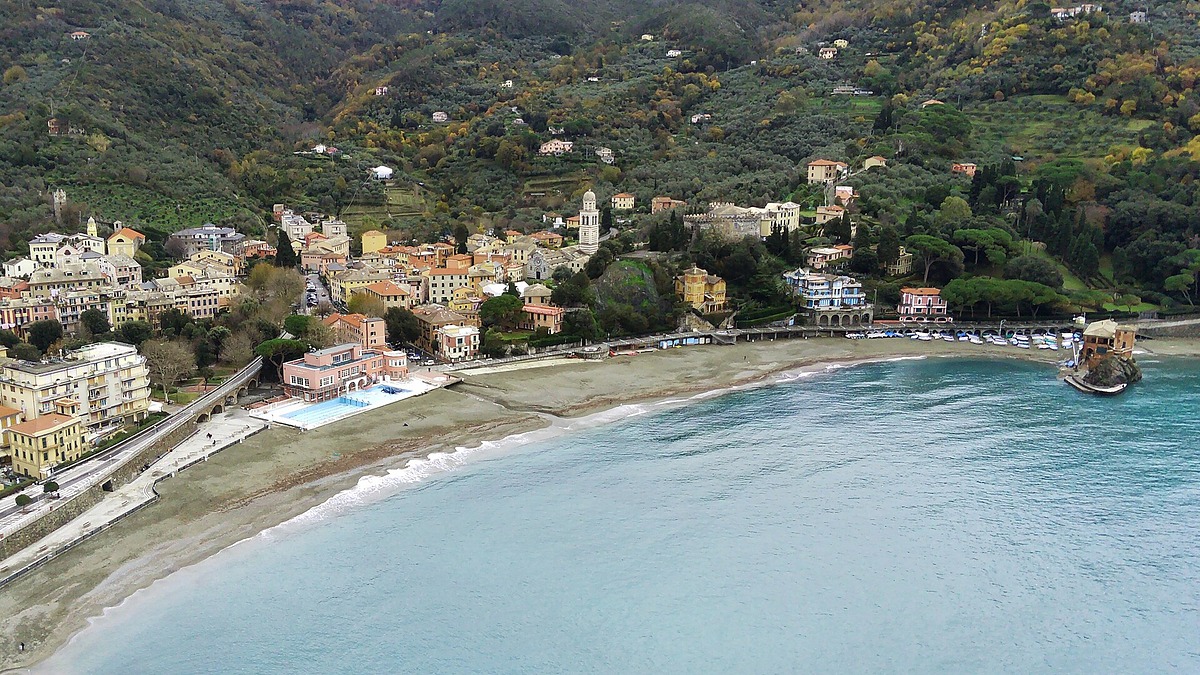
Levanto is the beach the Cinque Terre doesn't have. Its main beach is a wide arc of sand and smooth pebbles in front of the town, a short walk from the station, with lidos along the promenade and free stretches between them. It is also one of Liguria's best-known surf beaches, with schools and board hire on the sand.
For a Cinque Terre trip, Levanto is also where the park's train card zone begins: Monterosso is the next stop, and Navigazione Golfo dei Poeti's Cinque Terre ferry calls here too in season, weather permitting.
Bonassola, the next bay north, is the quieter alternative, with a 2026 Blue Flag for its beach, and you can walk or cycle there from Levanto along the Maremonti path, a former railway that runs through tunnels to Framura. A little further up the line, Sestri Levante has the bay that ends up on the posters.
5. Baia del Silenzio, Sestri Levante: free sand, capped in summer
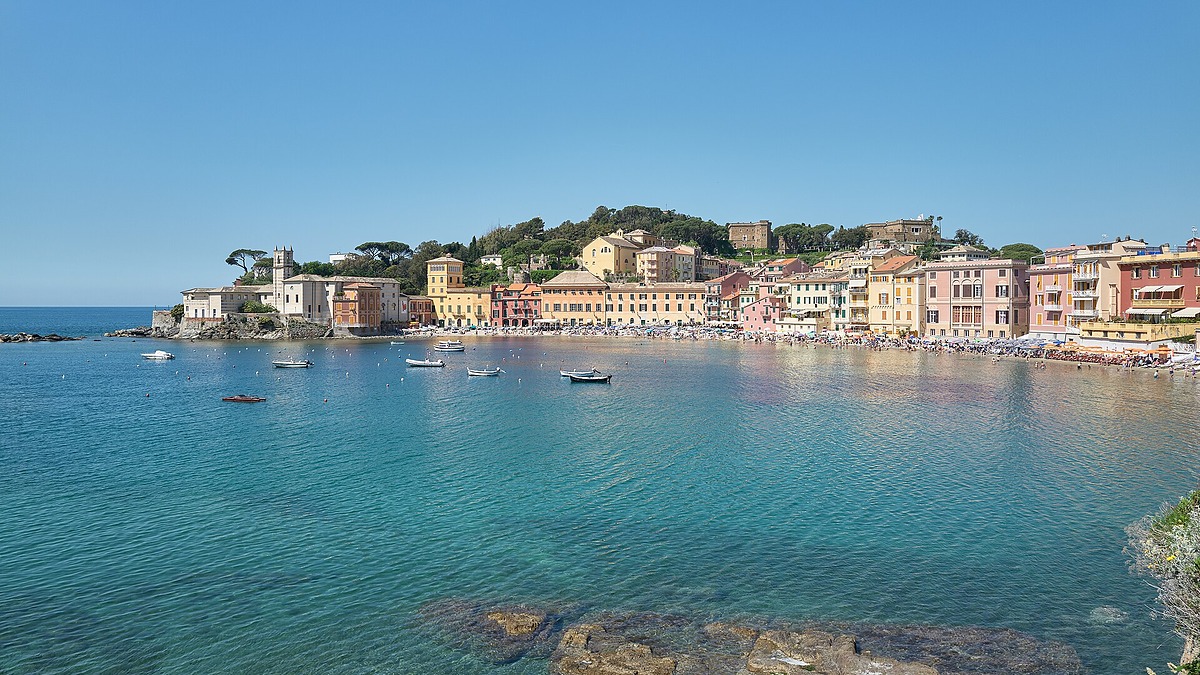
The Baia del Silenzio is a small curve of fine sand on one side of Sestri Levante's narrow old-town peninsula, with tall coloured houses built to the edge of the beach and fishing boats drawn up on the sand. The water is shallow and sandy underfoot, and the beach is free. From Sestri Levante station it is about 15 minutes on foot, under 1km, through the lanes of the old town, according to Spiagge.it.
In high summer it is also capped. From 1 July to 31 August 2026, the council limited the beach to 450 people at a time between 8.30am and 5.30pm, counted at three entrances, according to Mentelocale's report on the 2026 rules. There was no booking and no ticket: when the count was full, entry paused until people left. Lifeguards, showers and toilets were free, and outside those hours, and before July or after August, there was no cap. The measure has been confirmed each year since 2023, so look for the 2027 rules from June. Checked November 2026.
If the gate is shut, walk to the Baia delle Favole on the other side of the peninsula, a longer town beach with lidos. West of Sestri, the railway runs on to the Portofino headland.
6. Camogli: pebbles below the painted houses
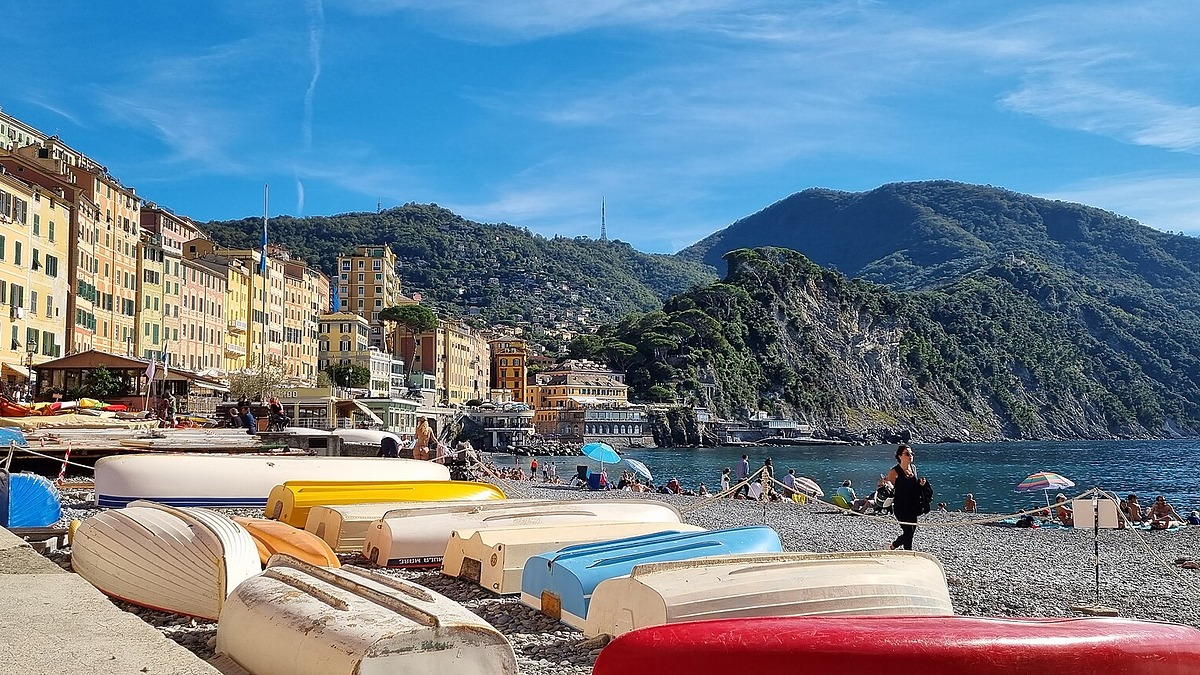
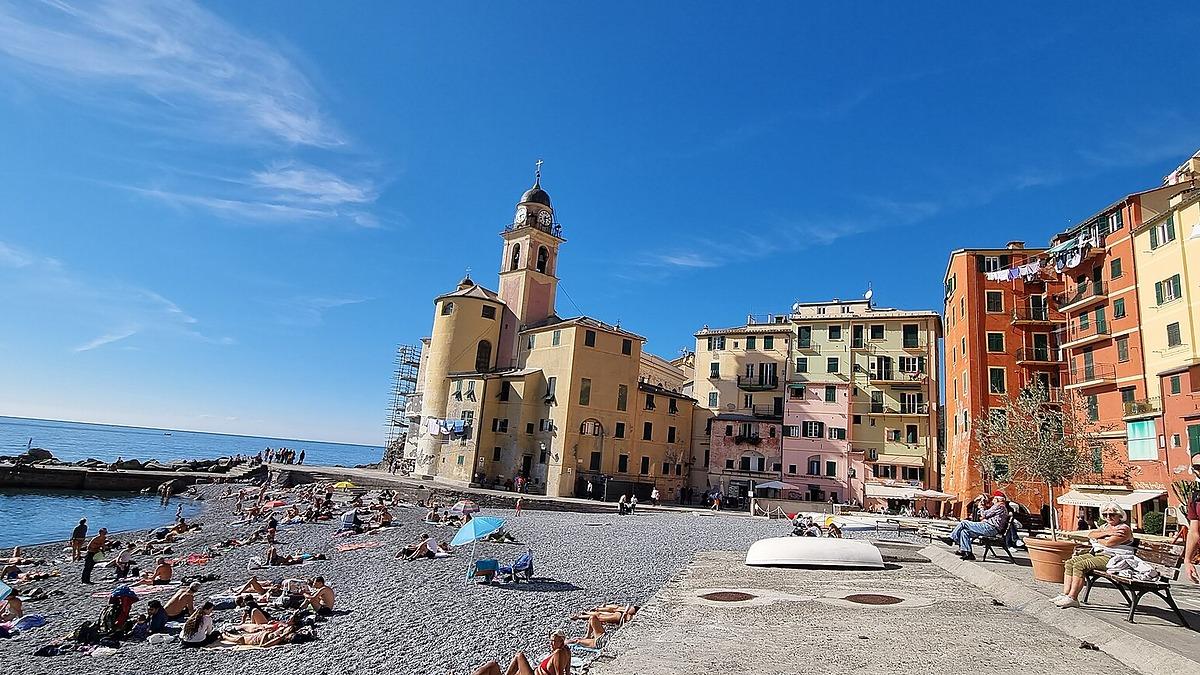
Camogli's beach runs along the front of the town, a long sweep of smooth pebbles directly below the promenade and the tall, painted houses, with the harbour and its wooden fishing boats at one end. Lidos rent umbrellas and sunbeds, and there are free stretches between them.
It is the easiest day trip on this list from Genoa. Regional trains from Genova Brignole take 30 to 40 minutes, and the station is a short walk above the seafront. The beach is also the departure point for the boat to San Fruttuoso, which makes Camogli the base for the next entry, and Genoa's Boccadasse is a train and bus ride away.
7. San Fruttuoso: the abbey beach you reach by boat
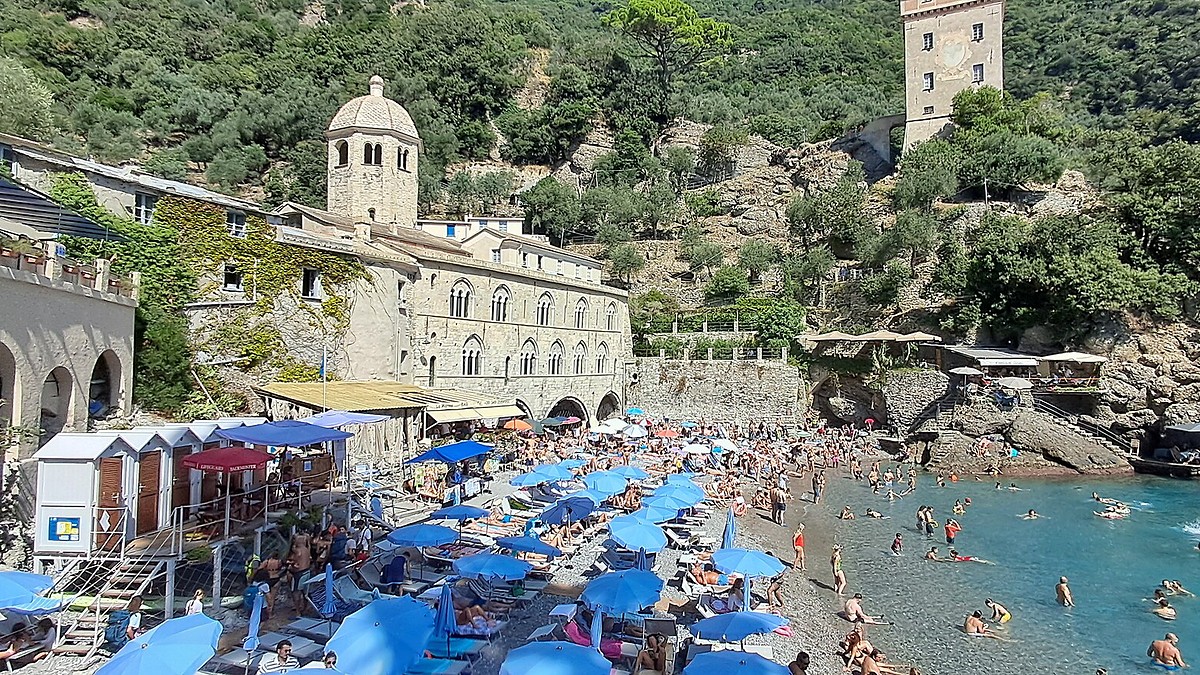
San Fruttuoso is a pebble cove at the foot of the Portofino headland with a medieval abbey right behind the beach and the underwater Christ of the Abyss statue in the bay offshore. There is no road: you arrive by boat or on foot, so the hamlet stays small and the midday rush, when the boats unload, is hard to miss. Part of the beach is free, and the rest is a lido, Bagni San Fruttuoso, that rents umbrellas and sunbeds, according to SiViaggia. Come on the first boat or late in the afternoon.
Golfo Paradiso's boats run from Camogli all year, hourly from 9am in summer and less often in winter, with the last boat back at 6pm in June and 7pm in July and August 2026. A return cost €17 for an adult in 2026. Rough seas cancel sailings and can close the abbey, run by the FAI, Italy's equivalent of the National Trust, so check on the morning.
Walkers can cross the headland from Camogli or Portofino on the woodland paths of the Parco di Portofino; check trail closures with the park before you set out. On the other side of the headland, Paraggi is the beach under Portofino: a small bay mostly given over to lidos, with a limited free area. Reach it by bus from Santa Margherita Ligure or on foot from Portofino.
8. Boccadasse, Genoa: the city's fishing-village beach
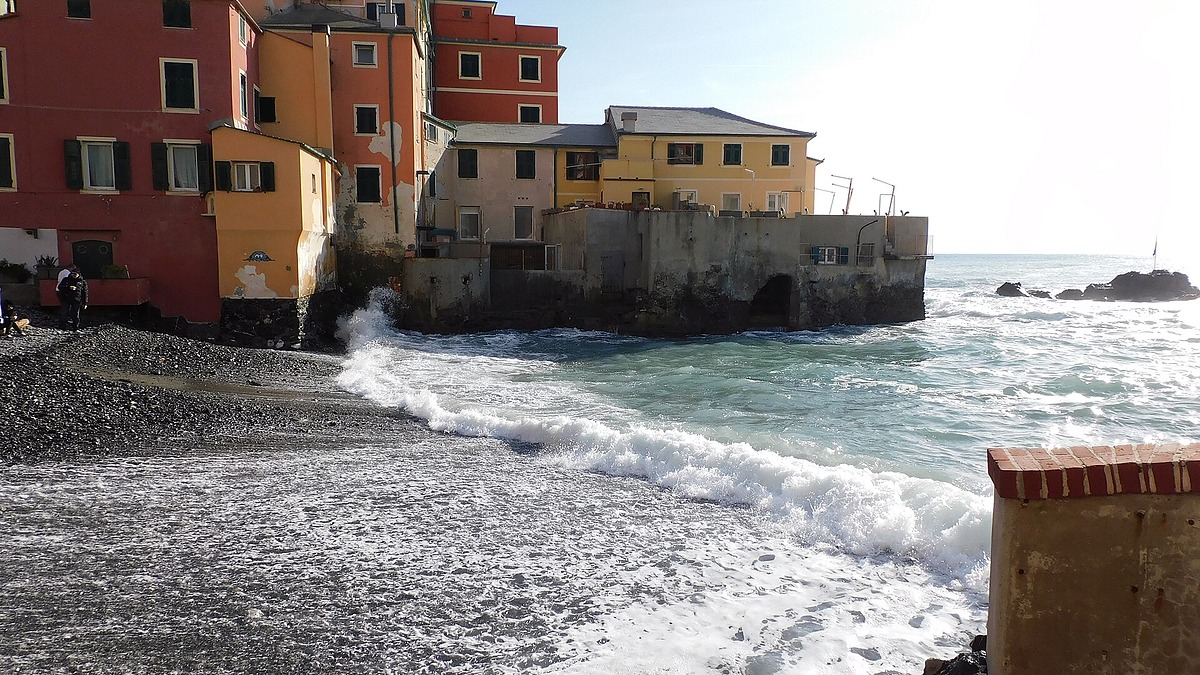
Boccadasse is a former fishing village inside Genoa, a cluster of pastel houses around a small pebble beach at the eastern end of Corso Italia. The beach is free and unequipped. In summer the city lays a walkway down to the water, and the council's 2026 beach sheet lists a hot shower and an accessible toilet on Via Aurora.
The council ran a lifeguard service on set dates between 15 June and 13 September 2026, daily from 10am to 7pm from 4 July to 23 August, according to the Comune di Genova's Boccadasse sheet. AMT buses 31, 42 and 607 stop nearby, and walkers come in from Corso Italia down the stepped lane of Via Aurora. Come for a late-afternoon swim after a morning in the old town.
Where to swim in Cinque Terre without a beach
Manarola and Corniglia have no beach at all, and plenty of people swim there anyway. In Manarola, swimmers go in straight off the rocks around the harbour. Corniglia's marina is a small inlet of rocks and stones below the village, reached on foot.
Both are for confident swimmers on calm days. When there is a swell, waves break over the rocks and climbing out gets hard, and you can't count on a lifeguard. The same goes for Riomaggiore's cove. If the sea looks rough from the station platform, take the train to Monterosso and swim off the sand.
Sand, pebbles or rock: what to expect on the Riviera di Levante
Beyond the Cinque Terre the coast is gentler, but expect pebbles. Of the eight, only Monterosso, Levanto and the Baia del Silenzio have real sand, and Monterosso and Levanto mix it with smooth stones. Water shoes make every beach here easier, and a foam mat beats a towel. In return, the water stays clear.
The long sandy beaches are on the other side of Genoa, on the Riviera di Ponente, which this guide leaves for another day. Alassio is the best known and the most expensive (more on that below), and Varigotti has the Baia dei Saraceni, a sandy cove that turns up on most Ligurian beach lists.
Free beaches and what a lido costs
On the Levante, free sand is easier to find than the rows of umbrellas suggest. Vernazza, Riomaggiore, the Baia del Silenzio and Boccadasse are free outright, and Monterosso, Levanto and Camogli keep free stretches between the lidos.
Lidos in the Levante towns don't publish one price list, and they rent by the day as well as the week. For a benchmark, the Altroconsumo beach price survey found Alassio, on the Ponente, the most expensive of ten Italian resorts for the first week of August 2026. There, an umbrella and two sunbeds averaged €340 for the week across the first four rows, and €368 in the front row.
In July and August, go early to the free strips or book ahead: some Monterosso lidos, such as Bagni Eden, take online bookings through Spiagge.it. The bigger daily cost in the Cinque Terre is often the train.
Trains, boats and the Cinque Terre Card
One railway links all eight beaches, from Genoa through Camogli and Sestri Levante to Levanto and the five villages. Between Levanto and La Spezia, trains charge a special tourist fare that changes with the crowds, and a day card often works out cheaper.
- Cinque Terre Treno MS Card: €22, €29.50 or €35 for an adult day in 2026, depending on whether the date was low, medium or high demand, according to the Cinque Terre National Park's card page. It covers regional trains between Levanto and La Spezia, the coastal path from Monterosso to Vernazza and Corniglia, the Via dell'Amore, village buses and station toilets. Prices applied from 14 March to 1 November 2026, so expect the 2027 table around March.
- Single train tickets: €5, €8 or €10 a ride on the same low, medium and high bands in 2026, according to Trenitalia's Cinque Terre tariff. Trains between Levanto and La Spezia leaving after 7.30pm charge the lowest band.
- Cinque Terre Trekking Card: a cheaper card for the paths, the Via dell'Amore and village buses, without trains: €10 for an adult day, or €15 on high-demand dates, according to the park's Trekking Card page.
- Winter: from 2 November to 31 December 2026 the train card costs a flat €17.30 a day.
- Cinque Terre ferry: Navigazione Golfo dei Poeti's Line 02 links Riomaggiore, Manarola, Vernazza and Monterosso, but not Corniglia, and the same line calls at Levanto, weather permitting. The full timetable ran from 28 March to 1 November 2026, according to the operator, and until 8 December only its Cinque Terre Trip excursion calls, at Vernazza and Monterosso. Check the operator for 2027 fares and timetables.
- Camogli to San Fruttuoso: €11 one way, €17 return for an adult in 2026, all year from Camogli.
- Boccadasse: AMT city buses 31, 42 and 607.
The card pays off once the coastal path joins two or three train rides in a day. The park and RFI list engineering weekends on 19 and 20 December 2026, 9 and 10 January and 6 and 7 February 2027. According to RFI, trains stop between Corniglia and La Spezia from 10.30pm on Friday to 6.30am on Monday, and between Levanto and La Spezia from 10.30pm to 6.30am on the Friday and Saturday nights. Check Trenitalia before you travel. Checked November 2026.
When to swim: late May to early October
June and September are the months to aim for in 2027. The sea off Genoa averages 21°C in June and 23°C in September, against 25°C in August, according to Weather2Travel's monthly averages, and the beaches are far quieter. Late May, at about 18°C, is for hardy swimmers, and early October, at about 20°C, still works on a calm, sunny day.
August is the crowded month, building to Ferragosto on 15 August, Italy's biggest beach holiday. It is when the Baia del Silenzio cap bites and the free strips at Monterosso fill early. Our Mediterranean in September guide compares the late-summer water elsewhere.
Where to stay for the beaches: Levanto, Monterosso or Camogli
For the most beach time, stay in Levanto. It has the roomiest beach on this stretch, it is one stop from Monterosso, and the train card zone starts at its station. Monterosso is the pick if you want to stay inside the Cinque Terre and still have sand outside the door.
Riomaggiore and Manarola are good bases for the paths and the evenings, but you will swim off rocks or take the train to the sand. For Camogli, San Fruttuoso and Boccadasse, stay in Camogli: Genoa is 30 to 40 minutes away by regional train, and the San Fruttuoso boat leaves from the beach. Sestri Levante splits the difference, between Camogli and Levanto on the line, with two beaches of its own.
Which Ligurian beach to pick
For a family beach day in the Cinque Terre, Monterosso's Fegina, on the free sand by the station or a lido if you want shade. For the most beautiful bay, the Baia del Silenzio, before 8.30am or outside July and August. For somewhere you can't drive to, the boat from Camogli to San Fruttuoso. For a week of swimming with the villages on the doorstep, base yourself in Levanto.
If this is one stop on a longer Italian trip, our best beaches in Puglia guide covers the free sand of the south, and our best beach holidays in Europe guide sets Liguria against the rest of the Mediterranean. Our best beaches in Italy guide sets Liguria against Sardinia, Sicily and Puglia.