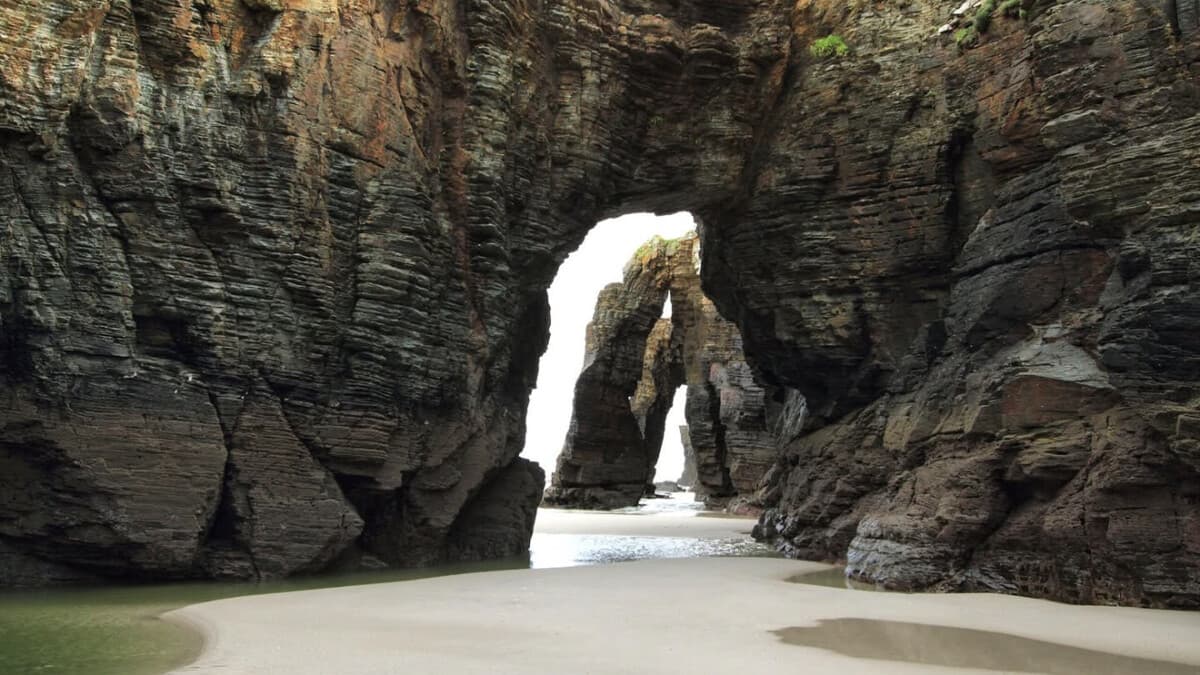
Twice a day, the Atlantic builds a cathedral, and twice a day it drowns it. Praia das Catedrais, on Galicia's north coast west of Ribadeo, keeps Spain's greatest rock architecture, buttressed arches up to 30 metres high, carved through slate and quartzite laid down around 500 million years ago, on a beach that only exists around low tide. At high water the sea runs to the cliffs and the naves are gone. No other famous beach in Spain is this literal about its opening hours.
Fame has consequences. Since the Xunta capped access, getting onto the sand in summer means a free permit, and getting anything out of the visit means reading a tide table. This guide covers both, because most of what goes wrong here, sold-out August dates, visitors arriving at high tide to find no beach, and worse, comes from planning around the wrong one.
The permit: free, capped, and gone in weeks
From 1 July to 30 September, plus Easter week, the sand is capped at 4,812 visitors a day. The permit is free and only exists on the Xunta's official site, bookable up to 30 days ahead, up to 25 people per request; you get a PDF with a QR code that wardens check against ID at the top of the stairs. August dates can sell out two to three weeks ahead, so the rule is simple: book the moment your 30-day window opens. Accessing the sand without authorisation in season risks a fine, reported to start at 600 euros.
Know what the permit is not. It does not cover the clifftop, which is free: the path and viewpoints above the arches need no booking at all. And it is not the only door: the summer shuttle bus from Ribadeo and Foz includes access with its roughly 2 euro ticket, and Ribadeo accommodation can often arrange entry for guests when the online quota is gone, so ask where you are staying.
The tide: the rule that actually matters
The arches are walkable for roughly two hours either side of low tide, and the booking site shows the low-tide time for your date, which is the single most useful piece of information in the whole process. Outside that window you are looking at the sea from a staircase.
Take the returning water seriously. It crosses the flat rock platform fast, and the eastern side floods first, creating what rescuers have called a false sense of calm on the other. Around 30 people were plucked off the rocks by lifeguards in a single incident in August 2021, a couple were airlifted from the same corner a month earlier, and a nine-year-old had to be rescued from 20 metres up a cliff in 2024. In 2018 a young woman was killed by rock falling at a cave mouth, a death for which Spain's Audiencia Nacional found the administrations partly liable in a February 2026 ruling that faulted the signage of the time. The rules that exist now, no climbing on the arches, no entering the caves, start back before the tide turns, are written in that history. Follow them and the visit is as safe as a walk gets.
What you actually see
From the bottom of the staircase, turn right and walk about 600 metres west: that is where the biggest formations stand. The sequence the sea is working through is visible all around you, fractures opened into caves, caves punched through into arches, arches collapsed into freestanding stacks, and at low tide you walk the nave floor between them with wet sand underfoot and the buttresses overhead. Photographers should chase a morning low tide, when the light rakes the rock and the day's 4,812 have not all arrived.
Be honest with yourself about two things. First, capped does not mean empty: everyone's permit funnels into the same four-hour window, and in August the famous arch gets a photo queue. Second, this is not a swimming day out: the Cantabrian averages around 19 degrees in high summer and the beach spends half its life underwater. The official name, Praia de Augas Santas, the beach of holy waters, promises more than the water temperature delivers. You come for the architecture.
Getting there, and the plan B coast
The beach sits about 10km west of Ribadeo: A-8 exit 516, then the N-634 and the signed local road to a large free car park by the stairs, full before 10am in August. Carless, the FEVE narrow-gauge line between Ribadeo and Ferrol stops at Esteiro, ten minutes' walk away, or there is the permit-included summer bus. A cafe and toilets sit up top by the parking, and wardens plus seasonal lifeguard cover watch the beach itself in summer.
If you miss the permit or the tide, the coast does not end. The same wave-carved platform runs west through As Illas and Os Castros, neighbouring beaches with arches, stacks and pools of their own, no cap, no booking, and a fraction of the people. They are the local secret hiding in plain sight of one of Spain's most regulated beaches, and on a sold-out August day they are the better visit anyway.
Is Praia das Catedrais worth it?
Yes, unambiguously, and precisely because it asks you to earn it with ten minutes of admin and one glance at a tide table. Book the permit the day your window opens, pick a morning low tide, walk right to the big arches, and be back at the stairs before the sea reclaims its church. Skip the swim, respect the rock, and if the quota beats you, take the free clifftop path and the wild sisters next door. It is the most managed beach in our guide to Spain's quietest coasts, and the one place where all that management protects something genuinely irreplaceable.