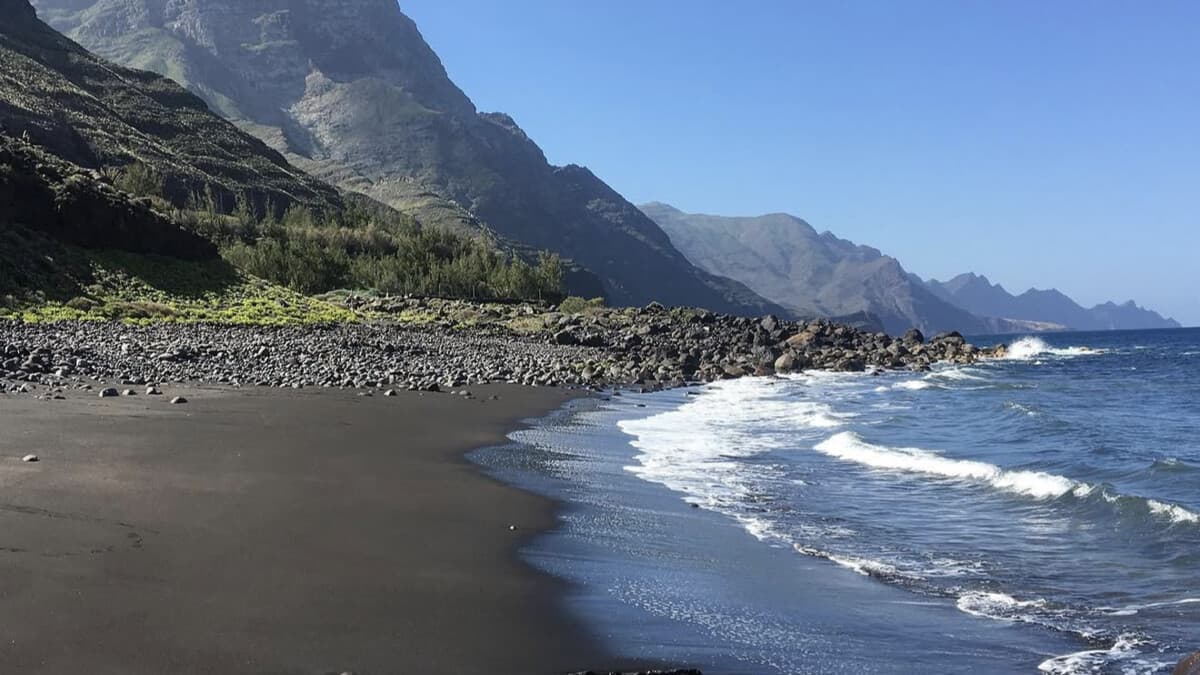
In 1481, the last native king of Gran Canaria stood before the Catholic Monarchs in Córdoba and asked to keep one piece of his island. Tenesor Semidán, baptised Fernando Guanarteme, chose the valley of Guayedra, a fold of palms and cliffs on the northwest coast where he and his followers could live on under their own customs. Stand on the beach at its mouth today, black sand, boulder banks, the Tamadaba massif rising behind and not a building in sight, and you can see exactly why this was the corner worth asking for.
Guayedra is the wildest easily-reachable beach on Gran Canaria, ten minutes from Agaete yet hidden from the road, with a dirt track, roughly four parking spaces and nothing at all waiting at the bottom. That scarcity is the whole system: the beach is never crowded because it physically cannot be. It repays the effort with drama rather than comfort, and this guide is honest about both halves of that deal.
A beach a king chose
The setting is the show. The beach sits at the seaward end of the Barranco de Guayedra inside the Tamadaba Natural Park, part of Gran Canaria's UNESCO Biosphere Reserve, with Canary palms filling the valley behind and the dark wall of the Tamadaba cliffs closing off the coast to the south. Presiding over that wall is Roque Faneque, a sea cliff just over 1,000 metres high, the highest in Europe and among the highest on Earth. Guayedra sits in its shadow rather than directly beneath the drop, and the serrated coastline running southwest from the beach explains its local nickname, the Dragon's Tail.
The valley itself is nearly empty, a handful of restored rural houses among the palms where an old farming hamlet once stood. Film scouts noticed what the king did: Netflix shot scenes for the first season of The Witcher on this sand in early 2019, the beach doubling as a wild Continent shoreline.
Getting to Playa de Guayedra
There are three ways in, and all of them are part of the filter.
By car, the turning is easy to miss by design: a discreet exit off the GC-200 coast road at about km 5.1, on the Barranco de Guayedra hairpin a few minutes southwest of Agaete, marked by nothing grander than a cluster of rubbish containers and a bus stop. From there a narrow 700-metre dirt track drops to a clearing with space for roughly four vehicles. Be straight with yourself about the track: it is unguarded, with the ravine below it, and while locals take ordinary cars down slowly, the regional tourism board suggests a 4x4. If the spaces are full, they are full; do not wedge your car into the track, because nothing about this beach forgives improvisation. From the parking, a path reaches the shore in 10 to 15 minutes.
On foot, the signed SL-1 trail leaves the GC-200/GC-172 junction on the edge of Agaete and works its way over to the beach in roughly 40 minutes to an hour, palms in the valley and the cliffs ahead, with one caveat: the big La Aldea road project is tunnelling through this coast, and walkers have reported the path closed on weekdays during works, so check locally or save the hike for a weekend. Otherwise, Global's route 101 bus, the Gáldar to La Aldea line through Agaete, stops at the Guayedra stop right by the turning, though only four or five buses pass a day, so photograph the timetable before you walk away from it.
Carry everything: water, food, shade. The nearest anything is back in Agaete or the fish restaurants of Puerto de las Nieves, and the beach has no bin, no shower, no bar and no lifeguard. Two more rules of this protected coast worth knowing: camping and fires on the beach are prohibited, whatever the odd fire ring suggests, and recreational drones are banned across this stretch of the Tamadaba park, so the sunset shot happens from the sand.
Black sand, boulders and a beach that changes shape
Guayedra is around 200 metres of black volcanic sand and stone, and it does not look the same twice. The back of the beach is coarse dark sand, then comes a belt of big rounded boulders, and at low tide a strip of fine black sand emerges at the waterline, the strip everyone comes for. The balance shifts through the year: summer builds the sand up, winter swells drag it away and leave a stonier beach behind. Come at low tide in the warm months and you get Guayedra at its best; come after a winter storm and you may find mostly boulders, which has its own severe beauty. Water shoes earn their place in your bag either way.
By long local custom this is also a naturist beach, one of the traditional nudist spots of Gran Canaria's north, though it is mixed in practice and nobody will look twice whichever way you take your sun. The far end is where naturists tend to settle. You will likely also meet the island's giant lizards patrolling the back of the beach; they are harmless and mostly interested in your fruit.
Can you swim at Guayedra?
Sometimes, and only on the sea's terms, which is more than most pages about this beach will tell you. Guayedra faces due west into the open Atlantic with no headland shelter, the waves break directly onto a steep shore, and the water moves boulders audibly when there is swell running. The official beach data lists strong waves and wind as its normal condition, there is no lifeguard, and the currents here have caused genuine emergencies, including a multi-person rescue in 2020.
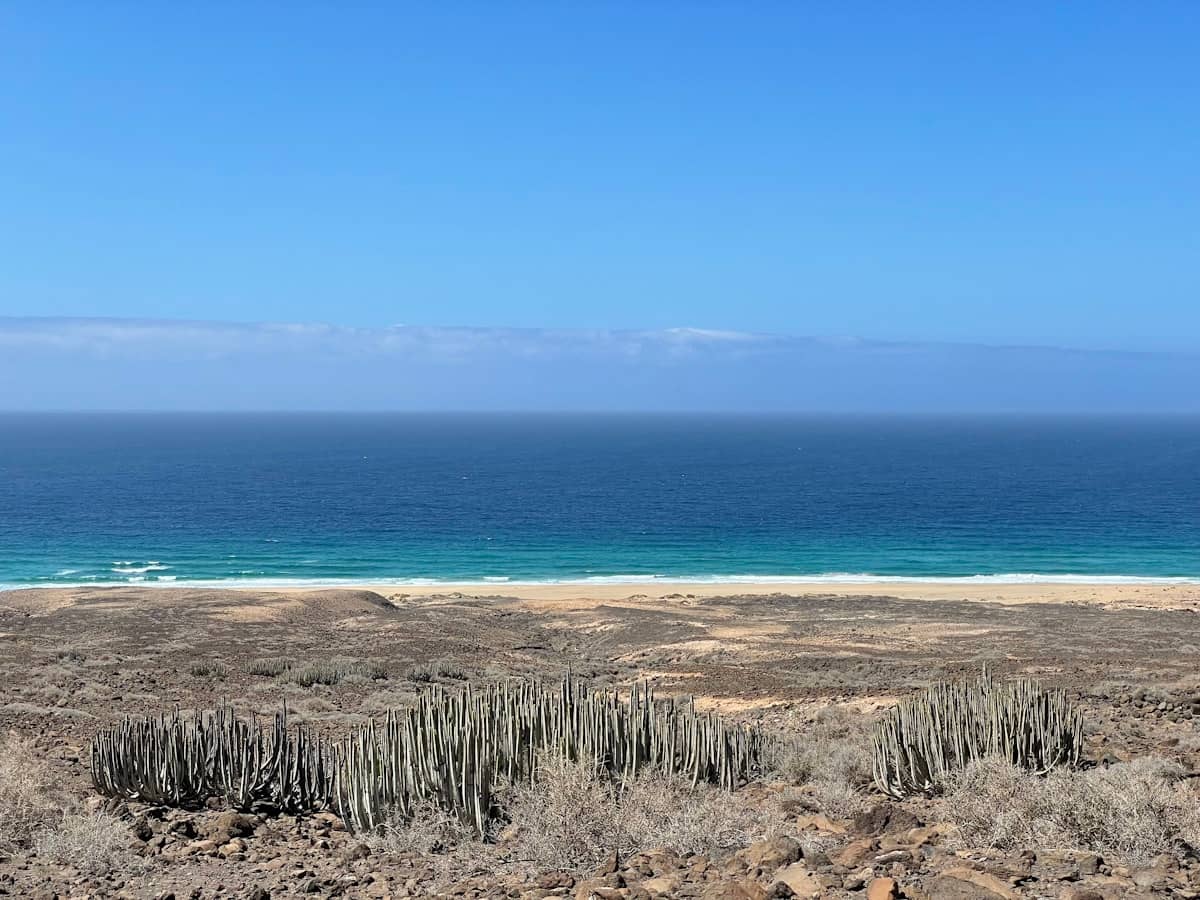
None of that means never. On a flat summer day at low tide, entering over the sandy strip rather than across the rocks, Guayedra gives you a bracing, memorable Atlantic swim. The rule is simple: check the swell forecast before you come, and if the sea is doing anything at all, make it a walking and watching day. Treat it like its Fuerteventura cousin Playa de Cofete, a beach you visit for the scenery first and the water only when it lets you.
When to go, and the sunset
The Agaete corner sits in a curious pocket of sunshine. While the trade winds pile the famous panza de burro cloud onto the rest of Gran Canaria's north coast in high summer, this stretch stays largely clear, which is why the northwest keeps a beach season at all. Late June to October is the window, and September and October are its sweet spot: sea at its warmest around 23 to 24 degrees, the summer sand still in place, the first winter swells not yet arrived.
Whenever you come, stay for the evening. Guayedra faces the sunset square on, and on a clear day the silhouette on the horizon is Tenerife, with Mount Teide rising behind the water as the sky goes orange. It is one of the best free spectacles on the island, and you will share it with a handful of people at most.
Is Guayedra worth it?
Yes, emphatically, as long as you go for what it is. Guayedra is not a swimming-pool beach and never will be: the parking is scarce, the facilities are nonexistent, the surf calls the shots and the sand comes and goes with the seasons. What it offers instead is the rarest thing on a busy island, a genuinely wild shore ten minutes from town, under Europe's highest sea cliffs, in a valley a king judged worth trading a kingdom for.
Bring water, shoes and no expectations of comfort, check the swell, arrive early or walk in, and Guayedra gives you the best of Gran Canaria's untouched northwest. For where it sits among Spain's calmest coasts, see our guide to Spain's nine quietest beaches.