Most travel articles about Waimea Beach Kauai are actually about Oahu's Waimea Bay. They have the same name, they sit in the same state, and search engines confuse them constantly. They are not the same beach. Oahu's Waimea Bay is the turquoise-water big-wave winter surf icon on the North Shore. Kauai's Waimea Beach is something completely different: a historic west-shore river-mouth bay, dark sand from red-dirt runoff, a 19th-century pier, plantation-era cottages, and the spot where Captain Cook stepped off HMS Resolution in 1778 and started the modern history of Hawaii.
You do not come to Waimea Kauai for the swim. You come for the history.
Two Different Waimeas
In Hawaiian, "Waimea" means "reddish water," and there are several Waimea places across the islands precisely because so many of them have rivers that colour their bays. The two most-confused are:
Waimea Bay (Oahu). North Shore Oahu, turquoise water, calm in summer, 30 to 40 foot winter surf. Famous for big-wave surfing. Covered in our Best Beaches in Oahu guide.
Waimea Beach (Kauai). West shore Kauai, dark sand from red-dirt runoff, historic pier, plantation town, Cook landing site. The subject of this review.
If you are coming to Hawaii for the swim or the surf and you have read about a famous Waimea, you almost certainly mean Oahu. If you are coming for west Kauai history (Waimea Canyon, the plantation era, Polihale), the Waimea on Kauai is the one you want.
Why Almost Nobody Swims Here
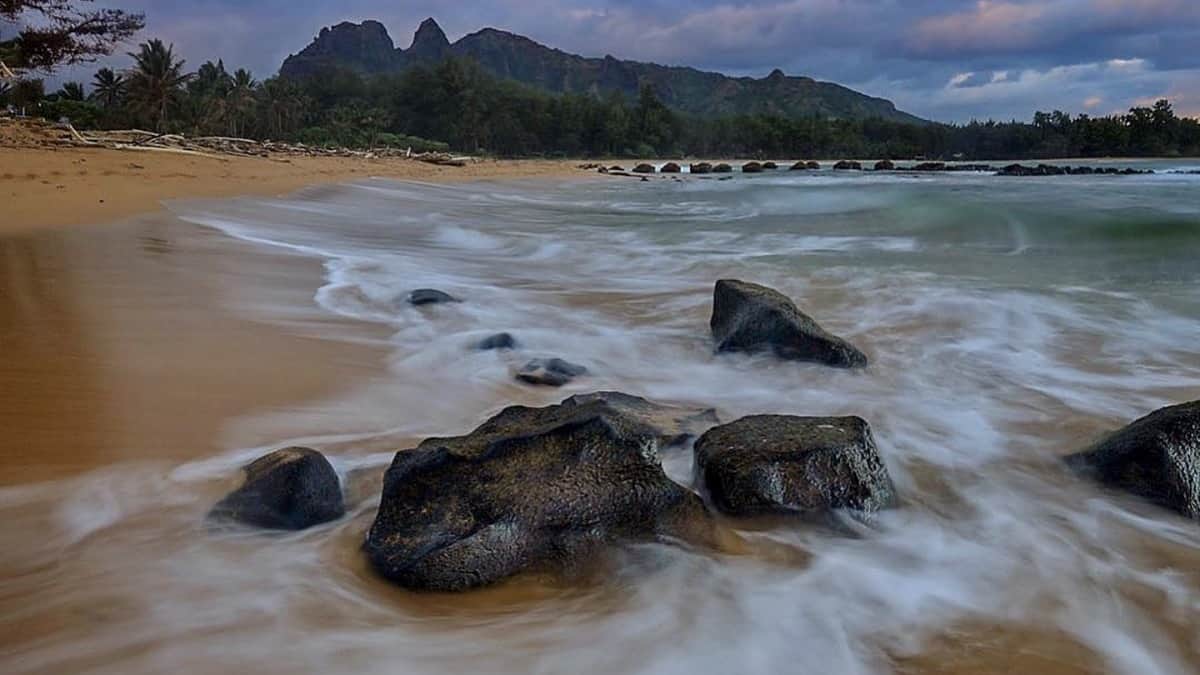
The Waimea River drains a vast watershed that includes Waimea Canyon, the "Grand Canyon of the Pacific," and the river carries down red iron-rich silt from those exposed cliffs and dumps it into the bay year-round. The result is murky reddish-brown water that does not clear up the way a typical beach river-mouth does after a rain. The discolouration is permanent.
Add in the fact that the bay has no fringing reef to break swell, the currents are strong, the shorebreak can stand up sharply on certain swells, and there is no lifeguard, and you have a beach that looks unswimmable on first arrival because it is. Local kids do swim here on calm days. Visitors almost never do. The cleaner alternatives on the west shore are Salt Pond Beach Park (10 minutes east) for the family swim and Polihale (further west) for the dramatic walk-and-sunset experience.
What Waimea is for is everything else.
Where Captain Cook Stepped Off the Resolution
On January 20, 1778, HMS Resolution and HMS Discovery anchored off the mouth of the Waimea River. A landing party went ashore. This was the first documented European contact with the Hawaiian Islands, and it set in motion the entire modern history of Hawaii: introduction of Western diseases, the eventual unification of the kingdom under Kamehameha, the missionary period, the sugar plantation era, the overthrow of the monarchy in 1893, statehood in 1959. All of it traces back to a small landing party stepping out of a longboat onto this beach.
The actual landing site is at Lucy Wright Beach Park, on the south side of the Waimea River mouth, with a historical marker on the small bluff above the sand. The marker is unassuming. There is no museum, no visitor centre, no themed experience. The bay looks today essentially as it did when Cook arrived: dark sand, brown water, mountains rising behind. Standing at the marker is one of the more genuinely thoughtful experiences available on Kauai, especially if you have read anything about the period.
The Pier and the Plantation Cottages
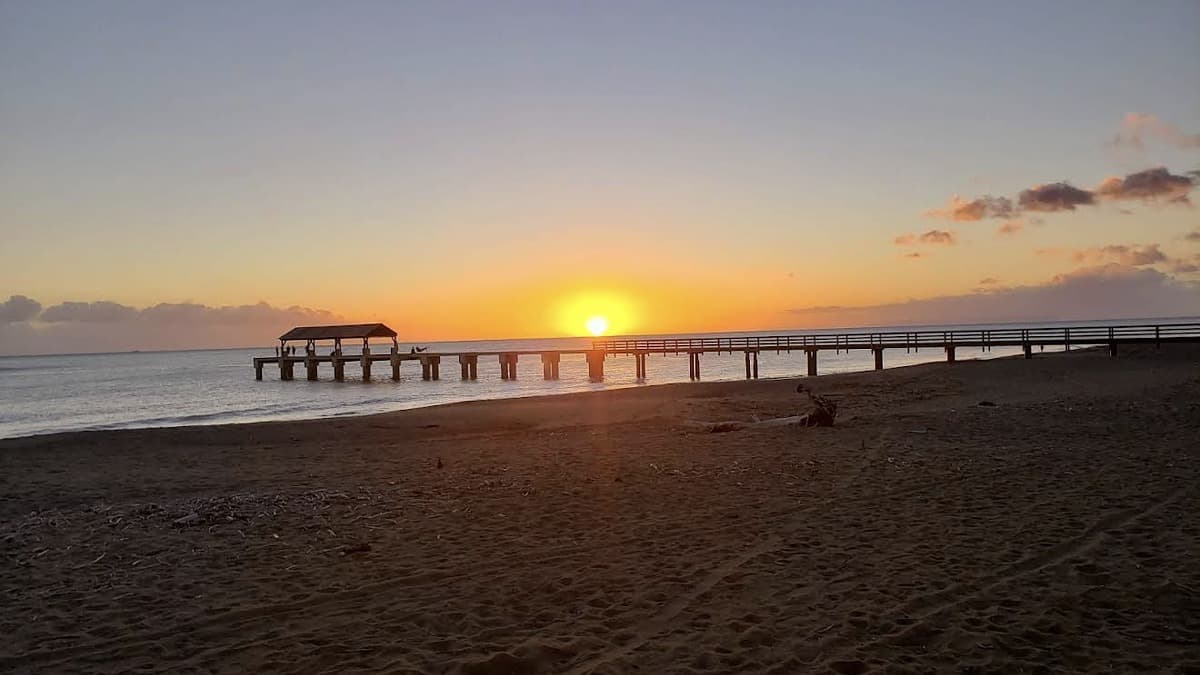
The Waimea State Recreational Pier sits on the bay just north of the river mouth, extending around 300 yards into the water on concrete and steel pilings. The pier was built for inter-island shipping in the early 20th century, when Waimea was a major sugar-plantation port. It now functions as a public fishing pier and a walking platform with views back to the town and out to the open Pacific.
Sunset from the pier is excellent. The pier faces roughly west, the Pacific drops the sun straight into the horizon, and on clear evenings the cliffs of the Na Pali coast are visible to the north. No swimming or jumping from the pier is permitted, and the rules are enforced.
Behind the dunes are the Waimea Plantation Cottages, a historic property of around 60 restored 1900s-era plantation worker cottages set under coconut palms. The cottages are simple and nostalgic and walkable to both the beach and the historic town centre. This is one of the few places in Hawaii where you can sleep in lodging that is genuinely from the plantation era, and the experience is closer to a 1920s movie set than a modern resort.
What to Actually Do Here
A morning at Waimea looks like this. Park at Lucy Wright Beach Park, walk to the historical marker, read it, walk the river-mouth area, and notice how little has changed. Drive five minutes to the pier, walk to the end, watch the local fishermen, photograph the bay. Wander into Waimea town for the historic shops and restaurants on the main street. Drive up to Waimea Canyon (45 minutes from the beach to the lookout) for the geological story behind the red dirt that colours the river.
If you are spending more than half a day in west Kauai, combine Waimea with Salt Pond Beach Park (the family swim) and Polihale (the long sunset walk), and you have used the west shore well.
Should You Visit?
Yes, but for the right reasons. Waimea Kauai is a historical and photographic beach, not a swim beach. If you arrive expecting Oahu's Waimea Bay, you will be confused. If you arrive expecting a quiet historic west-shore experience with the most significant European-contact site in the Pacific, the bay delivers exactly what you came for.
For the wider west-shore picture and the swim alternatives, see our Salt Pond Beach Park review and the Best Beaches in Kauai guide. For the Oahu Waimea Bay (which is what most people mean when they search for "Waimea Beach"), our Best Beaches in Oahu guide covers it as part of the North Shore section.