Upham Beach has a habit of disappearing and coming back. The sand runs off south every year because the beach sits on the downdrift side of Blind Pass, four rock T-groins were built to slow the loss, two hurricanes in 2024 flattened the dune line anyway, and a 125.7 million dollar county renourishment that finished in March 2026 just put the beach back to a width it has not held in years. Anyone visiting in April 2026 is walking on sand that arrived in the last six months. That comeback, plus what it means for where Upham fits on the St Pete Beach strip, is the whole story worth telling.
Where Upham Sits on the St Pete Beach Map
Upham Beach is the northern tip of Long Key, the barrier island that holds the city of St Pete Beach. Directly to the north across Blind Pass is the south end of Treasure Island, the next barrier island up. Directly to the south is several continuous miles of St Pete Beach sand that runs all the way down to Pass-a-Grille. The beach proper runs roughly from 67th to 71st Avenue along Gulf Boulevard, with the main parking lot, the Paradise Grille kiosk, restrooms, and outdoor showers clustered at the south end at 6850 Beach Plaza.
The name is not a geographic accident. It is a developer name. The Upham Company, a St Pete Beach real estate firm, built up the Corey Avenue business district in the 1930s, and the beach was formally dedicated on 13 February 1937. You will not hear many locals say the name carries any particular ceremony. Most people just call it Upham.
The usual St Pete Beach visitor drives right past Upham without stopping because Don CeSar further south gets the postcard attention. What Upham actually offers is less corporate frontage, the unusual sight of black rock fingers reaching into a pastel Gulf, and sunsets that catch those rocks in silhouette in a way no other beach on this strip does.
Why Four Giant Rock Fingers Stick Out Into the Gulf
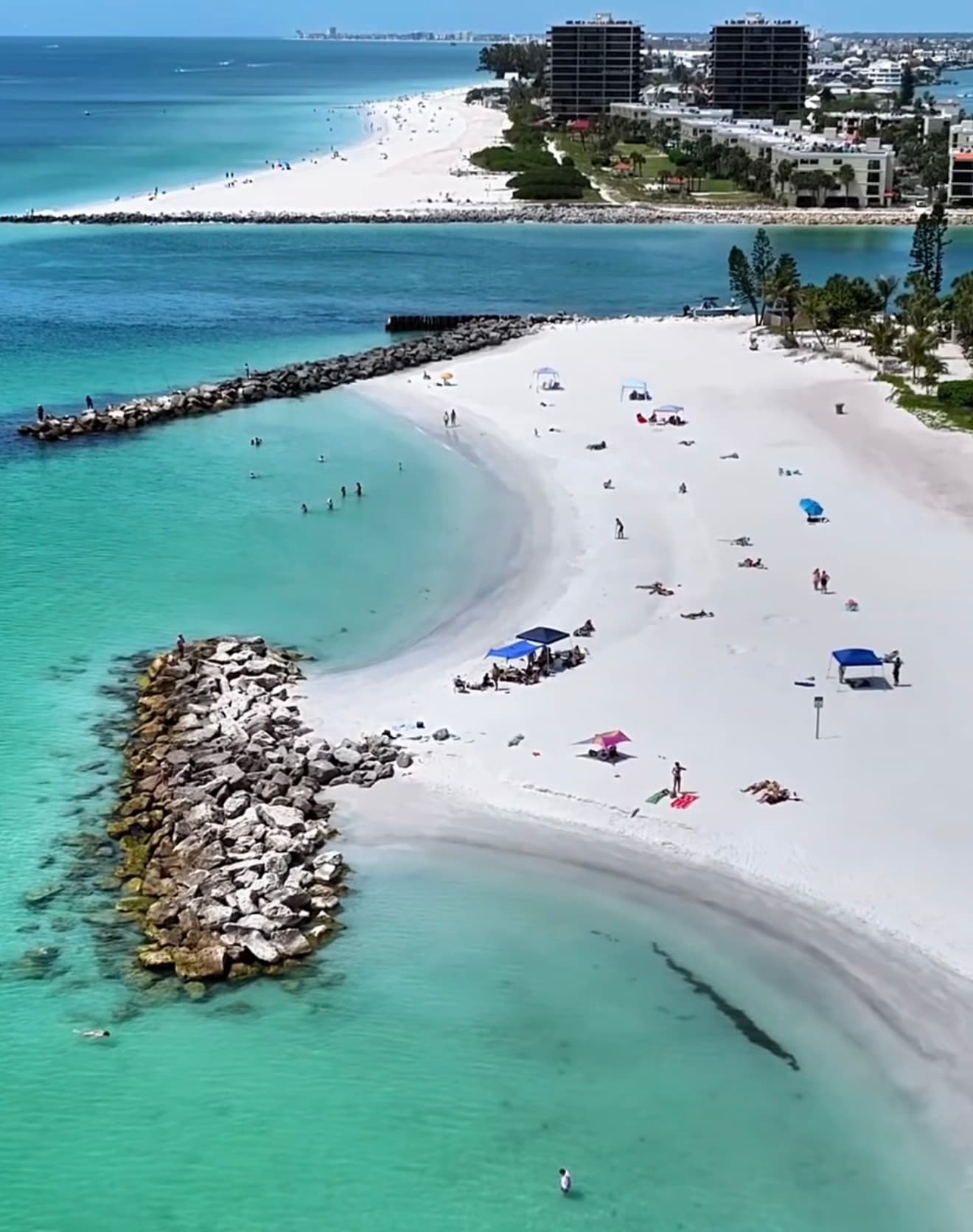
The T-groins are the thing that defines Upham visually and physically. There are four of them, finished in August 2018, built from limestone boulders, angled out perpendicular to the beach then turning at a T so the seaward end runs parallel to the shore. They are there because Upham has been losing sand at a brutal rate for decades. The tidal current pulls sand south through Blind Pass and the prevailing longshore drift keeps carrying it further south again, so the top of Long Key is permanently starved while the rest of the island accretes.
The T-groins you see now are actually the second generation. In January 2006 the city and county tried five sand-filled geotextile tubes, the cheaper temporary version. They slowed erosion but failed structurally and aesthetically (black seaweed-covered tubes are not a beach postcard). In 2018 a roughly 9.5 million dollar project replaced them with four permanent rock T-groins. The spacing between them catches fresh sand from renourishment projects and holds it longer than a flat beach would. That is the purpose. Not aesthetic. Not wave protection for swimmers (though the current breaks are real). Engineered coastal accounting.
After Helene, the T-groins were partially buried by displaced sand and debris but remained intact. They are the reason Upham still has a beach after two cat-3 storms in two weeks.
The 2024 Hurricanes and the $125M Comeback
Helene made landfall in the Big Bend on 26 September 2024 and pushed catastrophic storm surge into the Pinellas barrier islands, flattening most dunes along St Pete Beach. Milton landed near Siesta Key on 9 October 2024 and completed what Helene started. Upham Beach lost most of its remaining dune, large parts of its berm, and many of its sand-access paths. Paradise Grille's Pass-a-Grille location did not reopen until 31 January 2025, 122 days after Helene. The Don CeSar began its phased reopening on 26 March 2025 and was not fully operational until September.
The rebuild took all of 2025. Pinellas County announced a 125.7 million dollar emergency renourishment covering Upham, Sand Key, and most of the county's Gulf-facing sand, funded almost entirely by local Tourist Development (bed) Tax dollars plus around 11 to 13 million dollars in state grants. The US Army Corps of Engineers was not part of the funding because federal rules require uniform beach-access easements from every private parcel, and a small group of beachfront owners blocked that years ago. The project would have waited otherwise, so the county paid for it itself.
Construction began on 12 September 2025. Roughly 2.5 million cubic yards of offshore sand were pumped and graded across nine to twelve miles of Pinellas coast, with Upham's share somewhere around 66,000 cubic yards. The work wrapped in March 2026. The beach you see now is visibly wider between the T-groins than it has been at any point since 2020.
Swimming, Red Tide, and the Gulf Reality
The Gulf of Mexico at St Pete Beach is warm, shallow, and forgiving. Water temperatures run from roughly 64 F in January to the mid 80s in August, the bottom shelves gently for a hundred yards before any real depth, and the T-groins actively reduce longshore current in the swimming zone. No lifeguards. No riptide history to speak of at Upham specifically.
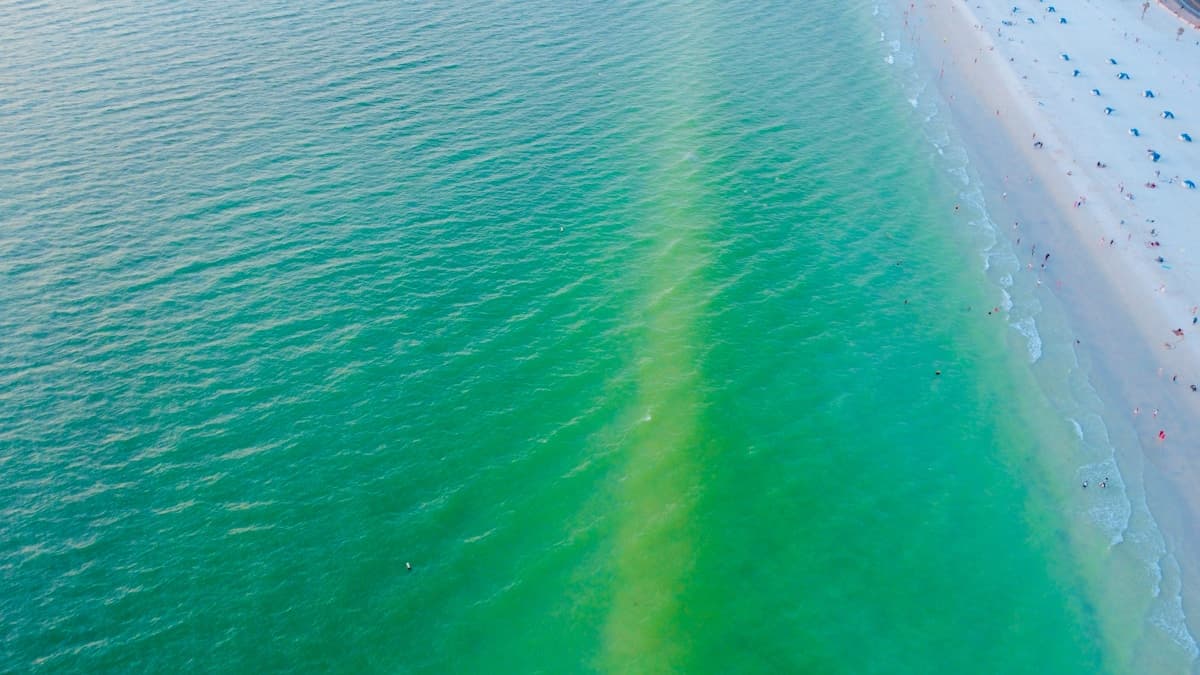
The actual Gulf variable worth checking is red tide. Karenia brevis blooms are a recurring southwest Florida event, most common between late summer and late fall, and while they originate further south the northward drift occasionally puts Pinellas waters into advisory. The February 2025 bloom did drift up the coast before dissipating. The 2026 season forecast from FWC and Mote Marine is the live answer. Before a swim visit, check current-conditions reports from the Florida Fish and Wildlife Conservation Commission rather than assuming. A green Gulf does not mean a clean one.
The water clarity at Upham is green-turquoise rather than blue. It is not the Florida Keys and it is not Destin. The sand is pale and soft but finer-grained than the sugar powder up in the Panhandle. Different beach character. Easier to reach from Tampa.
Parking, Paradise Grille, and What's Actually Open
The main Upham lot at Beach Plaza has 183 metered spaces at 3.25 USD per hour, enforced 8am to 8pm, paid at meters or via ParkMobile Zone 4412. Reports of a 15 USD daily cap circulate but on-site signage is the controlling answer. Arrival before 10am or after 4pm is the way to avoid circling. The lot fills on March and April weekends.
Paradise Grille is the food option on the beach itself. Open-air, ordering at a window, picnic-table seating on the sand, burgers and fish sandwiches. Simple and overpriced, which is beach food everywhere.
Outdoor freshwater showers and public restrooms sit at the main access point. A wide concrete ramp provides wheelchair access down to the sand, and beach wheelchair loans are available through City of St Pete Beach. There are no umbrella rentals on the beach; bring your own or walk south to one of the resort frontages. No alcohol on the sand, which is enforced during spring break.
Dogs are not allowed on the sand at Upham or anywhere else on St Pete Beach's Gulf frontage. The only dog beach in the city is on the Bay side at the south end of Pass-a-Grille Way.
Is Upham Beach Worth It in 2026?
Yes, more than most years. The renourishment that finished in March 2026 gave Upham the widest beach it has held since the mid-2010s, and the T-groins that make the place structurally unusual also make it photographically distinct. Come for the sunset, come for the fresh sand, come for a swim that is calmer than Treasure Island or Pass-a-Grille on the same day. Do not come expecting Keys-clear water. Check red tide before you drive. Pay the meter. Skip the dog. And understand that the beach you are walking on in spring 2026 is the product of a 125.7 million dollar bet by Pinellas County that the Gulf is worth keeping wider than nature would leave it. Upham is the Florida beach that keeps coming back because someone keeps paying to bring it back, and that is its own kind of coastal story.