La Oliva, the council that runs Corralejo, El Cotillo, the Corralejo dunes and Isla de Lobos, gave initial approval on Thursday 29 October 2026 to a tourist tax of €0.56 per person per night (Diario de Fuerteventura, 30 October 2026). It would apply to all tourist accommodation in the municipality, holiday lets included, but it is not in force yet and "no date has been confirmed for when visitors would start paying" (Canarian Weekly).
In other words, the Fuerteventura tourist tax is a La Oliva tax, on nights spent in La Oliva, and nobody pays it today. Below: what it would cost per stay, who is exempt, which resorts fall inside the boundary and which don't, and the steps left before it can be charged. Checked November 2026.
Is there a tourist tax in Fuerteventura? Only in La Oliva, and not yet
On 3 November 2026 no Fuerteventura council was charging visitors a nightly tax. La Oliva's vote is the first step towards one. Its Spanish name is the tasa turística, formally a "fee for services and activities arising from tourism and the duty of sustainability" (Diario de Fuerteventura).
Councillors split along party lines. Coalición Canaria and PSOE, which govern La Oliva, voted for it, joined by Nueva Canarias councillor Oliver González. Partido Popular voted against and En Marcha abstained (Canarias7, 30 October 2026). PP councillors had asked for the item to be shelved, citing an unfavourable report from the municipal treasurer.
Pages that still say "Fuerteventura has no tourist tax" are right for now, and will be wrong for Corralejo and El Cotillo stays if the ordinance clears its final vote.
€0.56 per person per night: what a Corralejo stay would cost
There is one flat rate, the same €0.56 "regardless of the price of the accommodation", whether that is a studio above a Corralejo bar or a hotel on the Grandes Playas (Diario de Fuerteventura). That makes the sum simple: people who pay, times nights, times €0.56.
| Who is staying | Nights | People who pay | Tax for the stay (€) |
|---|---|---|---|
| Solo traveller | 3 | 1 | 1.68 |
| Couple | 7 | 2 | 7.84 |
| Couple | 14 | 2 | 15.68 |
| 2 adults, children aged 5 and 8 | 7 | 4 | 15.68 |
| 2 adults, children aged 5 and 2 | 7 | 3 | 11.76 |
| 2 adults, children aged 5 and 8 | 14 | 4 | 31.36 |
In the fifth row, the two-year-old is exempt. Under-3s are the only age exemption in the published summaries of the ordinance, and they list no reduced child rate, so a five-year-old pays the same as a parent.
Who is exempt, and who collects it
Two groups are exempt, according to the ordinance as reported by Diario de Fuerteventura and Canarias7:
- Children under three.
- Residents of La Oliva, who must show a residence certificate.
Neither report mentions any other exemption, for example for residents of other Canary municipalities. Until the initial approval appears in the provincial bulletin, the full ordinance text is not public, so check it before assuming a discount.
Every establishment and home registered for tourist use under Canarian law falls under it, holiday lets included. Owners or operators collect it at any point before your stay ends and keep a record of taxable nights and exemptions. They pay the council twice a year: between 1 and 20 April for stays from October to March, and between 1 and 20 October for stays from April to September (Diario de Fuerteventura).
On a package holiday, expect your hotel or host to ask for it, not your tour operator. Jet2's in-resort fees page says local charges of this kind are paid at the accommodation and are not included in the package price. On 3 November 2026 that page had no La Oliva entry, which fits a tax that does not exist yet.
Which Fuerteventura resorts are inside La Oliva
La Oliva covers the north of the island, including the Parque Natural de las Dunas de Corralejo, which runs from Puerto Remedios beach in Corralejo south to the Montaña Roja volcanic cone (Spain's official tourism site). Everything south of the municipal boundary is outside this ordinance. Municipalities in the table come from the 2025 INE population nomenclátor, Spain's official list of settlements. Cofete and the Sotavento beaches are not settlements in that list. Cofete lies inside the Jandía Natural Park, which is in Pájara (Hello Canary Islands, the Canary government's tourism site), and Sotavento runs south from Costa Calma on the same Pájara coast.
| Resort or beach base | Municipality | Covered by La Oliva's tax? |
|---|---|---|
| Corralejo town and the Grandes Playas | La Oliva | Yes |
| El Cotillo, La Concha and Los Lagos | La Oliva | Yes |
| Lajares, Majanicho, Parque Holandés | La Oliva | Yes |
| Isla de Lobos | La Oliva | Day visits are not taxed |
| Puerto del Rosario | Puerto del Rosario | No |
| Caleta de Fuste | Antigua | No |
| Las Playitas, Gran Tarajal | Tuineje | No |
| Costa Calma, Sotavento, Morro Jable, Cofete | Pájara | No |
Corralejo and the Grandes Playas
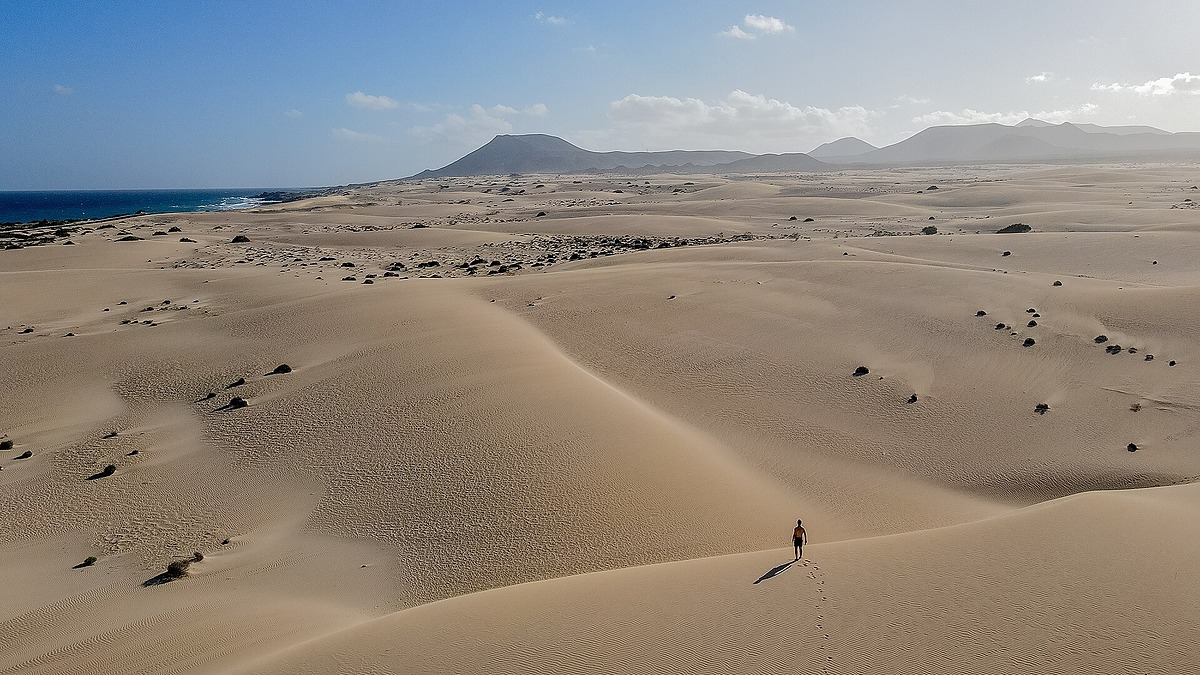
South of Corralejo town, the Grandes Playas are the long run of sand where the dune park meets the sea, with Lobos and Lanzarote across the strait. In all, the park covers 2,668.7 hectares (spain.info). Come here for space and a classic sand beach within 10 minutes' drive of restaurants. Because the beaches face the northeast trade winds, a windbreak is close to essential in summer. Our Corralejo dunes section in the Fuerteventura hub covers Flag Beach and the quieter stretches further south. Hotels on the dunes and holiday lets in town would both charge the €0.56.
El Cotillo and La Concha

El Cotillo, on the northwest coast, is La Oliva's second resort. La Concha and the Los Lagos coves, just north of the village on the road to the Tostón lighthouse, have calm, shallow pools behind a volcanic reef, the best water for young children in the north. Our El Cotillo lagoons entry in the Fuerteventura beaches guide covers them in more detail. Smaller and quieter than Corralejo, the village would still have every tourist bed under the tax.
Day trips to the Corralejo dunes stay free
La Oliva's charge falls only on visitors who spend the night in one of its tourist establishments (Diario de Fuerteventura). There is no entry charge on the beaches or the dune park in the ordinance. Someone sleeping in Caleta de Fuste or Costa Calma who drives up for a day on the Grandes Playas or the El Cotillo lagoons pays nothing extra.
Isla de Lobos, reached by boat from Corralejo harbour, is untaxed too. Lobos has its own rule, unrelated to the tax: you must request an authorisation from the Cabildo de Fuerteventura, the island government, before landing. Requests go through its online LobosPass system, and when the system began in January 2019 the Cabildo set the limit at 200 visitors on the islet at a time, in a morning and an afternoon shift (Cabildo de Fuerteventura). Both were still in place in July 2026 (El Español). Sort the authorisation before the day you sail. Checked November 2026.
Pick a base for the beaches and the wind, not to dodge €7.84. The north suits people who want the dunes, Lobos and El Cotillo's sheltered pools on the doorstep. Kitesurfers are better off in the south.
Playa de Sotavento: the southern base outside the tax
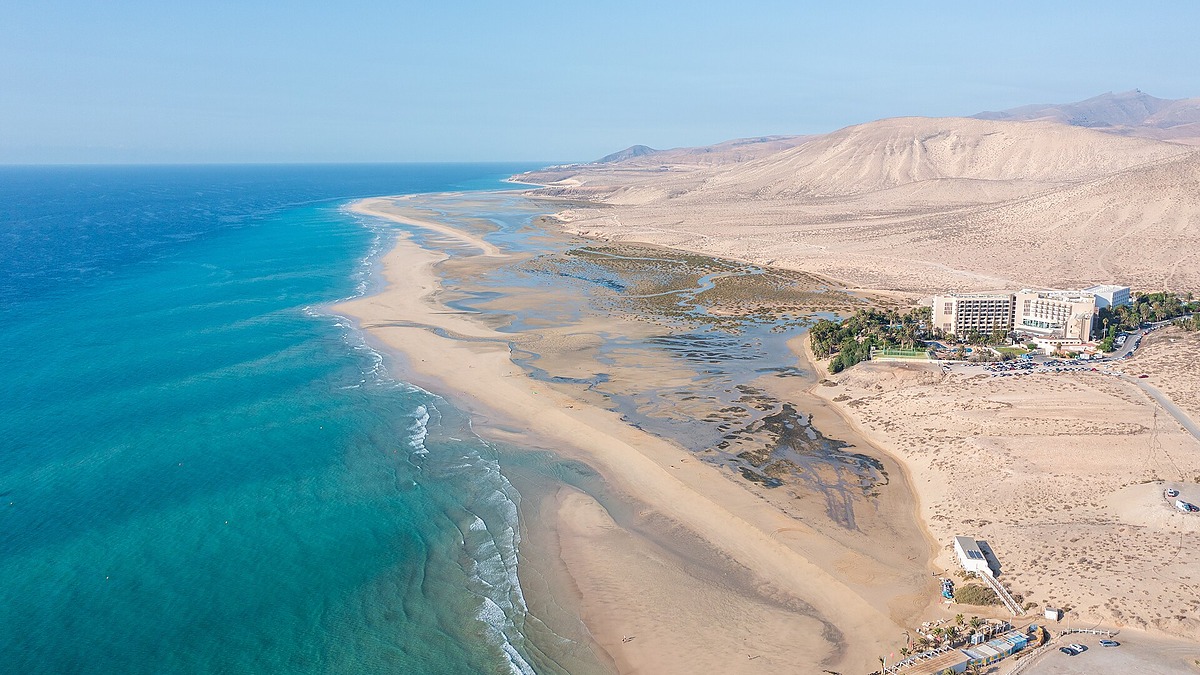
Playa de Sotavento, on the Jandía coast in Pájara, is the obvious comparison. Its long run of sand forms a shallow lagoon behind a sandbar at low tide, and Playa Barca on this stretch hosts the Fuerteventura Windsurf and Wingfoil World Cup each summer, held from 17 July to 1 August in 2026 (event organisers). Nights in Costa Calma or the Sotavento hotels carry no La Oliva charge. Wind that makes it great for kites also makes it a poor place to lie on a towel. Further south, Playa de Cofete, reached by a dirt track from Morro Jable, is also in Pájara.
When could it start? 30 business days, then a likely court fight
No start date has been confirmed by the council or reported by any of the outlets covering the vote, and none of them reported the notice as published in the provincial bulletin by 3 November 2026. Checked November 2026. Diario de Fuerteventura sets out the remaining steps:
- La Oliva publishes the initial approval in the Boletín Oficial de la Provincia de Las Palmas and on the council noticeboard.
- Anyone with an interest gets 30 business days to lodge objections.
- If objections arrive, the council reviews them and the full council votes on final approval. If none arrive, the ordinance becomes final without another vote.
- Only once final approval is published does the tax take effect.
Objections look likely. Asofuer, the Fuerteventura tourism business association, rejects the charge. Its president, Antonio Hormiga, said the association would defend its position through administrative and judicial routes (Canarias7). As Hormiga put it: "A tax does not become a fee by changing its name." In a statement reported by Tourinews on 2 November 2026, Asofuer cited "serious doubts" over legality and asked the council to open talks on legally sounder alternatives (Tourinews).
La Oliva's own treasury agrees. Its report, cited by the PP, concludes that charging for overnight stays is legally an impuesto (a tax), which a town council has no power to create, rather than a tasa (a fee for a service) (Canarias7). Against that, the council's legal report argues the reverse: that what is charged for is the provision of services, even though it is billed per night (Diario de Fuerteventura).
What happened to Mogán's tourist tax
That tasa-versus-impuesto argument has already lost one Canarian council a court case. Mogán, in southwest Gran Canaria, charges €0.15 per person per night (RTVC, 13 July 2026). Upholding a challenge from the Las Palmas hotel and tourism federation, FEHT, the Canary Islands High Court (TSJC) declared the ordinance null. Judges voted on 28 May 2026 and the judgment is dated 9 July (Canarias7, 13 July 2026). It was made public on Monday 13 July 2026 (RTVC).
In the court's view, the services the money paid for were described in "ambiguous, imprecise, generic" terms, and the council had turned a fee into a disguised tax. It ordered Mogán to pay up to €3,000 in costs (RTVC). None of this is final yet. Mogán's mayor said the council would take it to the Supreme Court, and the tax stays in force until the case is settled, with the money already collected frozen (Fuerteventura Digital, 15 July 2026). Jet2's in-resort fees page still lists the €0.15 Mogán charge, payable at the hotel. Checked November 2026.
La Oliva's text reads like a response to that judgment. It names what the money funds: beach lifeguards and surveillance, beach signage, cleaning and sanitation, water supply, emergency services, upkeep of parks and green areas, replacement of infrastructure, and sports and cultural events (Canarias7). Whether that list is specific enough is the question a court would be asked.
Canary Islands tourist tax: no regional charge
No regional tax covers all the islands. Regional president Fernando Clavijo rejected a Canary-wide tourist tax again in the regional parliament in September 2025, arguing it would widen the gap between busy and quiet islands (Canarias Ahora). Tenerife has charged Teide trail fees since 19 January 2026, such as €15 for visitors from outside the Canaries on the Telesforo Bravo summit path between 9am and 5pm, but these are hiking access fees, not a charge on your hotel night (RTVC, January 2026). For the charges in Venice, Amsterdam and the Balearics, see our guide to Europe's beach rules, caps and tourist taxes.
If you are booking Corralejo or El Cotillo for 2027, budget €0.56 per person per night, ask your host whether they will collect it, and check back here: the BOP publication date will set the earliest point at which it could apply.