
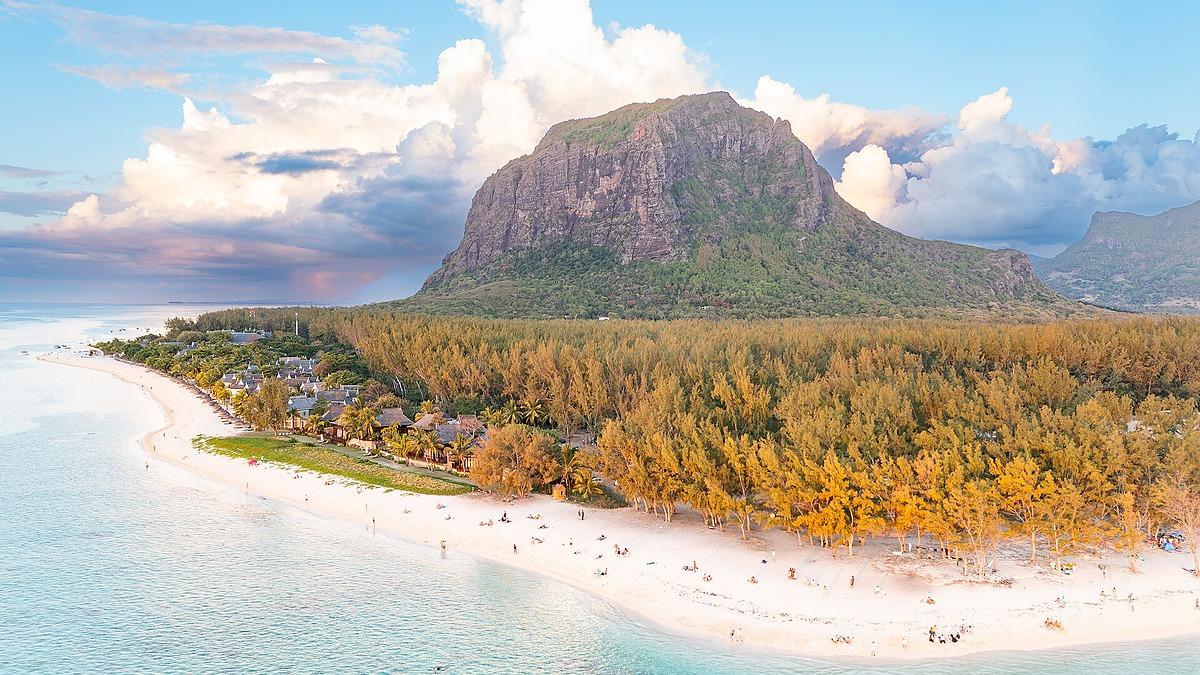
Le Morne Beach wraps around the peninsula at the south-west tip of Mauritius, below the rock wall of Le Morne Brabant, and The World's 50 Best Beaches ranks it 40th in the world for 2026. Resorts front most of the sand, so a visit depends on finding the public stretch between the Dinarobin and LUX* Le Morne hotels, which has free parking, toilets and a restaurant. Come early: from May to October the trade wind builds after a lighter morning and fills the lagoon with kites.
What Le Morne Beach is like
The sand curves around a flat peninsula, with the mountain, a UNESCO World Heritage Site, rising directly behind it to the east. On the west side a wide, shallow lagoon runs out to the reef; the south side faces the kite lagoon and the reef break called One Eye. Filao trees, a kind of casuarina, shade the back of the beach. According to The World's 50 Best Beaches, the water is easy to enter and sandy-bottomed, with calm, clear areas for swimming and snorkelling. There is coral on the bottom in places, though, so read the note on water shoes below.
Is Le Morne Beach public? Where the free stretch is
No beach in Mauritius is private. As Expat.com's guide to the beach laws explains, the sand between the high- and low-water marks belongs to the State and must stay open to everyone. Hotels lease the land above it, but you can walk the shore in front of any of them. The sand between the tide lines is public everywhere; the hotel sunbeds are not.
The Beach Authority's list of proclaimed public beaches includes two sizeable ones on the peninsula: "Le Morne", with about 500m of sea frontage, and "Le Morne Brabant (Pointe Sud Ouest)", about 1,000m at the south-west point. Checked November 2026.
- Main public beach: on the west side, between Dinarobin and LUX* Le Morne, with the car park, public toilets and Emba Filao restaurant.
- La Pointe: the south-west tip, between the St Regis and Riu Palace hotels, facing One Eye. The Beach Authority gives it the longer frontage of the two, but Lonely Planet describes it as a narrow sliver of sand with very little space, especially at weekends. It suits kite-watching more than a beach day.
From north to south the hotels are Paradis Beachcomber, Dinarobin, LUX* Le Morne, the St Regis Le Morne at the south-west corner, then the Riu Palace and Riu Turquoise by the kite lagoon. Some maps still show the St Regis as the JW Marriott Mauritius, its name from 2021 until May 2025.
How to get to Le Morne Beach
Le Morne Road (the B113) leaves the coastal road between La Gaulette and Le Morne village and, on OpenStreetMap's route, runs about 4km west along the foot of the mountain to the public beach. Le Morne is about 56km from the airport (roughly an hour's drive), 32km from Flic en Flac and 13km from Chamarel.
Parking at Le Morne public beach
The free car park is right behind the public beach. Arrive early at weekends, the busiest days. Kiters park on grass under the filaos behind the kite lagoon, according to the Kite in Moris spot guide.
By bus or taxi
Routes 5 (from Quatre Bornes) and 120 (from Port Louis) both run to Baie du Cap via Le Morne, according to the National Land Transport Authority. They stop at "Le Morne (Hotel Junction)", where the B113 begins, about 4km (50 minutes on foot) from the public beach. Some buses are listed as calling at Le Paradis hotel, which shortens the walk, so ask the driver.
The authority's published timetable dates from 2011 and shows route 5's last bus leaving Baie du Cap at 2.30pm, so don't count on a bus back after sunset. Checked November 2026. Without a car, take a taxi and agree the fare and pick-up time in advance.
Swimming, snorkelling and the kite zones
The lagoon off the public beach is shallow and calm, and best in the morning, when the Sportif kite guide says the wind tends to be lighter. Snorkelling is gentle rather than spectacular, over sand and scattered coral.
Wear water shoes: the Kite in Moris spot guides warn of coral, sea urchins and the rare stonefish on the bottom. They put the water at about 23°C in winter and 28 to 30°C in summer. Swimmers need to know the two kite zones:
- Kite Lagoon: on the south side, where the road ends at the Riu hotels. It is 50cm to 1.5m deep depending on the tide, hosts most beginner lessons and gets crowded.
- One Eye: a powerful reef break on the outer reef off La Pointe, for expert riders only, and unsupervised, Kite in Moris says.
Swimmers should keep out of the launch zones and away from the reef. At high tide, the kite lagoon guide warns, it is harder to stand in the lagoon and currents can sometimes be quite strong. No official source lists lifeguard cover at Le Morne, so don't count on one and keep a close eye on children. Checked November 2026.
When to visit Le Morne Beach
The Mauritius Meteorological Services (MMS) defines summer as November to April and the official cyclone season as 1 November to 15 May. Its outlook for summer 2026-27 expects five to seven named storms in the south-west Indian Ocean and below-normal rain. Temperatures should run above normal, up to about 36°C on the western coasts on some days, with long humid spells and light wind from December to March.
| Months | Weather | Wind | Best for |
|---|---|---|---|
| November to April | Hot and humid; wettest in February and March; cyclone risk | Easing in November; lighter and less reliable from December | Calm swims, early or late |
| May and October | Transition months; October is the driest | Trades building or easing | Swimming and kiting |
| June to September | Cooler and drier; sea about 23°C | Strongest, steadiest trades | Kiting; swim in the morning |
Weekdays are quieter than weekends all year, and World Beach Guide finds the beach quietest before 11am.
The beach faces west, into the sunset: MMS tables put it at about 6.25pm in mid-November and 6.50pm by late December.
Food, toilets and shade
Emba Filao, a restaurant on the public stretch, is the lunch stop, and the public toilets are close to LUX* Le Morne. Kite in Moris says a food truck parks on the public beach at lunchtime almost all year. At the kite lagoon the schools rent gear, but there is usually nothing to eat or drink, so stock up in La Gaulette first. Shade comes only from the filaos at the back of the beach, so bring an umbrella in summer.
Near Le Morne: the mountain trail and the underwater waterfall
According to the Le Morne Heritage Trust Fund's visitor information, the mountain trail is open 7am to 4pm daily, with the last start at 2.30pm. An easy first section climbs 2.53km to a plateau at 260m. Above it, the steep gully to the metal cross needs a signed liability form, and the trust recommends a qualified guide. The trail closes in heavy rain warnings and from cyclone warning class II. Checked November 2026.
Offshore, the underwater waterfall is an optical illusion of sand pouring off a drop in the seabed, visible only from the air. Seaplane flights leave from La Prairie beach, a short drive east.
Is Le Morne Beach worth it?
Yes, if you are staying on the south-west coast, if you kite, or if you want a sunset over the sea with a mountain at your back. Families get a calm, shallow lagoon in the morning, as long as everyone wears water shoes. Skip it if you want reef snorkelling or an empty beach at the weekend. Without a car, book a taxi both ways rather than relying on the bus.
From the north coast, do it differently: Grand Baie is about 70km away, so come on a weekday and arrive early. If you are choosing between Indian Ocean islands, our Anse Source d'Argent review covers the Seychelles beach ranked higher on the World's 50 Best Beaches list; Le Morne is free and easier to reach.
Best plan in kite season: a weekday between May and October, the public car park by 9am, a swim before the wind picks up, lunch at Emba Filao, then the kiters on the lagoon in the afternoon.