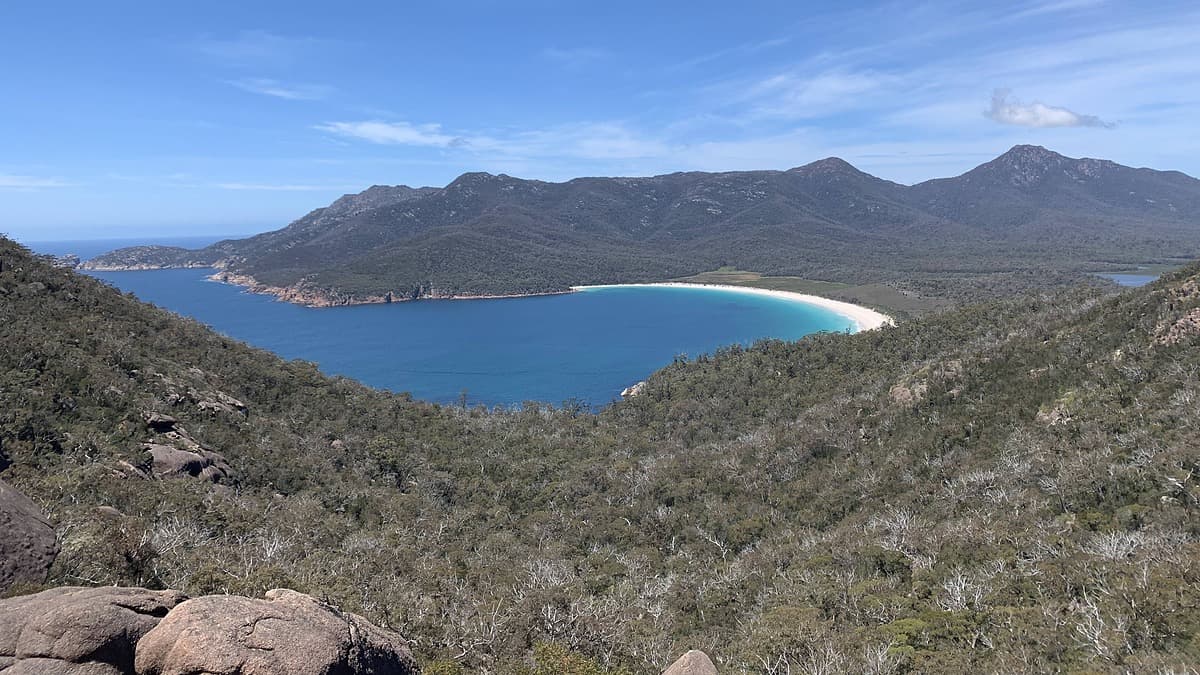
Seen from the saddle above it, Wineglass Bay is one clean curve: 1.7km of white sand swinging between two granite ranges on Tasmania's east coast, backed by nothing but a low, scrubby dune. Surf Life Saving Australia calls it the most photographed beach in Tasmania, yet no road comes near it. The tarmac stops at a car park in Freycinet National Park. The rest is on foot: a steep 1.3km climb to the lookout, then roughly 1,000 stairs down the far side to the sand.
What you're really choosing is how far to walk. The famous view costs a steep hour or so on foot. The sand costs another 1,000 stairs down, and the same stairs back up. If climbing is out, a day cruise from Coles Bay shows you the bay from the water. Walk in, or take the water taxi, and you'll need a Tasmanian parks pass, AUD 49.15 per car for 24 hours; the cruise needs none.
| How | Distance and time | Cost | Best for |
|---|---|---|---|
| Lookout | 2.6km return, 1 to 1.5 hrs | Parks pass | Anyone fit enough for a steep track |
| Lookout and beach | 6km return, 2.5 to 3.5 hrs | Parks pass | Fit walkers with half a day |
| Water taxi to Hazards Beach | Boat, then 2km across the isthmus | AUD 130 return, plus parks pass | The sand, minus the stairs |
| Day cruise from Coles Bay | 9.45am to 2.30pm | From AUD 190 | Anyone who can't climb |
How the bay got its shape, and maybe its name
Freycinet is, in the parks service's words, two eroded blocks of granite, tied together by sand: the Hazards to the north, Mount Graham and Mount Freycinet to the south. Wineglass Bay is the eastern shore of that sandy neck. Hazards Beach is the western one, on the far side of an isthmus 1.5km wide. The pink in the Hazards comes from feldspar in the granite, and the bright orange on many shoreline boulders is lichen.
The name is harder to pin down. Up to nine whaling stations worked the peninsula and nearby islands, one of them at Wineglass Bay, and Australian Geographic says the bay "at times ran foul with blood". The popular story is that the red water, like wine in a glass, gave it the name, but no record we found links the two. The plainer explanation is the outline you see from the saddle, which is where every visit starts.
The lookout walk: 1.3km uphill
The track climbs through coastal woodland and past big granite boulders, with seats along the way. It's Grade 3, steep and rough with plenty of steps, and Parks and Wildlife says it isn't suitable for anyone with health issues or restricted mobility. At the top, the whole arc of the bay is laid out below the platforms, the southern peaks behind it. Stay behind the barriers: the edges are cliffs.
This is also where the crowds gather. In the summer holidays, Parks and Wildlife has asked visitors to arrive outside the 11am to 3pm peak, and Discover Tasmania recommends early morning or afternoon whatever the season.
For a higher view, Mount Amos, which starts from the same car park, climbs one of the Hazards: 3.6km and about 3 hours return, graded 4, over granite slabs that are extremely dangerous when wet. Save it for a dry day, and leave young children at home. From the saddle, the only way on is down: the stairs drop into the bush towards the beach.
About 1,000 stairs, down and back up
The stairs run from the saddle to the sand, and every one has to be climbed again on the way back. Parks and Wildlife calls it quite a workout and recommends walking boots.
The beach is steep and white, and the water deepens quickly. Walk 20 minutes to the southern end for the view the lookout can't give you: the Hazards rising behind the full length of the beach. There's a composting toilet and nothing else, so carry in your water and carry your rubbish out. Behind the dune is a small walk-in campsite: free, no booking, tents and fuel stoves only.
Strong walkers can keep going on the 11km Hazards Beach circuit. It's a Grade 4 loop of 4 to 5 hours, and Parks and Wildlife admits the inland leg round Mount Mayson "can feel longer than it should". For everyone else, the question at the bottom of the stairs is whether to get in.
Swimming at Wineglass Bay: unpatrolled and cool
You can swim, but nobody is watching. Surf Life Saving Australia gives the beach a hazard rating of 3 on its 1-to-10 scale, where 1 is least hazardous, and its waves usually run 0.5 to 1m, easing towards the sheltered southern corner. What surprises people is the slope: the beach shelves steeply with no sandbar, so the water is deep close to shore. Keep children within reach.
The water is cool: Surf Life Saving's live reading in early November 2026 was about 15°C. Expect a bracing dip, not a long swim.
Wallabies, sea eagles and the whale months
Parks and Wildlife says Bennett's wallabies, pademelons and echidnas are commonly seen in the park, and from the lookout you may spot white-bellied sea eagles overhead or gannets diving. Don't feed anything: processed food can give wallabies a jaw disease that kills them slowly.
Whales pass in two windows. Humpbacks and southern right whales migrate between May and July and again from September to December, according to the cruise operator, and whales and dolphins sometimes come into the bay. On land, whales, seals and dolphins have all been seen from the step-free boardwalk at Cape Tourville.
Seeing the bay without the climb
The Wineglass Bay Cruises day trip rounds the peninsula past Schouten Island and into the bay, often with dolphins alongside. If you can't manage the walk, it's the closest you'll get to the sand.
- When: leaves Coles Bay at 9.45am (check in by 9.30am), back about 2.30pm.
- Fares: adults AUD 190, or AUD 210 with lunch; children aged 3 to 16 from AUD 115; the adults-only Sky Lounge is AUD 325.
- Weather: if conditions rule out Wineglass Bay, the boat takes an alternative route around the Schouten Island group.
- Book ahead: the operator, Pennicott Journeys, says tours often sell out.
The water taxi is the way to reach the sand without the stairs. Freycinet Aqua Express runs from Coles Bay to Hazards Beach for AUD 130 return, and from there it's about 2km, roughly 30 minutes, along the Isthmus Track to Wineglass Bay. You'll still need a parks pass.
From the air, Freycinet Air flies helicopter scenic flights over the Hazards and the bay from Friendly Beaches, advertised from AUD 325. Check the live price, flight length and minimum numbers when you book.
For wheelchair users, Cape Tourville's 600m boardwalk circuit gives glimpses into Wineglass Bay. The surface is good but the gradient is moderate, so you may need someone to assist. The park also lends a free TrailRider all-terrain wheelchair; it needs two or more fit helpers, and should be booked a week ahead.
Getting there, the parks pass and the crowds
Coles Bay is about 2 hours 30 minutes by car from Hobart, and the walking tracks car park is a short drive on into the park. Avoid park roads after dark, when the wildlife is out.
Every Tasmanian national park needs a parks pass. Prices on the Parks and Wildlife site, checked November 2026:
- Daily Pass: AUD 49.15 per vehicle (up to 8 people) for 24 hours, or AUD 24.55 per person on foot, bike or bus.
- Holiday Pass: AUD 98.35 per vehicle for up to two months in every park, worth it once you plan three or more park days.
- Children under 5: free.
Buy it online or at the Freycinet Visitor Centre (9am to 4pm daily), and fill your bottles there or at the car park tap: there's no water on the track.
About 290,000 people a year visit the park, according to its July 2026 update, and every Wineglass Bay walk starts from the same car park. The first works under its car park and traffic plan could begin before the end of 2026, so check the park's alerts before you go. Stay a night in Coles Bay, or at Freycinet Lodge inside the park, and you can be on the track well before the midday rush.
Pack for weather that can turn in any season. In September 2026 a couple were airlifted from the Wineglass Bay area after a relative reported them uncontactable, and police urged walkers to carry warm clothes, food and an emergency communication device.
Is Wineglass Bay worth it?
Yes, if you know you're signing up for a climb rather than a lazy beach day. It came 21st on the World's 50 Best Beaches 2026 list, one of three Australian beaches alongside Wharton Beach.
With a couple of hours, walk to the lookout early or late, then drive on to Cape Tourville. With half a day and good knees, go down: walking the sand to the southern end, the Hazards behind you, is a different and better experience than looking down from the platform. If climbing is off the table, take the cruise. And if you only do one thing, be on the saddle early and keep walking down.