
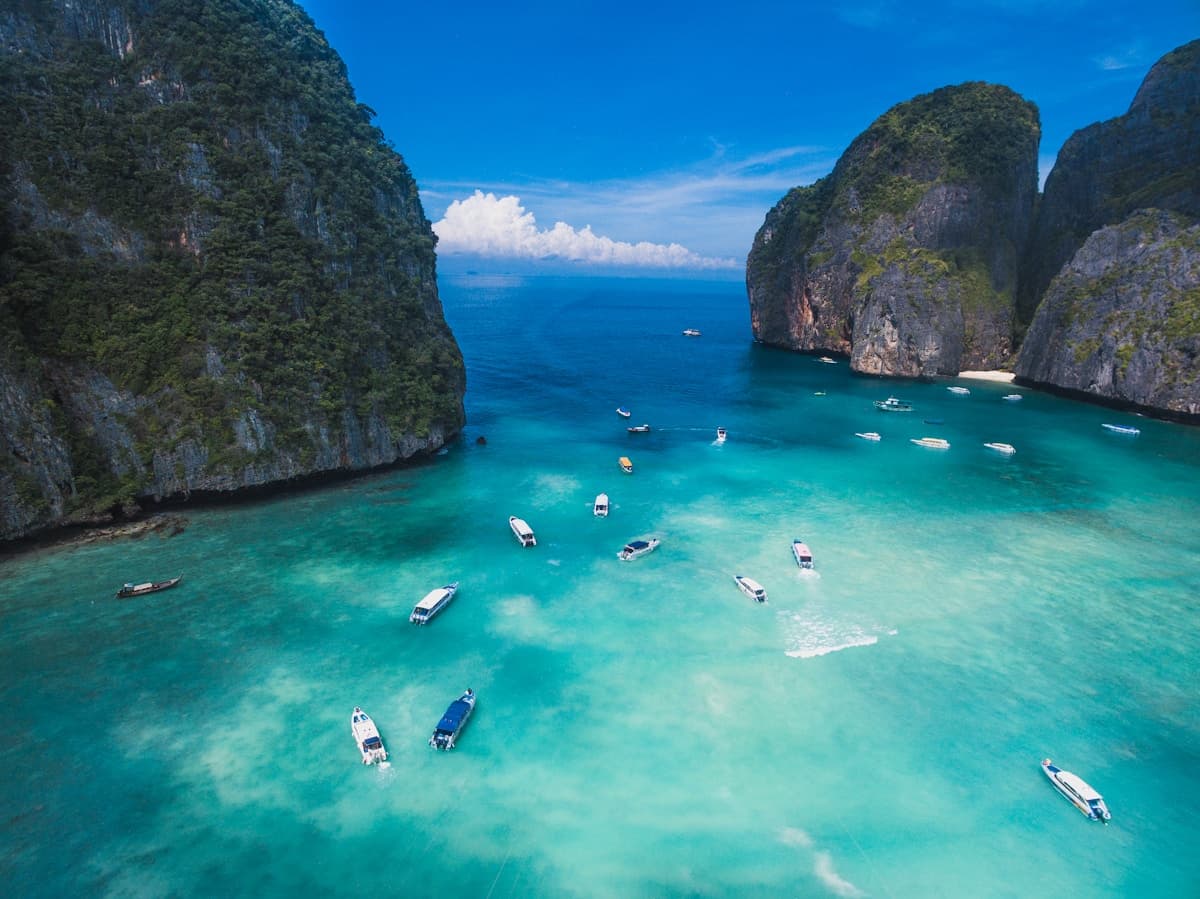
In 2000, Danny Boyle filmed Leonardo DiCaprio discovering paradise in a hidden Thai bay surrounded by limestone cliffs. The movie was called The Beach, and it effectively ruined the place it was celebrating. Within a decade, Maya Bay was receiving over 5,000 visitors a day. Boats anchored directly over the coral. Sunscreen and diesel fuel clouded the water. The reef died in patches. Blacktip reef sharks, once common in the shallows, disappeared entirely. By 2018, the Thai government had seen enough. They closed Maya Bay to all visitors and left it alone for four years.
The bay reopened in 2022 with strict new rules. The question now is whether any of it worked, and whether visiting Maya Bay in 2026 is actually worth the effort.
What Maya Bay Looks Like After Recovery
The short answer is that the recovery has been remarkable. The coral reef inside the bay, which marine biologists had essentially written off, has regrown significantly. Juvenile blacktip reef sharks patrol the shallows again. The water clarity has improved so dramatically that you can see the sandy bottom from the clifftop entrance platform. Before the closure, the water often looked murky from the churn of hundreds of boat propellers and thousands of pairs of feet stirring up sediment.
The beach itself is small. Strikingly small, actually, if you have only seen it in wide-angle film shots. Maya Bay is roughly 250 metres of white sand inside an almost completely enclosed amphitheatre of vertical limestone walls that rise about 100 metres on three sides. The scale of the cliffs makes the beach feel intimate rather than grand. On a clear morning, the water inside the bay turns a vivid turquoise green that looks enhanced but is not.
The difference between Maya Bay now and the pre-closure version is night and day. Photos from 2017 show a beach packed with hundreds of longtail boats rafted together, umbrellas jammed across every metre of sand, and water the colour of weak tea. Today it looks like a different place entirely. The no-boat zone inside the bay means visitors approach from a new pier on the back side of the island and walk through a short forest trail to reach the beach. Boats can no longer anchor in the bay itself.
The New Rules and How the Visit Actually Works
Visiting Maya Bay in 2026 is nothing like the old free-for-all. You need to book a time slot in advance through the Thai National Park reservation system. Entry is capped at 300 visitors at a time, and each group gets a one-hour window on the beach. The national park fee is 400 THB (about 11 USD) for foreign adults, and you will need your passport number when booking.
Most visitors arrive as part of an island-hopping tour from Ko Phi Phi Don, Phuket, or Krabi. These packages typically cost between 1,500 and 3,500 THB (40 to 100 USD) per person and include boat transport, lunch, snorkeling stops at other islands, and the Maya Bay time slot. If you are staying on Phi Phi Don, hiring a private longtail is the more flexible option. A return trip costs around 1,500 to 2,500 THB (40 to 70 USD) for the whole boat, and the ride takes about 20 minutes.
When you arrive at the island, your boat docks at Lo Sama Bay on the opposite side. From there, you walk a concrete path and wooden boardwalk through the forest for about ten minutes to reach Maya Bay. Park rangers check your booking at a checkpoint before you enter. The whole system is well organized, if a little clinical compared to the old days of just pulling up on the sand.
The No-Swimming Rule
This is the part that frustrates people most. You cannot swim at Maya Bay. Wading in up to your knees is allowed, but actually swimming is banned. Park rangers stand on the beach and enforce it. The rule exists to protect the recovering coral and reduce human impact on the marine life that has returned to the bay.
Is it disappointing? Honestly, yes. Standing on what might be the most beautiful beach in Southeast Asia and not being able to get in the water feels strange. But after seeing what unrestricted tourism did to this place, the logic is hard to argue with. The reef is growing back. The sharks are back. The water is clear again. Those things are directly connected to keeping people out of the water.
Most tour operators compensate by including snorkeling stops at Pileh Lagoon and other spots around the Phi Phi islands where swimming is still allowed. The snorkeling at Pileh Lagoon in particular is excellent, with visibility often exceeding 15 metres and plenty of tropical fish in the sheltered water between the limestone karsts.
Is Maya Bay Worth the Hassle in 2026?
This depends entirely on what you want from the experience. If you are expecting to spend a lazy day swimming in a hidden cove like something from a movie, Maya Bay will not deliver that. The time limit, the booking requirement, the no-swimming rule, and the managed walkway all strip away the spontaneity that made the original fantasy appealing.
But if you can accept it as a one-hour visit to an extraordinarily beautiful natural site, it works. The bay genuinely earns the hype. The limestone walls catching the morning light, the colour of that water, the quietness now that boat engines are banned from the bay itself. There is a peacefulness to it that visitors ten years ago never experienced. You get an hour on the sand, time to take it in, photograph it, wade in the shallows, and then you leave. It is more like visiting a national park viewpoint than hanging out at a beach, and framing it that way makes the experience land better.
The early morning slots are the ones to book. Fewer people, softer light, and a better chance of spotting the blacktip sharks cruising the shallows before the midday crowds cycle through.
Alternatives If You Want an Actual Beach Day
If the restrictions at Maya Bay feel like too much, the Phi Phi islands have plenty of other beaches where you can actually swim, snorkel, and stay as long as you want. Ao Pileh (Pileh Lagoon) is arguably more impressive for snorkeling. Bamboo Island has a long white sand beach with no time limits and far fewer visitors. Long Beach on Phi Phi Don itself is beautiful and easy to reach.
Beyond the Phi Phi islands, Thailand's Andaman coast is loaded with beaches that rival Maya Bay without the restrictions. Kuta Beach in Bali offers a completely different but equally iconic Southeast Asian beach experience, while Entalula Beach in El Nido has a similar hidden-cove-among-limestone-cliffs feel without the booking requirements.
Practical Details for Your Visit
Getting there: Fly into Phuket or Krabi, then take a ferry to Ko Phi Phi Don (1.5 to 2 hours, around 450 to 600 THB). From Phi Phi, book your Maya Bay trip. Alternatively, book a full-day island tour from Phuket or Krabi that includes Maya Bay.
When to go: November through April is dry season with calm seas. Maya Bay closes completely from August to September each year for continued environmental recovery. The monsoon months (May to July) bring rougher water and some tour cancellations.
What to bring: Reef-safe sunscreen is strongly encouraged and some operators now require it. Bring a waterproof phone case, a hat for the exposed walk, and water. There are no shops, toilets, or facilities on Ko Phi Phi Leh.
Book early: During peak season (December to February), slots fill up days in advance. Book your time slot as soon as your travel dates are confirmed. Morning slots between 7am and 9am are the least crowded and most photogenic.
The Bigger Picture
Maya Bay's story is really a story about what happens when a place becomes too famous too fast, and whether damage like that can be undone. The answer, at least here, seems to be yes. It requires rules that feel restrictive, and a version of the experience that is more managed than magical. But the alternative was a dead reef, brown water, and a beach that existed only as a backdrop for selfies. What Maya Bay has become is imperfect, but it is alive again. That counts for something. If you have seen the photos from Navagio Beach in Greece, you will know that extraordinary natural beauty and overtourism often go hand in hand. Maya Bay is trying to prove there is another way.