
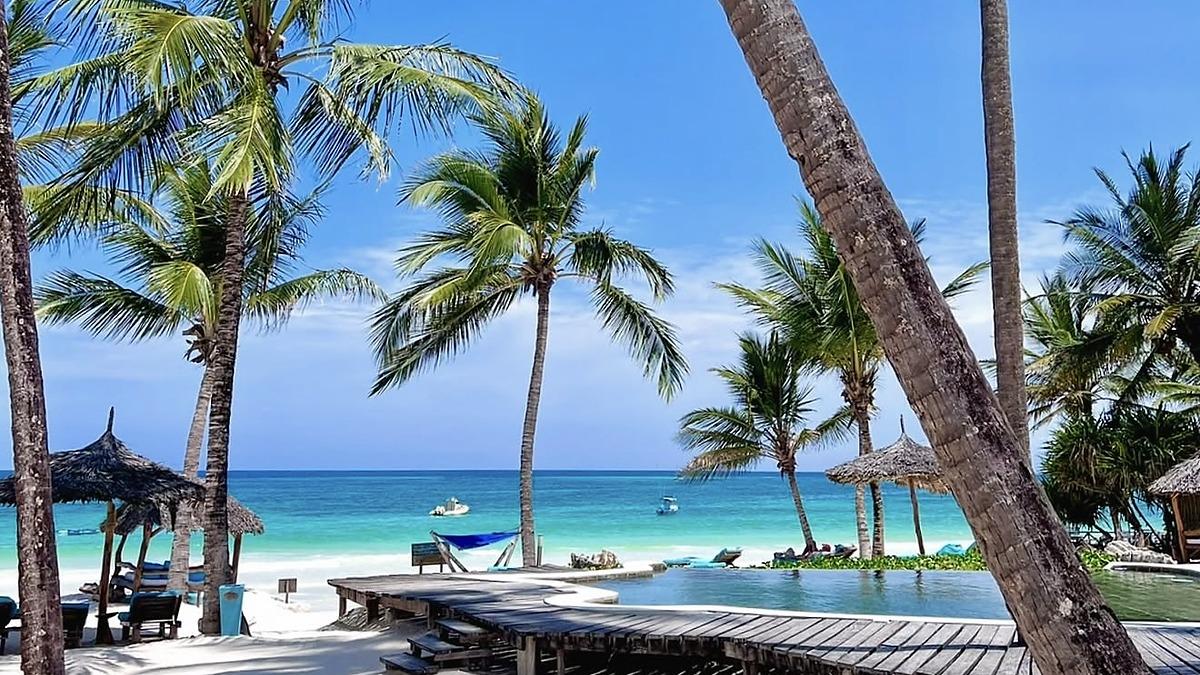
Diani Beach is 17km of white sand on Kenya's south coast, in Kwale County about 30km south of Mombasa, with the town of Ukunda behind it. A wide reef offshore keeps the lagoon shallow, so the tide decides whether you wade or swim. Since August 2024, a bypass has let drivers from Mombasa's airport skip the Likoni ferry.
What Diani Beach is like, from Kongo to Galu
The sand runs unbroken for 17km from the Kongo River mouth in the north to Galu in the south, with hotels and resorts behind much of it. Offshore, a reef keeps the lagoon calm. Off Nomad Beach, Snorkeling Report puts the reef at almost a kilometre wide, with a floor inside it of mostly sand, seagrass and rubble and few live corals. You wade at low water and swim at high.
Public access roads off Diani Beach Road reach the sand, including Trade Winds, Bidi Badu and Kongo Mosque. Bidi Badu has public toilets, and the parking at the Kongo end is often full, according to The Star. For a drink on the sand, Fodor's lists Nomad Beach Bar & Restaurant at Nomad Beach Resort. For coral and fish, take a boat south to the marine park.
How to get to Diani Beach from Mombasa and Nairobi
From Moi International Airport the drive is about 50km on OpenStreetMap's routing: west onto the Dongo Kundu bypass, then south on the A7 through Ukunda. Kwale drivers told the Nation in March 2026 that the bypass brought the trip under an hour, though some avoid it after dark because it is often deserted.
The bypass is free to use. In September 2025 the Treasury approved a feasibility study for tolling it through a private operator, but no toll is being charged yet. Checked November 2026.
The older route crosses the Likoni channel from Mombasa island. Foot passengers ride the ferry free, and vehicles pay the Kenya Ports Authority's charges, from KSh75 for a motorbike. The UK Foreign Office names the area on and around the Likoni ferry as one where crime is higher, so keep phones and bags out of sight on the crossing. From the Likoni side, matatus run south to Ukunda and tuk-tuks cover the last leg to the beach road. Checked November 2026.
| Route | Time | Good to know |
|---|---|---|
| Moi airport by road, via the bypass | Under an hour | About 50km; drive in daylight |
| Mombasa island via the Likoni ferry | Depends on the queue | Foot passengers free |
| Nairobi to Ukunda by air | 1h10 to 1h15 on Safarilink | Safarilink from Wilson, twice a day; Jambojet from JKIA |
| Nairobi by road | A full day | About 510km |
Safarilink's Diani flights page puts Ukunda airstrip five minutes by taxi from the beach. Overland, the Madaraka Express train from Nairobi ends at Miritini, where the bypass begins.
When to visit Diani Beach: mid-December to March
For a beach holiday, aim for mid-December 2026 to March 2027. That is the dry kaskazi season, when the least seagrass washes up (see below). Late March can catch the start of the long rains. June to September 2027 suits kitesurfers, though more seagrass comes ashore.
Both seasons follow the trade winds. According to H2O Extreme, a Diani watersports school, the kaskazi blows from the north-east from mid-December to mid-March and the kusi from the south-east from June to mid-September. The rains fall in between.
Kenya Met's October to December 2026 forecast, issued in August 2026, expects above-average short rains in Kwale, ending in the first or second week of December. The long rains follow from March and usually peak on the coast in May.
Diani Beach tides, the reef lagoon and seaweed
The coast has two high and two low tides a day, and at spring tides the range at Mombasa is more than 3m, according to the Kenya Marine and Fisheries Research Institute.
Snorkel in the hour or two before low tide, when Snorkeling Report says visibility is best and the sea calmest. It also advises staying within 300m of the beach. Collector and burrowing urchins live in the lagoon, so wear reef shoes. Boat and jet-ski traffic gets heavy after midday, so go in the morning and tow a dive flag.
Seagrass follows the wind. On Nyali and Bamburi beaches just north of Mombasa, a 1999 study in the journal Aquatic Botany found it washed up mostly from March to October, in the south-east monsoon, and very little from November to March. Diani gets the same winds.
Is Diani Beach safe? Crime, beach boys and health
The UK Foreign Office (FCDO Kenya advice) does not advise against travel to Kwale County. The coastal areas it warns against are far to the north: within 15km of the coast between the Tana and Galana rivers, and Lamu County outside Lamu and Manda islands. It does say terrorists are very likely to try to carry out attacks in Kenya, and it lists beaches among possible targets. It also warns of a high threat of terrorist kidnap, noting that Westerners have been targeted in coastal counties.
The FCDO also advises against walking alone in isolated areas, even in daylight, and says crime often rises over Christmas and New Year. Leave the beach before dark and keep valuables at your hotel. Checked November 2026.
Sellers on the sand, known as beach boys, offer boat trips and tours. Follow the FCDO's safari advice: use a reputable operator and never buy a tour from a tout. Away from resorts, dress conservatively; the coast is mainly Muslim.
Lifeguards are not a given. Over Christmas 2023 Kwale County ran a beach safety campaign, and Kenya News Agency reported the governor saying lifeguards would be deployed on Diani's beaches, with patrols by the county and local beach management units. Don't count on that cover at other times: swim where other people are swimming. Checked November 2026.
TravelHealthPro rates malaria risk as high outside Nairobi city and the highlands. It is also tracking Ebola in Kenya, where the first case was confirmed on 6 October 2026. The World Health Organization's 6 November update counted nine confirmed cases and two deaths, all linked to that first patient, with no new case since 19 October. Check TravelHealthPro's Kenya page before you fly. Checked November 2026.
Since 5 October 2026, most visitors need Kenyan government travel health insurance, bought with the electronic travel authorisation, according to the FCDO. Checked November 2026.
Day trips from Diani: dolphins at Kisite-Mpunguti and the colobus monkeys
The Kenya Wildlife Service's Kisite-Mpunguti Marine National Park, for coral and dolphins, is reached by boat from Shimoni, about 57km south of Diani by road. In October 2025 the High Court suspended KWS's 2025 fee rise pending a hearing, so check the current rate on KWSPay before you go. Checked November 2026. The 2025 rates, per person for 24 hours, are:
- Non-resident adults: USD 25.
- African citizens: USD 15.
- Kenyan residents: KSh675.
- East African citizens: KSh500.
- Children aged five and under: free.
Angolan colobus monkeys live in the forest behind the beach. Colobus Conservation, on Diani Beach Road, opens Monday to Saturday, 8.30am to 4pm. It says vehicles hit about 55 monkeys a year on a 9km stretch of road, so it has hung aerial ladders, called Colobridges, across it.
Is Diani Beach worth it?
Yes, if you want a long, sandy beach after a safari and will plan around the tide. Families can wade in the lagoon at low water, kitesurfers get two reliable seasons, and at 17km the beach has room to spread out even in the dry season.
Skip it if you want coral straight off the sand or a beach without sellers: the lagoon is mostly sand and seagrass, so book a day at Kisite-Mpunguti instead. Avoid May, when the long rains peak. For a smaller Indian Ocean beach framed by granite boulders, see our Anse Source d'Argent review. Kitesurfers choosing between Indian Ocean spots can also read our Le Morne Beach review, in Mauritius.
Best plan: fly into Mombasa between mid-December and March, take the bypass in daylight and stay near an access road. Snorkel and walk the flats at low tide, ideally when it falls in the morning before boat traffic builds, and save an afternoon for the colobus centre.