There is a running joke about Southport: you go to the beach and the sea has gone home. It is not far off. Southport has one of the most dramatic tidal ranges in England, and at low water the sea withdraws more than a kilometre across flat wet sand, far enough that from the promenade you sometimes cannot see it at all. Arrive expecting to walk straight into the waves and you will be disappointed. Arrive understanding what kind of place it is, and Southport is one of the great British seaside days out.
Because the truth is that Southport was never really about the swim. It is a grand Victorian resort town with an enormous beach attached, and the draw is the pier, the boulevard, the funfair and the sheer space, not splashing in the surf. Set your expectations there and it makes a lot more sense.
Where is the sea? Southport's tides
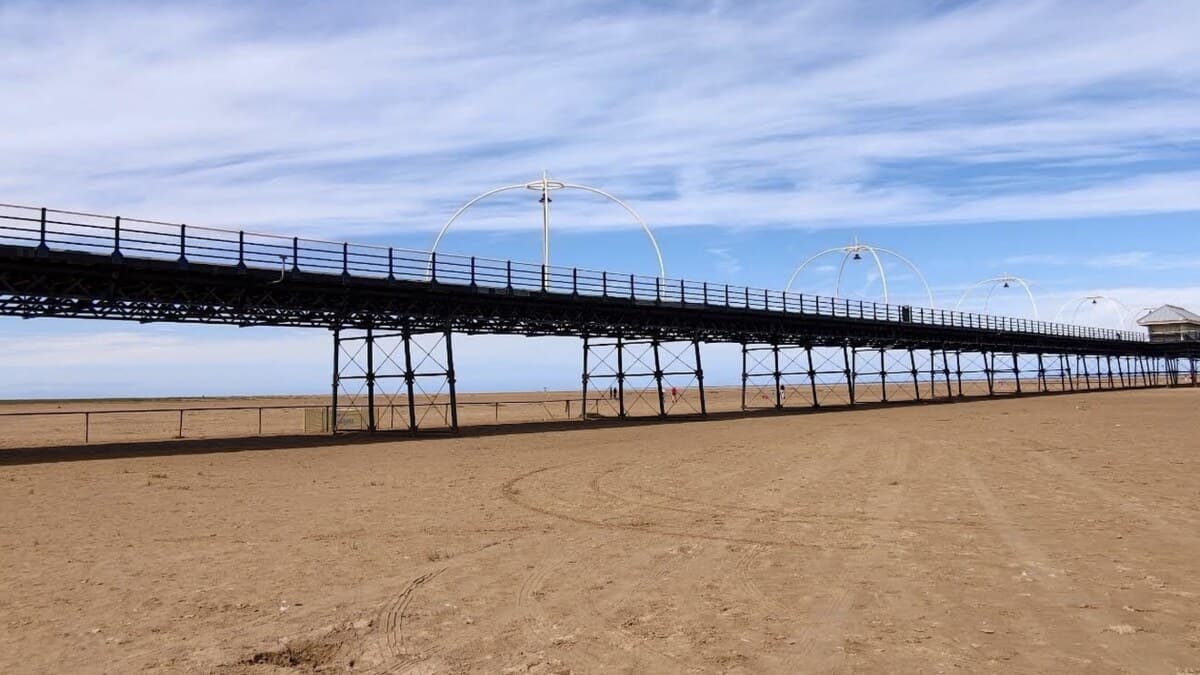
The tide is the defining feature of this beach, so it pays to understand it. Southport sits on a very flat, gently shelving stretch of coast near the mouth of the Ribble estuary, which means a huge area of sand stays exposed through most of the tidal cycle. Pair that with a big tidal range and you get the famous effect: at low tide the water is a long walk away over firm, rippled sand, and only at the highest tides does the sea come right up to the sea wall.
So if you actually want to see and reach water, time your visit a couple of hours either side of high tide and check a tide table before you go. At low tide it is a sand beach far more than a sea beach, which is either the disappointment or the whole point, depending on what you came for.
Is it safe to swim?
Honestly, this is not a swimming beach, and the signs at every access point say as much. The water tends to be either too far out or too shallow and murky to be much fun, there are soft sand and mud hazards across the flats, and the speed of the incoming tide over such flat ground can cut off anyone who has wandered out. Rip currents run near the groynes, and the water is cold enough for cold-water shock for much of the year.
There are RNLI lifeguards in peak summer, and if you stick to where they patrol on a calm day a paddle is fine. But for a proper swim you are far better at Ainsdale, two miles south, which holds a Blue Flag, or in Southport's own Marine Lake, where you can hire a pedalo with no tide to worry about.
What the beach is actually for
Once you stop expecting a swim, Southport's beach is brilliant at what it does do. The sheer scale of the sands makes it a natural for long, blowy walks, for kite-flying and the kite-buggying and sand-yachting the hard flat sand is ideal for, and for big-sky photography. The wider Sefton coast is a serious wildlife area too, with internationally important dunes and birdlife, so it rewards a slower look than the average resort beach.
It is, in short, a space beach. On a bright, breezy day with the tide out and the sand stretching to the horizon, it has a wide, bracing appeal that a small busy cove never will.
The pier, Lord Street and the resort
The town behind the beach is the real headline. Southport Pier is one of the longest in Britain, reaching far out over the sands, though it has been closed for major restoration in recent years, so check whether it has reopened before you bank on walking it. Lord Street, the grand tree-lined boulevard a block back from the front, is the town's showpiece, a long parade of canopied Victorian shopfronts and gardens that legend says inspired the boulevards of Paris.
Add the Pleasureland amusement park, the Marine Lake, and the usual run of arcades and chip shops, and you have a full day out that happens to have a giant beach beside it. Visit Southport has the current details on the pier, attractions and what is on.
Nearby: Ainsdale, Formby and Crosby
The Sefton coast south of Southport strings together several beaches worth the short hop. Ainsdale, two miles down, is the Blue Flag swimming alternative, backed by the protected Ainsdale and Birkdale dunes. Further on, Formby is National Trust land famous for its red squirrels, pinewoods and vast quiet sands. And at Crosby, Antony Gormley's "Another Place" plants 100 life-size cast-iron figures across the beach, gazing out to sea, one of the most striking pieces of public art on any British coast.
All three are reachable on the same Merseyrail line, so it is easy to combine Southport's resort with a quieter or more swimmable beach down the coast.
How to get there and parking
Southport is an easy train trip: Merseyrail runs from Liverpool in about 40 minutes, with direct services from Manchester and Wigan, and the station sits a short walk from Lord Street and the seafront. Going by train also sidesteps the beach's parking quirk.
By car it is off the A565, and the main beach parking runs along Marine Drive at around 8 pounds a day from April to September. The catch is the tide again: the beach car parks close on tides of 9 metres and above, so check the day's tide times before you commit to driving down.
Is Southport beach worth it?
For a classic British seaside resort day, with a pier, a grand boulevard, a funfair and miles of open sand, yes, as long as you arrive with the right expectations. Southport is not the place for a turquoise swim, and the famous vanishing sea catches people out. Come for the space, the town and the wildlife coast, time it to the tide, and swim down at Ainsdale instead. It earns its place among the best beaches in the UK as a resort, even if it would never win on the water, and sits alongside the rest of the best beaches in England for a northern seaside day.