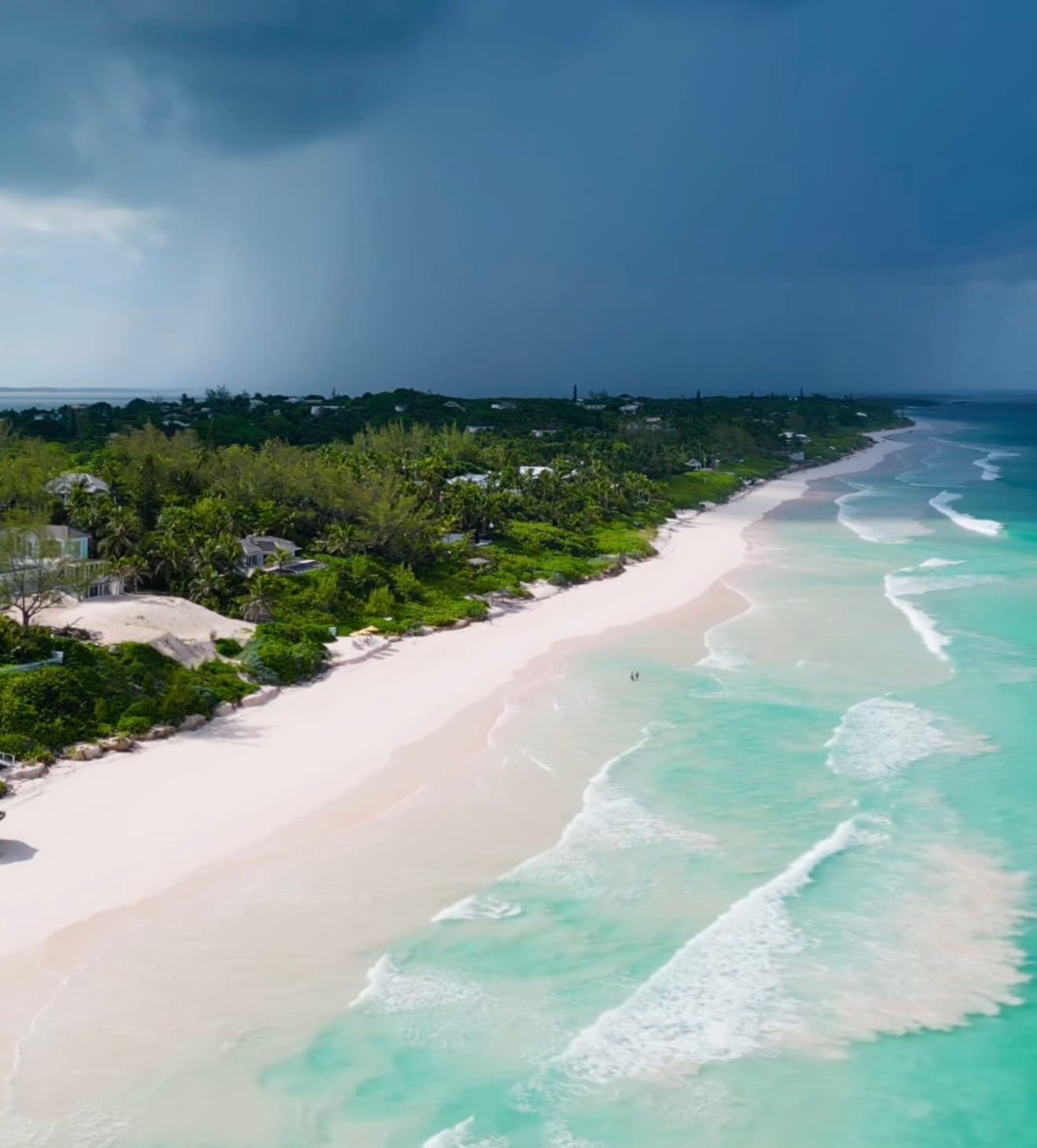
The beach does look pink. Not every day, not from every angle, and not as vividly as the travel posts you clicked through to get here. But the pink is real, it comes from a real organism, and on the right morning it is one of the more genuinely unusual sights in the Caribbean. Harbour Island is also two flights and a ferry from most US cities, the hotels on the sand run four figures a night, and the seaweed that hit the Atlantic Basin in 2023 and 2024 can still turn up here in summer. Understanding that whole package before you book is what this review is for.
Where Pink Sand Beach Sits and What Nearly Every Map App Gets Confusing
Pink Sand Beach runs along the entire east (Atlantic) coast of Harbour Island, a small island about three and a half miles long and a mile and a half wide, sitting off the northeast tip of Eleuthera in the Bahamian Out Islands. This is the first thing most first-time visitors miss. Harbour Island is not Eleuthera. It is a separate smaller island that you reach by water taxi from Eleuthera's main island, and the only settlement on it is Dunmore Town, a pastel Loyalist-era village with narrow lanes, golf carts, and a handful of boutique hotels.
From most US origins the trip is one flight to Nassau or to North Eleuthera (ELH) directly, a second hop if you transited through Nassau, and then a ten-minute water taxi across the channel from Three Island Dock to Harbour Island's Government Dock. Direct service into ELH exists from Miami, Fort Lauderdale, Atlanta, Charlotte and Nassau only. Toronto and most European cities route through one of those. Budget the travel day carefully.
Once you land, golf carts are the way people move. Rentals run around 50 to 100 USD a day from operators like Michael's Cycles and Major's. The beach is never more than a five-minute cart ride from anywhere on the island.
The Science of the Pink: Homotrema Rubrum
This is where most travel articles hand-wave and the reality is actually more interesting than the bluff. The pink comes from Homotrema rubrum, a single-celled marine organism in a group called foraminifera. The organisms attach to the underside of the offshore reef that runs parallel to the beach about 150 to 200 feet offshore. Their shells (technically called tests) are made of calcium carbonate laced with a red pigment, so when the creatures die, the white waves and the coral reef grind the shells into red fragments that wash up onto the beach mixed with ordinary white coral and shell sand. The ratio of red to white foraminifera fragments, plus the angle of the light, is what produces the blush.
A few realities follow from that.
- The pink is not uniform. It is strongest at the waterline where wet sand concentrates the red grains, and fades as you walk up onto the dry berm.
- It is not neon. Homotrema rubrum produces a pale rose. If an image shows bubblegum pink, it is saturated, lit in golden hour, or not Harbour Island at all (Pink Beach Komodo in Indonesia is the usual imposter).
- It looks pinker when wet. After rain, at low tide, early in the morning before the sun climbs, you see more of the tint.
- It is the same organism that colors Horseshoe Bay in Bermuda. Bermuda tends to show a slightly more saturated pink in person because the sand grains are coarser and hold the red fragments differently. Bermuda is also considerably easier to reach.
The Sargassum Question No One Puts in the Brochure
Atlantic sargassum blooms have been one of the defining Caribbean beach stories of the last three years. The record 2023 belt hit Mexico and the Dominican Republic hardest, 2024 was still heavy, and early 2025 forecasts pointed to another strong season. Harbour Island is on the Atlantic side of the Bahamas and does get sargassum in summer, usually from May through September, with the heaviest weeks often in July and August.
The island has been relatively lightly hit compared with the Mexican Caribbean because of local tidal patterns and because the beachfront hotels actively clean their sand lines. That does not mean you will not see it. If you are visiting between late May and early October, check recent sargassum reports for the eastern Bahamas before you book, and ask the hotel directly about current beach conditions. It is not a reason to skip Harbour Island. It is a reason not to be surprised.
What You Actually Do Here
Harbour Island is a small island with a short list of genuinely good things to do.
- Walk the beach. Three continuous miles of pink sand, rarely crowded outside the hotel frontages. The early morning walk before the sun climbs is the single best experience on the island.
- Horseback riding on the sand. The Pink Sands Resort image of riders along the waterline is the single most photographed thing here. Conch and Coconut and other concierge operators book 30 and 60 minute rides. Peak season requires advance booking.
- Snorkel Devil's Backbone. A submerged reef system stretching from the northern tip of Eleuthera, with historic shipwrecks, elkhorn and brain coral, parrotfish, stingrays, occasional reef sharks. Currents can be tricky so go with a local guide, not solo.
- Sunset at Girl's Bank. A harbor-side sandbar off the northeast of Dunmore Town. Shows up on Instagram with a piece of driftwood framed against the water. The original single tree is gone. The replacement driftwood is still photogenic and low-tide is the window.
- Dunmore Town itself. Walk or cart through the pastel streets. Queen Conch serves the best conch salad on the island. The Landing and Sip Sip are the long-standing dinner names.
Swimming, Safety, and the Reef
Pink Sand Beach is genuinely good for swimming because the offshore reef breaks Atlantic swells before they reach the beach. Water depth stays shallow (three to six feet) for a long way out, there are no meaningful rip currents, and the bottom is soft sand. There are no lifeguards. The usual Caribbean caveats apply, nothing unusual.
Reef sharks occasionally appear offshore near the Devil's Backbone snorkel sites. They are not considered a concern for swimmers on the main beach and there has been no significant incident record. The US State Department maintains a Level 2 advisory for the Bahamas as of 2025, driven almost entirely by crime concerns in Nassau and Freeport rather than anything on Harbour Island. The Out Islands are considered safe. Firearms and ammunition are strictly illegal in the Bahamas, which matters if you are driving through the US and forget what is in your bag.
Best Time to Come and When to Skip
December through April is the high-confidence window. Dry weather, daytime highs in the mid seventies, water temperature warm enough for swimming all day, no sargassum. Hotels run full and prices peak around the Christmas and Easter weeks.
May and November are shoulder months with lower rates, lighter crowds, and a small weather risk. Hurricane season runs 1 June to 30 November with peak risk August through October, and those are also the worst sargassum months. The beach still works on a good summer morning but the variance is higher.
Hurricane Dorian devastated Abaco and Grand Bahama in 2019. Harbour Island and Eleuthera were largely spared when the storm tracked north. The island's tourism infrastructure is intact. Any future storm track is the lottery you buy into when you book in August.
Is Pink Sand Beach Worth It in 2026?
Yes, with eyes open. The pink is real but pale, the trip is genuinely two flights and a ferry, and the hotels on the sand are among the more expensive in the Caribbean. What you get is one of the best-documented pink beaches in the world, a small island with a functioning Loyalist-era town, legitimately clear water over a protective reef, and a walking beach that rewards early mornings far more than midday. Come in the December to April window, stay on the beach if the budget allows or in Dunmore Town if not, walk at sunrise, and ride the horses if you can book them. The beach delivers on its claim. The Instagram color on a clear midday afternoon does not. Knowing that before you go is the whole trick.