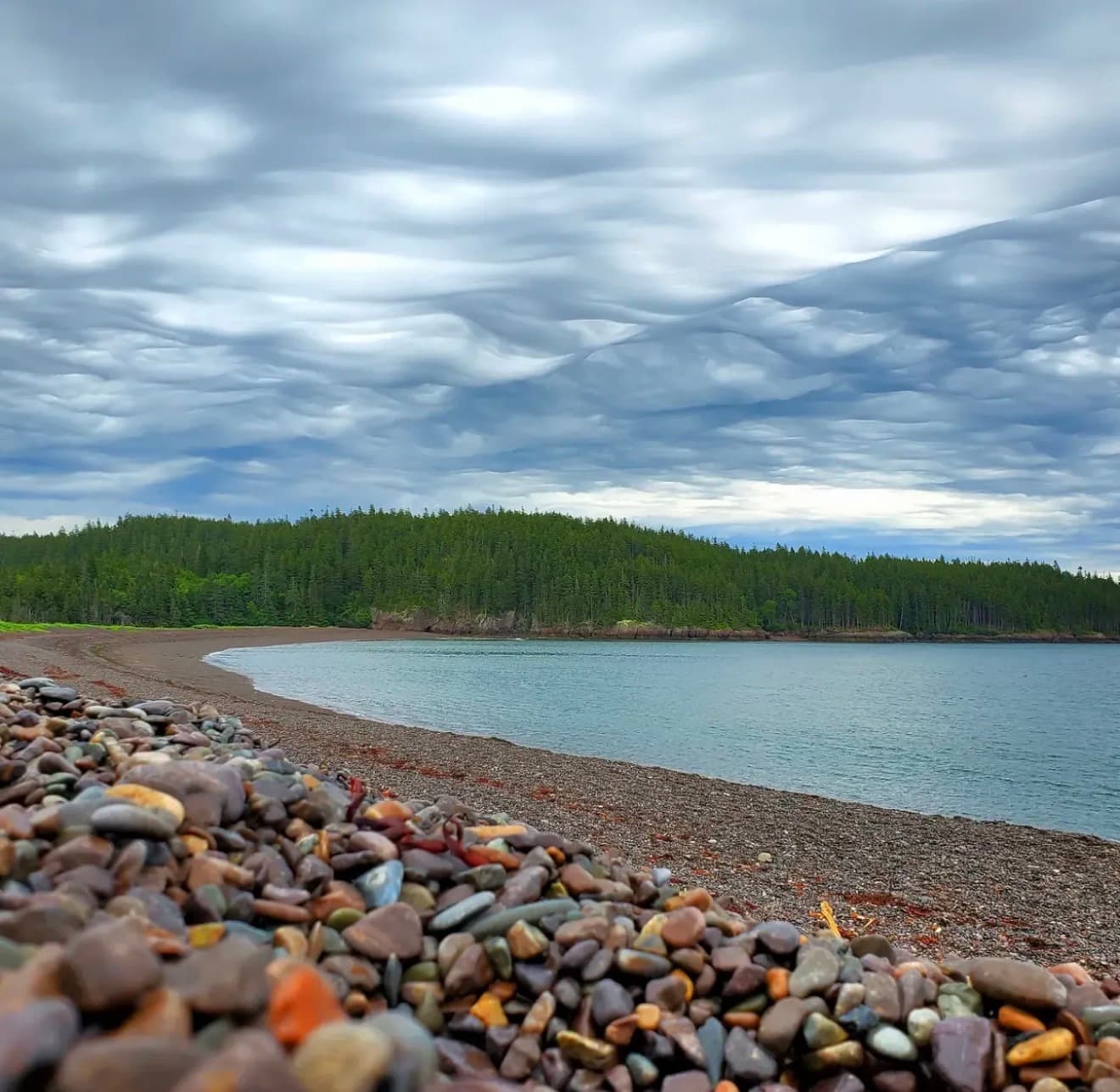
The name is wrong. That is the first thing to say about Jasper Beach, because almost everything written about this strange and wonderful stretch of Down East Maine repeats the same mistake, and getting it right changes the whole experience. The stones are not jasper. The Maine Geological Survey has been clear about this for decades. What you are walking on in Machiasport is a half-mile crescent of wave-polished volcanic rhyolite, white quartz, green volcanic flecks, and assorted glacial cobbles. It looks like jasper from a distance because rhyolite happens to carry the same reddish-brown iron colour. Someone, somewhere, looked at it a long time ago and got it wrong, and the name stuck. That is where the story starts.
The Name Is a Lie, and the Truth Is Better
Jasper is a specific mineral. It is an opaque, iron-rich form of quartz, the kind of stone you see polished into jewellery. The red cobbles on the berm at Howard Cove are not that. They are rhyolite, a fine-grained volcanic rock formed from a chemically different recipe, which erupted along the coastal Maine volcanic belt somewhere between 440 and 390 million years ago during the Silurian and early Devonian. Joe Kelley, the coastal geologist who has written the definitive short piece about the beach, puts the correction plainly. The Maine Geological Survey agrees.
None of this makes the beach less interesting. It makes it more interesting. You are not walking on a pile of costume-jewellery stones. You are walking on a specific slice of ancient volcanic arc, broken off a bluff by waves, tumbled by the Atlantic for thousands of years, and delivered back to you in egg-sized pieces that fit in your palm like the sea made them for that purpose.
Mixed in with the rhyolite are the other visitors. White quartz, sometimes with dark inclusions. Flat green discs that are perfect for skipping if the water were not usually too choppy to bother. Creamy whites, blacks, bricks, and the occasional oddball granite cobble that a glacier left behind tens of thousands of years ago. The colour mix is why the beach looks like it was designed for a photograph.
Where It Sits and How to Get There
Jasper Beach is in Machiasport, Washington County, Down East Maine, about as far east as the continental United States goes before you cross into Canada. The coordinates are 44.6417 north, 67.3755 west. The beach itself sits at the head of Howard Cove, on the western side of Machias Bay, framed by spruce headlands on both sides that slope down to the water in the classic Down East shape.
Getting there is straightforward if you commit to the drive. From Bangor, it is about 85 miles along US-1, allowing roughly one hour forty minutes. From Bar Harbor, allow two hours on coastal roads that are slower than the mileage suggests. From Portland, you are looking at 216 miles and about three and a half hours.
Once you are in Machias village, take Kennebec Road, turn right onto Port Road, which is Route 92, and then left onto Jasper Beach Road. The last turn drops you into a small gravel parking area and a slightly larger lot to one side. Parking is free. There is no attendant, no booth, no gate hours posted anywhere. You walk a few yards from your car and you are standing on the berm. The access is as easy as beach access gets.
What the Beach Actually Looks Like Today
Most travel articles about Jasper Beach quote a length of roughly a mile. The Maine Geological Survey says 800 metres, which is closer to half a mile. The MGS figure is the right one. The beach is a crescent-shaped pocket beach anchored at bedrock headlands, with a 27-acre park parcel behind it that the Town of Machiasport acquired in 2007 with support from the Land for Maine's Future Board.
The shape of what you see changes. This is a barrier spit, fed by an eroding glacial bluff at the western end, sorted by long-shore drift, and constantly reshaped by storms. The stones get smaller the further east you walk. Near the source bluff on the west, you find cobbles up to four inches. In the middle, fist-sized. At the eastern end near the tidal inlet, it flattens out into fine gravel. If you walk the full length slowly, you can watch the sorting happen in front of you.
Two back-to-back storms in January 2024 set record water levels along the Maine coast and reworked the Jasper berm. The iconic ridge of stones that older travel photos show, piled up taller than a person at the high point, got flattened and redistributed. The berm is dynamic by nature, so it will rebuild. But the current shape is different from what guidebooks printed in 2022 still describe, and if you came hoping for a specific photograph, know that the beach rearranged itself recently.
The landward side of the berm rises about four metres above normal water level and drops into a salt marsh and small lagoon system that the spit has walled off from the sea. Stumps of old spruce and layers of salt-marsh peat are visible at low water, evidence that the whole feature has been migrating landward for thousands of years as post-glacial sea levels have risen. The beach is moving. Slowly. You can see the receipts.
The Sound, and When You Actually Hear It
This is the part every travel piece about Jasper Beach gets wrong in a specific way. The stones do not sing. They rumble. Describing the sound as singing suggests a musical tone, like a resonant glass. What you actually hear is different and more interesting.
When a wave rolls up the berm and breaks, thousands of loose cobbles get shoved up the slope with it. When the wave retreats, all those stones tumble back down the slope together in a long, rolling, grinding wash of sound. It is percussive rather than melodic. Some visitors describe it as a rumble, some as a conversation, some as the ocean clearing its throat. Kelley's scientific description is a rumble. That is the right word.
The sound works best at low to mid-tide. At high tide, the working face of the berm is submerged and the noise is muffled. At dead low, the wave action is weaker and spread out. The window between those two extremes, when the waves are rolling into the middle of the berm with enough force to move the top layer of cobble, is when the beach sounds most alive.
For the full effect, visit on a day with moderate onshore wind and a slight swell running. A flat-calm morning gives you a pretty view and quiet stones. A strong southeast wind gives you the full rumble, spray in your face, and the Atlantic doing what it has been doing here for the last four thousand years.
Swimming, Weather, and the Cold-Water Reality
Nobody writes this part honestly, so here it is. You are not swimming at Jasper Beach.
Gulf of Maine water temperatures in this part of the coast peak around 55 to 60 degrees Fahrenheit in August and fall off quickly on either side of that. The nearest monitoring station at Cutler, immediately east of Machias Bay, is one of the coldest measured shores in the contiguous United States. On top of that, you are wading in on cobbles that are rounded but not smooth, which are painful on bare feet and unstable underneath you. The combination is a hard no for swimming.
This is a layers beach. Bring a light jacket even in July. Morning fog is common along the Down East coast through summer, especially before the sun burns off around 10am. A flat-calm sunny August afternoon is one of the most beautiful things you can experience in New England. A foggy July morning with the berm half-hidden in grey and the wave sound amplified by the mist is one of the most atmospheric. Both are Jasper Beach.
The black fly season in Washington County runs roughly from Mother's Day to Father's Day, which is mid-May to late June. Coastal breezes on the open cove keep most of them off the beach itself, but the approach and the parking area can be bad in that window. After the solstice, they thin out and you get the best weather of the year.
If you are visiting children or anyone who wants actual swimming, pair the Jasper trip with a detour to Roque Bluffs State Park, about twenty minutes south. The state park has a half-mile pebble-and-sand crescent on the ocean side and a 60-acre freshwater pond on the inland side that warms up much more than Machias Bay ever will.
Rocks Stay. Full Stop.
The rule that matters most at Jasper Beach is the one nobody wants to hear on vacation. Do not take the stones home.
The beach is a Town of Machiasport park. The stones are the beach. Every cobble you carry to your car is one the next storm has to find and replace, and the source bluff is finite. Across the broader New England coast, beach-stone removal has become enough of a problem that multiple towns and states are tightening their rules. At Jasper specifically, signs at the access ask visitors to leave the rocks, and the town treats removal as a violation of park ordinance.
The town has a solid reason. The whole berm exists because the source bluff erodes, the cobbles travel east along the shore, and the system keeps replacing itself. If enough visitors each take a handful, the arithmetic stops working. A beach that has reshaped itself under the Atlantic for four thousand years can be reduced in a few busy seasons. Plenty of New England beaches have been quietly stripped by well-meaning tourists filling buckets. Jasper Beach is one of the rare ones that still has its character intact, and the reason it still does is that most people follow the rule.
What you can do instead is pick up as many stones as you want, examine them, see how the light changes the red of the rhyolite at different angles, slide the flat green ones across the water for a few skips, and put them back where you found them. Photograph them. The photos are lighter and the beach stays whole.
Pairing Jasper With the Rest of Down East Maine
Nobody drives five hours from Boston just for a half-mile cobblestone beach, and you should not plan it that way either. Jasper Beach fits into a broader Down East itinerary that rewards the long drive with a string of features you do not get anywhere else in the United States.
Within twenty minutes of Jasper Beach, you have Roque Bluffs State Park for warmer swimming, Fort O'Brien State Historic Site for Revolutionary War history, and Bad Little Falls in Machias village for a dramatic cataract in the middle of town. Within about an hour east, you reach Cutler Coast Public Reserved Land, where a cliff trail runs along some of the most dramatic shoreline in New England, and Quoddy Head State Park in Lubec, which includes West Quoddy Head Light at the easternmost point in the contiguous United States. Forty-five minutes north at Pembroke, the Reversing Falls at Mahar Point shift direction four times a day with the tide in a way that is genuinely unusual.
A good plan is two nights in Machias or a cottage in Bucks Harbor, with Jasper Beach as the anchor stop of one afternoon, a different beach or trail the next morning, and the Quoddy Head lighthouse on the way home. That itinerary turns the drive into a trip rather than a day.
Is Jasper Beach Worth Visiting?
Yes, with the right expectations. If you came hoping for soft white sand, warm water, and a swimming afternoon, this is not your beach, and you should drive south to Roque Bluffs or further south to Popham or Ogunquit. If you came because you read about the singing rocks and you want to hear something that will never happen anywhere else in your life, this is exactly your beach, and you should stand at the mid-tide line with your eyes closed for ten minutes and let the Atlantic move the stones around.
Jasper Beach is the kind of place that rewards slow visits. Time it with the tide. Bring layers. Leave the rocks. Listen more than you photograph. Walk the length from the source bluff to the eastern tidal inlet and watch the stones get smaller under your feet. The beach has been doing this for four thousand years and has almost certainly not stopped singing, or rumbling, or whatever you want to call it, since the last glacier pulled back. For the short time you are standing on it, you are part of the same conversation.
The stones get the last word, and that word is not jasper.