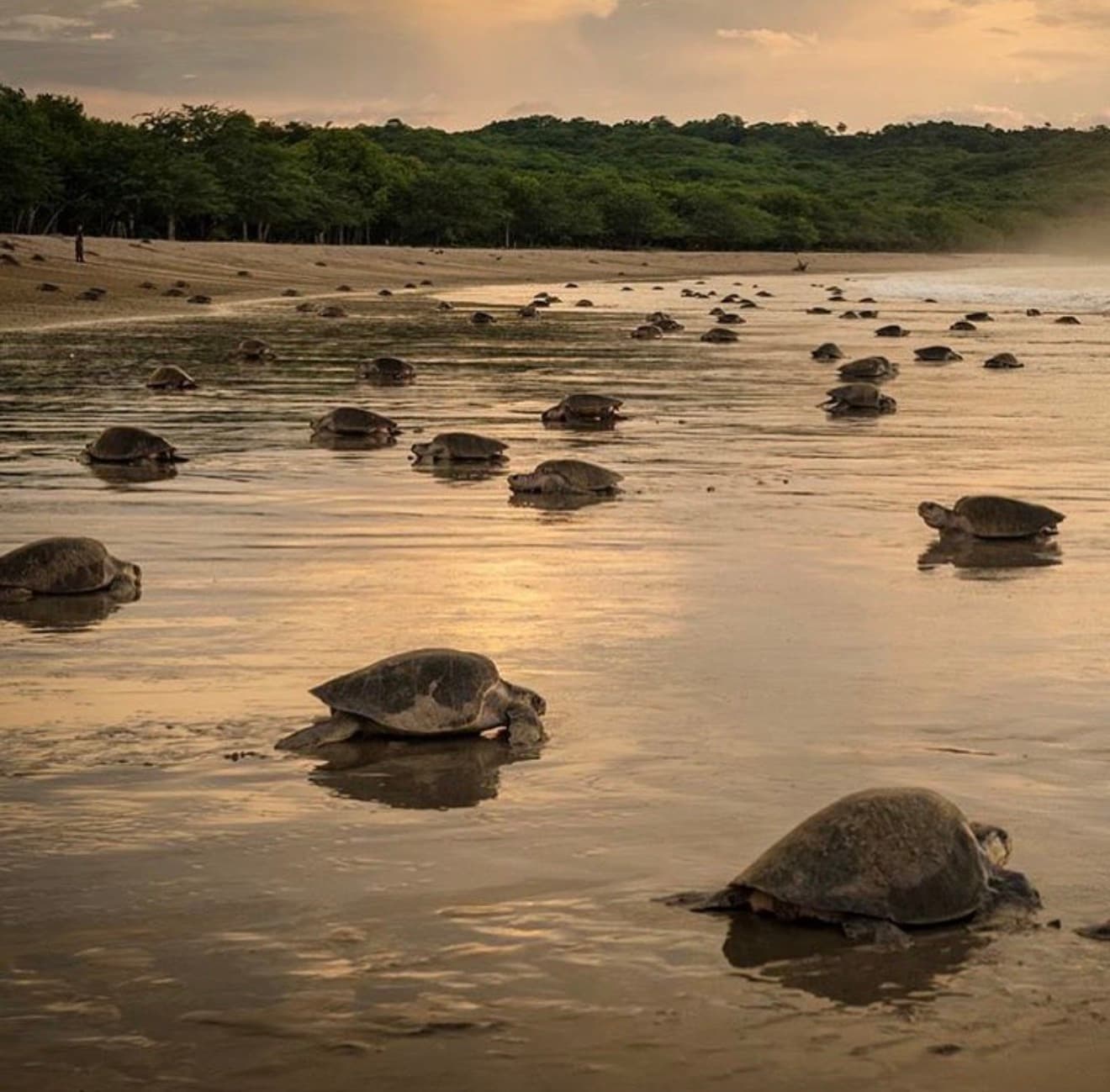
Most travel pages about Playa La Flor will tell you that you will see thousands of sea turtles nesting on the sand. What they will not tell you, and what the ranger at the MARENA station will say straight to your face when you arrive, is that you might see none. The turtles decide. The moon decides. The weather decides. You drove two hours south from San Juan del Sur on a dirt road, you paid your 200 cordobas, and the beach this evening is quiet. This is how La Flor works. And it is exactly why the beach still exists.
What an Arribada Actually Is, and What Happens Here
An arribada is a mass synchronised sea turtle nesting event. The word is Spanish for "arrival," and it describes something that happens on only a handful of beaches in the world. Thousands of olive ridley turtles, called paslamas locally, haul themselves out of the Pacific over three to six consecutive nights and dig nests in the sand within metres of each other. A single peak event at Playa La Flor has recorded close to 50,000 females on the beach. Across a full season from July to January, the refuge records more than 100,000 nests.
Playa La Flor is one of only two arribada beaches for olive ridleys in Nicaragua, the other being Chacocente further north in Carazo department. More significantly, it is one of only about six remaining arribada beaches in the entire Eastern Pacific. The two others in the region most travellers might have heard of, Ostional and Nancite in Costa Rica, are the comparison points. La Flor is smaller, less publicised, and harder to reach than Ostional, which is partly why it still works.
The refuge covers 7,349 hectares, officially the Refugio de Vida Silvestre La Flor, managed by Nicaragua's environment ministry MARENA. That size figure matters because older travel articles still quote a 3,000-hectare number that is out of date. The beach itself is roughly one to two kilometres of tan sand, not black volcanic sand, which is another detail that quietly matters: lighter sand means cooler nest temperatures, which means better hatch rates and a less skewed sex ratio than the darker beaches further south produce.
Olive ridleys are the dominant species and the only species that arribada here. Leatherbacks, Pacific greens, and hawksbills also nest at La Flor in much smaller numbers, but when people talk about the spectacle they mean the paslamas.
How to Time Your Visit
The single most useful piece of information about La Flor is not in any guidebook. It is the phone number of the ranger station. MARENA published a direct number for coordinator Cristhian Fuertes in April 2025: 8640-1188. Call it the day you plan to visit. The rangers know whether turtles are on the beach right now, whether the last arribada finished, or whether the beach is quiet. No tour operator will tell you this more reliably than the ranger sitting in the station can.
The season runs July through January, sometimes bleeding into February. Within that window, September and October are peak. July and August have smaller, less reliable arrivals. November through January shifts toward hatching season, when the eggs from September nests begin emerging from the sand forty-five to fifty days after they were laid.
Arribadas correlate with the darkest nights of the lunar cycle, typically the three to four nights before a new moon. The sky is darker, nesting turtles feel safer, and the synchronisation cue seems to work. Some sources add quarter moons to the list. No lunar rule is absolute. MARENA's own records from the 2024 to 2025 season show three separate arribadas by early January, with one producing 3,495 females over six days and another 27,911 eggs relocated to the on-site hatchery. The variance between events is enormous.
Plan the window. Call the station. Accept that the beach might be quiet. The alternative is a tour operator guaranteeing what they cannot guarantee, and you paying for a promise the turtles never agreed to.
Getting There from San Juan del Sur
Playa La Flor is about 20 kilometres south of San Juan del Sur, a drive of 30 to 45 minutes depending on the road and the season. The first part is paved. The final stretch turns to dirt and crosses a couple of seasonal streams. In the dry months from November to April, a normal rental car can manage the last kilometres if you drive carefully. From May to October, which covers most of the nesting season, you need high clearance or four-wheel drive. A sedan in September rain will get stuck, and you will be stuck in a place with no tow service.
The practical options:
Shuttle tour from San Juan del Sur is the most common way to visit. Hostels and agencies run evening trips, leaving town around 8 to 9pm, staying at the refuge until the early hours, and returning in the small hours of the morning. Prices run roughly 25 to 35 USD per person and often include the park entry fee. Group size varies.
Private taxi is 25 to 40 USD each way. This works if you are a small group splitting the cost or if you want to stay longer than a tour window.
Public bus is the cheapest route. Buses leave the San Juan del Sur municipal market heading toward El Ostional and pass the refuge entrance. Fares are a few cordobas. The catch is timing the return, since the service does not run through the night.
Self-drive is possible if you have the right vehicle and are confident on dirt roads at night. Parking is at the ranger station.
Entry fees as of 2026 are 200 cordobas for foreigners, about 5.50 USD, and 100 cordobas for Nicaraguans, with half-price for children. Camping is allowed at the ranger station for 500 cordobas per tent per night, which is worth considering if you want to be on the beach at the right hour without driving back in the dark.
The Rules That Actually Matter
The rules at Playa La Flor are not posted on a glossy sign with friendly icons. They are enforced by rangers with military backing who have seen thousands of turtles killed by things that sound harmless at the time.
No white light on the beach. Not your phone torch, not your camera flash, not your head-mounted travel lantern. White light makes nesting females abandon their nests and return to the sea without laying. It disorients hatchlings so badly that they crawl inland toward hotel lights and die on roads or in bushes. The refuge allows red-filter torches only. If you do not own one, buy a small red LED in San Juan del Sur before you go, or ask your shuttle whether they will provide one.
No camera flash, ever. A single flash can trigger a nesting female to abort. If you cannot take a photograph without flash, take no photograph. The pictures that circulate of turtles on La Flor at night are mostly long-exposure work by researchers with red light, not tourist snapshots.
Stay behind the turtle, not in front. The rangers will position you on the seaward side so the turtle never sees human silhouettes between her and the water. Do not touch the turtle. Do not touch the eggs. Do not sit on the sand where she might nest.
Keep the distance. A few metres back is the rule. In practice, if the rangers say move, move.
Visitor reviews from 2024 and 2025 occasionally mention inconsistent ranger reception, with some visitors turned away on very busy nights when the beach has already hit its carrying capacity. This is the system working. A refuge that turns people away in service of the animals is a refuge actually doing its job.
Can You Swim at Playa La Flor?
No. And this is a question many visitors arrive with, expecting a normal beach day pinned to the main attraction.
Swimming and surfing are not permitted inside the refuge. The water has the rip currents typical of this section of the Nicaraguan Pacific. More to the point, the beach is an active wildlife site, and recreational use would disturb nesting and hatchling runs. For swimming, the two local options are Playa El Coco, just north of the refuge boundary, and the town beach at San Juan del Sur, which is calmer and has food and bars right there.
Pair the trip. A swim afternoon at Playa El Coco, a ceviche dinner in San Juan del Sur, a shuttle to La Flor at night for the turtles, and sleep in the morning. That is the itinerary the place was built for.
Is Nicaragua Safe to Visit in 2026?
This is the part most travel articles either skip or treat as a throwaway line. It deserves better.
The US State Department currently rates Nicaragua as Level 3, Reconsider Travel. The primary concerns listed are wrongful detention of US citizens, arbitrary enforcement of laws, limited healthcare, and crime. The UK FCDO issues similar warnings. These advisories are not rumour. Since the 2018 political crisis, Nicaragua has been a materially different country from what it was a decade ago, and pretending otherwise does no one any favours.
In practice, tourists continue to visit San Juan del Sur and the southern Pacific coast without significant incident. The beach towns are economically dependent on tourism, the local operators have kept running, and the Refugio at La Flor has been operational every season since reopening. MARENA's own numbers show 543 visitors between January and April 2025, which is low by pre-2018 standards but not zero.
Sensible precautions:
- Register your trip with your embassy. STEP for US citizens, the equivalent for UK and EU travellers.
- Keep your political opinions quiet. Posts, conversations, and any photography near government buildings or military personnel can cause real problems.
- Avoid demonstrations entirely.
- Buy comprehensive travel insurance that covers medical evacuation. Healthcare outside Managua is limited.
- The night drive to La Flor on a dirt road is statistically more dangerous than anything else about the trip. Belt up, drive slow, and if your shuttle driver is rushing, ask him to slow down.
The real risks at the refuge itself are ocean currents if you ignore the swimming rule and the occasional scorpion or snake in the grass near the parking area. Not crime.
What Happens When There Is No Arribada
Most visitors come for the arribada and are told ahead of time that a quiet night is a possibility. What those visitors are not usually told is what a quiet night actually offers.
Hatchling releases run outside of arribada nights throughout the hatching window, roughly October through February. The MARENA hatchery on site incubates thousands of relocated nests each season, 27,911 eggs in the 2024 to 2025 season alone, and rangers time releases to sunset when predator birds are least active. If you time your visit to this window, the chance of seeing baby turtles making their first run to the ocean is very high, and the quiet dignity of that moment is, for many people, more memorable than an arribada crowd.
Night beach walking with a ranger and a red torch reveals crabs, occasional single nesting females outside of arribadas, and the sounds of the forest behind the beach. Howler monkeys call from the trees. Seabirds settle on the rocks at Punta La Flor.
Daytime visits let you see the refuge itself: the dry tropical forest transitioning to mangroves at the river mouths, iguanas the length of your arm sunning on rocks, parrots in the canopy, the empty arc of sand that in three weeks will hold forty thousand turtles. The daytime beach is one of the quieter wild beaches on the Nicaraguan Pacific coast, and the refuge fee is genuinely modest for what you are walking into.
Conservation tours led by the rangers explain the work: the InvestEGGator decoy eggs run by Paso Pacífico that use GPS to track poached nests, the 19,995 ranger patrols MARENA logged at La Flor in 2024, the army cooperation that keeps the egg traffickers at the margins. None of this is glamorous. All of it is how the arribada you might see on a different visit still exists to be seen.
Is Playa La Flor Worth Visiting?
Yes, with the right expectations and a tolerance for uncertainty. If you need a guarantee, book a captive-nesting centre somewhere in Costa Rica and accept that it is a different experience. If you want one of the last genuinely wild mass nesting beaches in the Eastern Pacific, and you are willing to treat the evening as a night with the ocean rather than a ticketed show, La Flor is among the most extraordinary places you can be on this coast.
Time the window. Call the ranger. Bring a red torch. Stay quiet. Leave the eggs. Keep the Level 3 advisory in mind and plan accordingly. And if the night is empty of turtles, walk the sand in the dark for an hour anyway. You are standing on a beach that tens of thousands of paslamas have been choosing for longer than any country has existed to name it, and on the right moonless night in October, thousands more will choose it again. They just did not choose tonight. Come back, or sit with the quiet, and let that be the story.