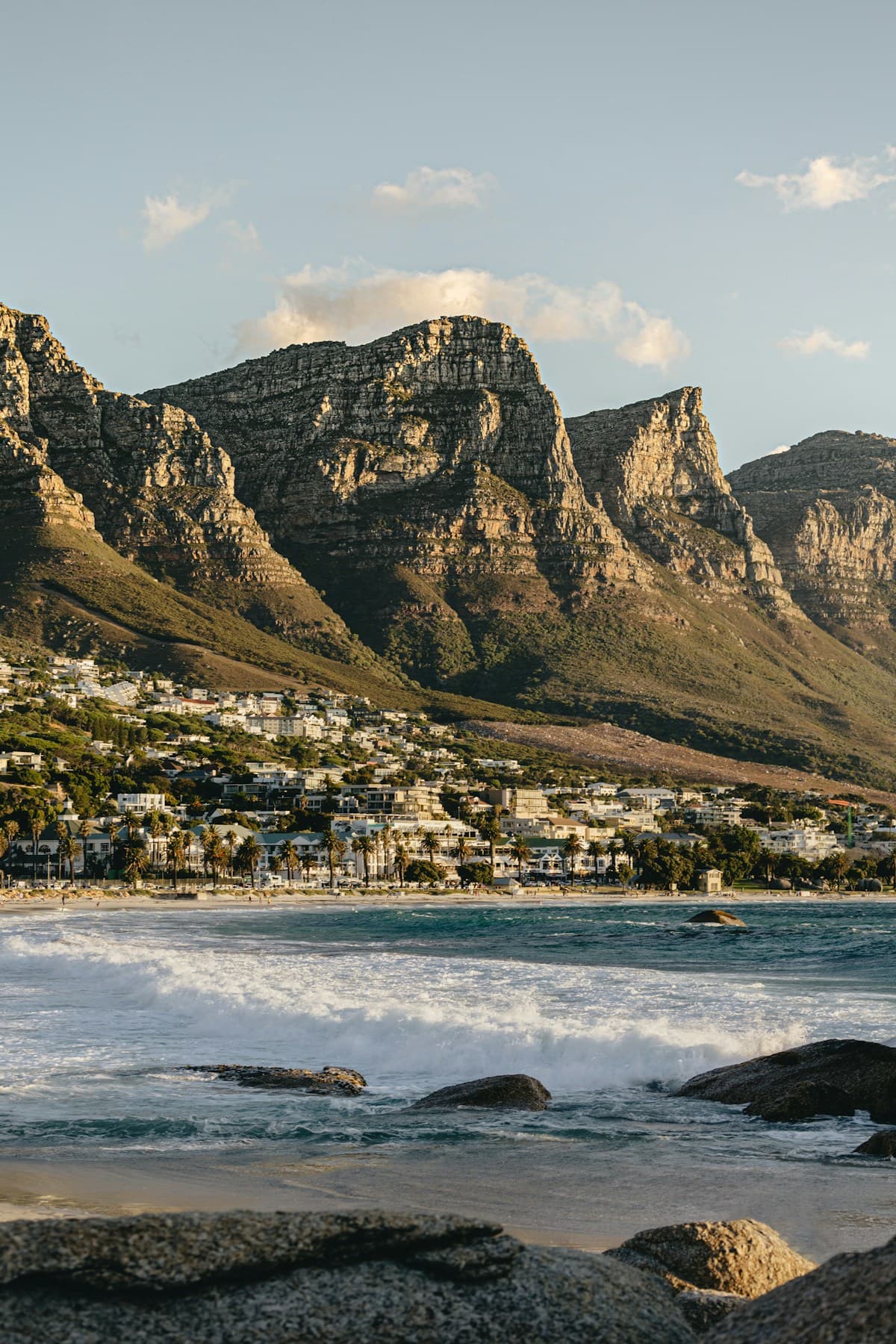
The first time you see Camps Bay, it stops you mid-sentence. A wide sweep of white sand, turquoise Atlantic water, a row of palm trees lining the road, and behind all of it, the Twelve Apostles mountain range rising straight up like a granite wall. Table Mountain looms to the right. It's one of those views that looks like a desktop wallpaper but somehow manages to be even better in person.
Cape Town's Most Beautiful Beach You Probably Won't Swim At
Then you dip your toe in the water and everything changes. The Atlantic Ocean along Cape Town's western coast sits at 8 to 16°C, and that upper number is generous. Most of the year it's closer to 10 or 12°C. Cold enough that going waist-deep feels like a challenge and full swimming is reserved for the genuinely tough or the slightly mad.
This is the paradox of Camps Bay. It looks like the kind of beach where you'd spend a lazy afternoon floating in the shallows. In reality, it's a beach for looking at, walking along, and drinking wine beside. And honestly, that's enough.
The Setting That Makes Everyone Reach for Their Camera
There's no getting around it. Camps Bay has one of the most dramatic backdrops of any urban beach anywhere. The Twelve Apostles, a series of rocky buttresses extending from Table Mountain, tower directly behind the beach. On a clear day, the granite faces catch the light in shades of grey and amber. In the afternoon, as the sun drops toward the Atlantic, the whole scene turns golden.
The beach itself is about 600 metres of fine white sand. It's wide enough that you don't feel cramped even on busy days, though finding a spot near the palm trees on a December Saturday requires arriving early. The sand is soft, the beach slopes gently, and there are large granite boulders at both ends that frame the bay nicely.
If you've been to Navagio Beach in Greece and thought that was dramatic, Camps Bay offers a different kind of spectacle. Navagio is remote and wild. Camps Bay is the rare beach where serious natural beauty sits right next to a proper city, restaurants, and cocktail bars.
The Cold Water Reality
Let's talk about what everyone wants to know. Camps Bay faces the Atlantic, not the Indian Ocean. Cape Town sits at the meeting point of two oceans, and the difference in water temperature between the city's west coast (Atlantic) and east coast (False Bay) beaches is significant.
The Benguela Current sweeps cold water up from Antarctica along the west coast. At Camps Bay, that means water temperatures rarely crack 16°C even in the peak of summer. In winter, you're looking at 8 to 10°C. For context, the English Channel averages about 15°C in summer. So yes, Camps Bay water is properly, unambiguously cold.
You'll see people on the beach. Lots of them. You'll see far fewer people in the water. The typical approach is wade in to the knees, maybe the waist, gasp, take a photo, and walk back out. Some locals do swim regularly, often as a morning routine, and they'll tell you that you get used to it. Most visitors don't stay in long enough to test that theory.
If you actually want to swim in Cape Town, head to the False Bay side. Muizenberg and Fish Hoek face warmer Indian Ocean water and are where Capetonians go when they want to stay in longer than 45 seconds.
The Sundowner Strip and Restaurant Scene
The strip of restaurants and bars along Victoria Road, directly across from the beach, is where Camps Bay really earns its reputation. This is Cape Town's see-and-be-seen spot, particularly on warm summer evenings.
Cafes Caprice, The Bungalow, Chinchilla, Paranga. The names rotate as places open and close, but the concept stays the same: outdoor terraces with ocean views, cocktails, seafood, and people watching. A sundowner cocktail here with the sun dropping into the Atlantic is one of Cape Town's signature experiences. Expect to pay around 120 to 180 ZAR (roughly 6 to 10 USD) for a cocktail, which is steep by South African standards but reasonable by international tourist pricing.
Dinner at one of the beachfront restaurants will run you 300 to 600 ZAR (15 to 35 USD) per person for mains and a drink. The food quality varies, and locals will tell you that some of these spots trade more on the view than the kitchen. Ask around for current recommendations, because the best spot seems to change every year or two.
The Wind Problem
Here's something every blog seems to mention only in passing: the wind at Camps Bay can be brutal. Cape Town's infamous southeast wind, locally called the "Cape Doctor," blows through most summer afternoons. It's a strong, steady wind that picks up sand and makes lying on the beach genuinely unpleasant.
The pattern is predictable enough that you can plan around it. Mornings are usually calm and warm. By early to mid-afternoon, the wind kicks in and stays until evening. If you want a comfortable beach day at Camps Bay, get there by 10am and plan to move to a restaurant terrace by 2 or 3pm. The wind tends to drop again around sunset, which is partly why the sundowner culture here is so ingrained.
The Clifton beaches, just around the headland to the north, are better sheltered from the southeaster. Clifton 4th Beach is the most popular and sits in a cove that blocks most of the wind. It's a 10-minute drive or a 20-minute walk from Camps Bay. The water is equally cold, but the wind protection makes a real difference on those blustery afternoons.
Sunset Photography and the Golden Hour
If you're into photography, Camps Bay at sunset is about as good as it gets for an urban beach. The beach faces west, directly into the setting sun. The Twelve Apostles catch the last light. The palm trees create silhouettes. The wet sand reflects the sky. It's almost unfairly photogenic.
Golden hour runs roughly from 6pm to 8pm in summer (December to February) and 5pm to 6:30pm in winter. The beach gets quieter as people migrate to the restaurants, which means better photos with fewer towels and umbrellas in frame.
For the best vantage point, walk to the southern end of the beach toward the rocks. From there, you can frame the entire bay with the mountains behind it. Alternatively, grab a table at one of the elevated restaurant terraces and shoot from above.
Practical Details
Getting to Camps Bay from central Cape Town takes about 15 minutes by car along Victoria Road, which hugs the coastline around Lion's Head. The drive itself is worth doing. The MyCiTi bus (route 108) is cheap and reliable, running from Civic Centre station to Camps Bay for about 15 ZAR.
Parking is free along the beachfront but limited. On summer weekends and holidays, you might circle for 20 minutes looking for a spot. The side streets fill up too. Coming by bus or Uber avoids this entirely, and an Uber from the city centre runs about 80 to 120 ZAR (4 to 7 USD).
There are public restrooms near the beach, which are reasonably maintained. No beach chair or umbrella rentals, though. Bring your own or just use a towel. Lifeguards patrol during swimming season (October to April). The beach is clean and well-maintained by Cape Town standards.
For safety, Camps Bay is one of Cape Town's safer beach areas, but standard precautions apply. Don't leave valuables unattended. The beachfront is well-populated during the day, and the restaurant strip stays busy into the evening.
Is Camps Bay Beach Worth Visiting?
Without question, yes. Just go with the right expectations. This is not a swimming beach for most people. This is a beach you visit for the views, the atmosphere, the sunset, and the restaurants. On those terms, it delivers something genuinely world-class.
The combination of mountain scenery, white sand, and a buzzing social strip is hard to find anywhere else. Sydney's Bondi has a similar energy but different scenery. Rio's Copacabana has the mountains but a completely different vibe. Camps Bay sits in its own category, a beach where the backdrop does most of the heavy lifting and the surrounding culture fills in the rest.
If you're visiting Cape Town, spend at least one afternoon and evening here. Arrive in the morning if you want beach time without wind, move to a restaurant for lunch, and stay for sunset. That's the Camps Bay playbook, and after all these years, it still works. Pack a good camera and leave your swimming expectations on the Atlantic side of the mountain, where they belong. If you want warm water and a beach where you'll actually get in past your ankles, check our guide to beach holidays in October for better swimming options.